
Drafted with AI assistance from the sources listed; images are AI-generated illustrations. How EsoVitae is made
Cylinder Seal VA 243, a 3.4 cm Akkadian-period serpentine cylinder catalogued at the Vorderasiatisches Museum in Berlin, became famous in 1976 when Zecharia Sitchin claimed that the star and ring of dots carved on it depicted the solar system with an extra planet, “Nibiru.” Specialists in Mesopotamian art read the symbol as a star, a standard divine emblem, not an astronomical map, and the seal’s inscription names two people, not planets.
The Object on the Record: What VA 243 Actually Is
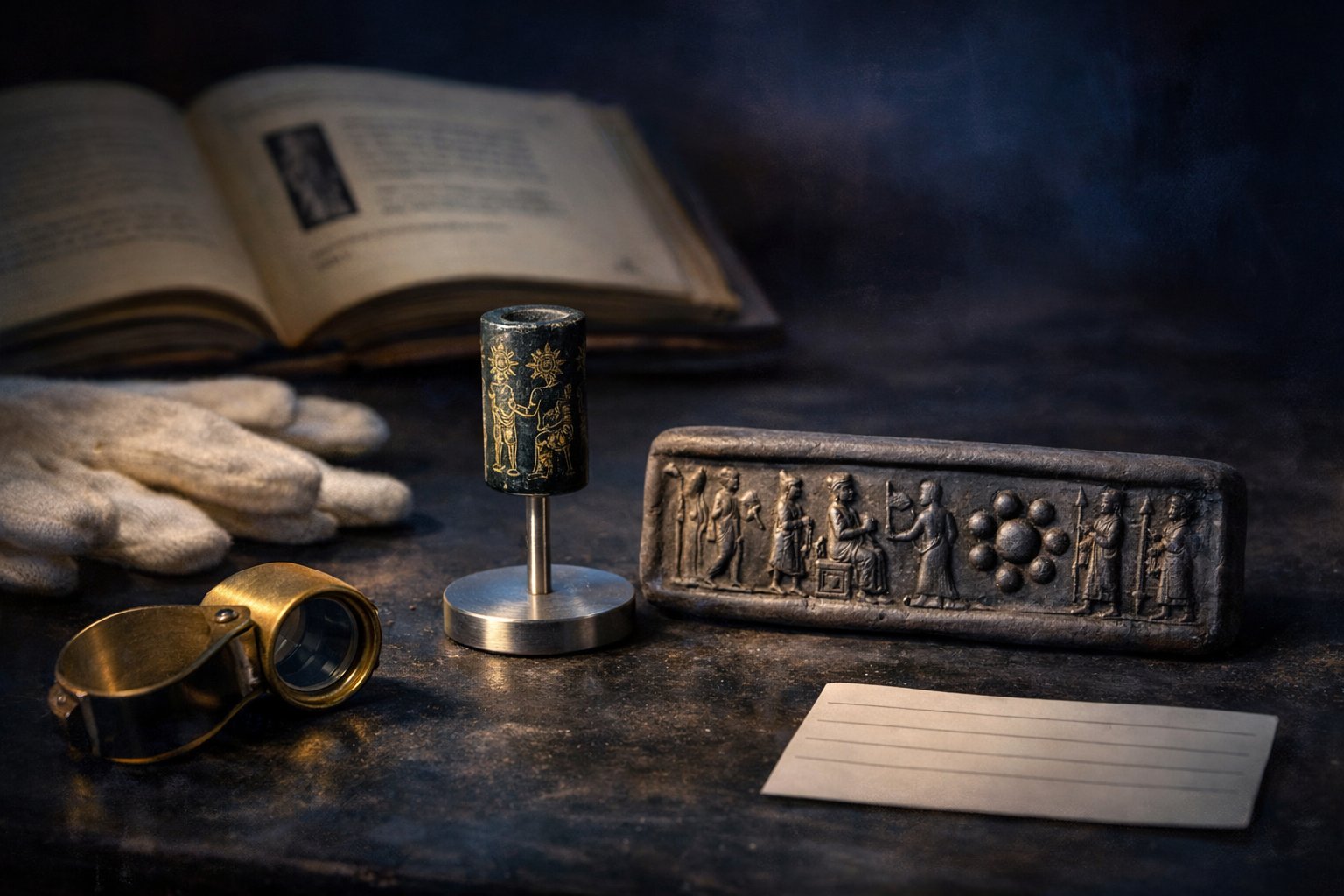
Cylinder Seal VA 243 is an Akkadian-period cylinder of serpentine, 3.4 centimeters tall and 2.1 centimeters in diameter, held by the Vorderasiatisches Museum in Berlin under the inventory number VA 243 (VA 00243 in the museum’s online catalogue). The museum dates the piece to the second half of the third millennium BCE and catalogues it as an Einführungsszene, an “introduction scene” [1].
The carving, when rolled onto wet clay, produces a continuous frieze. The museum’s description shows an enthroned god in a flounced robe, holding a plough in his raised right hand, facing a second god who leads a worshipper by the hand; the worshipper carries a lamb. A framed inscription panel divides the scene and names the seal’s owner. In the upper field, between the introducing god and the worshipper, sits the symbol that drives the entire dispute: a star surrounded by small dots, eleven of them in the count used both by Sitchin and by his critic Michael Heiser [2].
The seal is small and the carving is shallow. Photographs of the seal are available in the museum’s online catalogue, and the seal and its inscription were published in Anton Moortgat’s catalogue of the Berlin collection, Vorderasiatische Rollsiegel (1940), on page 101 [3].
The 1976 Claim: Sitchin’s Reading of the Rosette
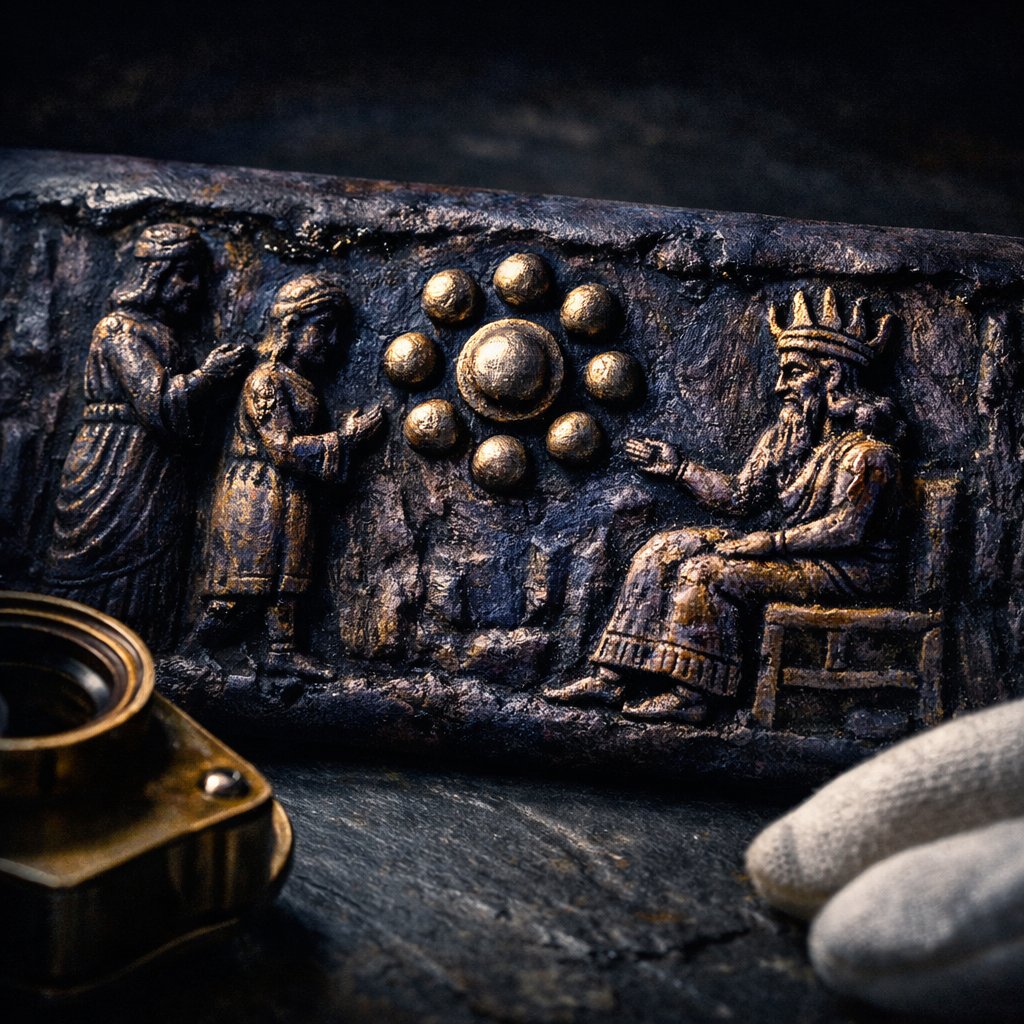
Zecharia Sitchin published The 12th Planet in 1976 and reproduced VA 243 as the keystone exhibit for his thesis: that the Sumerians knew of a twelfth body in the solar system — Sun, Moon, and ten planets, including a hypothetical large outer planet he called Nibiru. Sitchin counted the central disc plus eleven surrounding spheres and read the assembly as a heliocentric diagram, with Pluto, Mercury, Venus, Earth, the Moon, Mars, Jupiter, Saturn, Uranus, Neptune, and Nibiru orbiting a central Sun [4].
Sitchin’s argument depended on a chain of readings. First, that the symbol at the center of the group is the Sun. Second, that the eleven dots around it are the planets and the Moon, which together with the Sun make twelve, since he held that ancient peoples counted the Sun and Moon as planets. Third, that knowledge of a body beyond Pluto could only have come from the Anunnaki, gods of Sumero-Mesopotamian mythology whom he identified as extraterrestrial visitors [5].
The book sold widely. Over the next three decades Sitchin built the Earth Chronicles series around the framework, seven volumes running from The 12th Planet in 1976 to The End of Days in 2007, and his books have been published in more than 25 languages [6]. The seal photograph reached a mass audience that the museum’s catalogue card never did.
The Assyriological Reading: What the Symbol Actually Means
In Mesopotamian art the star is a divine emblem, not a planetary map. A star could mark a star or a planet, or stand above a figure to show that the figure is a god, and it was the usual symbol of the goddess Ishtar, the Sumerian Inanna, who stood for the planet Venus. Henri Frankfort’s Cylinder Seals (1939) illustrates an Ishtar seal whose star is very similar in design to the one on VA 243 [7].
The number of points on the star varies. Eight is the most frequent form in Mesopotamian religious art, but six- and seven-pointed stars also occur, sometimes on the same seal or stela, and the star on VA 243 has six. The number of points changed; the meaning did not: a star, a planet, or a deity, but not the sun [8].
Stripped of folklore, the symbol is a star. The sun god Shamash had his own emblem, a disc with four points and wavy lines between them, nearly always set inside a circle, and the VA 243 symbol has neither the wavy lines nor the circle. Heiser judged it most likely that the star marks a god linked to the fertile harvest the scene alludes to, or, less likely, the head of the divine council with its eleven other members [9].
Counting the Spheres: What the Dots Are
The count itself is not in dispute: the star on VA 243 is surrounded by eleven dots, and Heiser accepts that figure. The dispute is over what the dots are. In Mesopotamian art, dots stand for stars when the context is astronomical or a god is identified with a star; the Pleiades, for example, are regularly shown as seven dots. Heiser therefore reads the eleven dots as stars as well [10].
Michael Heiser (1963–2023), who earned a PhD in Hebrew Bible and Semitic Languages at the University of Wisconsin-Madison and ran a website devoted to debunking Sitchin’s claims, analyzed the seal in a paper written while he was still a PhD candidate. He made three main points: the inscription says nothing about planets or astronomy; the central symbol is not the Mesopotamian sun symbol but a star; and no cuneiform text shows that the Sumerians or later Mesopotamians knew of more than five planets [11].
The rosette also fails as a model of the solar system. As the astronomer Tom van Flandern pointed out, and Heiser repeats, the sizes of the dots do not match the sizes of the planets, and their distances from the central star do not show varying orbits [12].
The Cuneiform Inscription: What the Owner Wrote on His Own Seal
The three-line cuneiform inscription on VA 243 names two people, and the reading published in Moortgat’s 1940 catalogue of the Berlin seals refers to no planet, no Anunnaki, and no astronomy of any kind. Heiser, quoting Moortgat’s transliteration, gives it as dub-si-ga / ili-il-la-at / ir3-su: “Dubsiga, Ili-illat, your (or his) servant.” According to the cylinder-seal specialist Rudi Mayr, whom Heiser consulted, Dubsiga is the name of an apparently powerful person and Ili-illat is the seal’s owner, the servant [13].
Cylinder seals functioned as personal signatures in the ancient Near East. A merchant rolled his seal across the clay envelope of a tablet to authenticate the document; an official rolled hers across the bullae closing a jar of grain. The inscription was the legal anchor. If VA 243’s rosette had encoded astronomical knowledge of a hypothetical Planet X, the inscription would be the place to say so. It does not.
| Reading | Source | Year | Central symbol = | Surrounding count | Surrounding = |
|---|---|---|---|---|---|
| Sitchin | The 12th Planet | 1976 | Sun | 11 | Planets and Moon, including Nibiru |
| Heiser | “The Myth of a 12th Planet: A Brief Analysis of Cylinder Seal VA 243” | c. 2003 | Six-pointed star (a god or star) | 11 | Stars |
| Vorderasiatisches Museum | Online catalogue record | 2026 | Star | not given | Dots (Kreispunkte) |
The Nibiru Astronomy Problem: What Sumerian Texts Actually Say
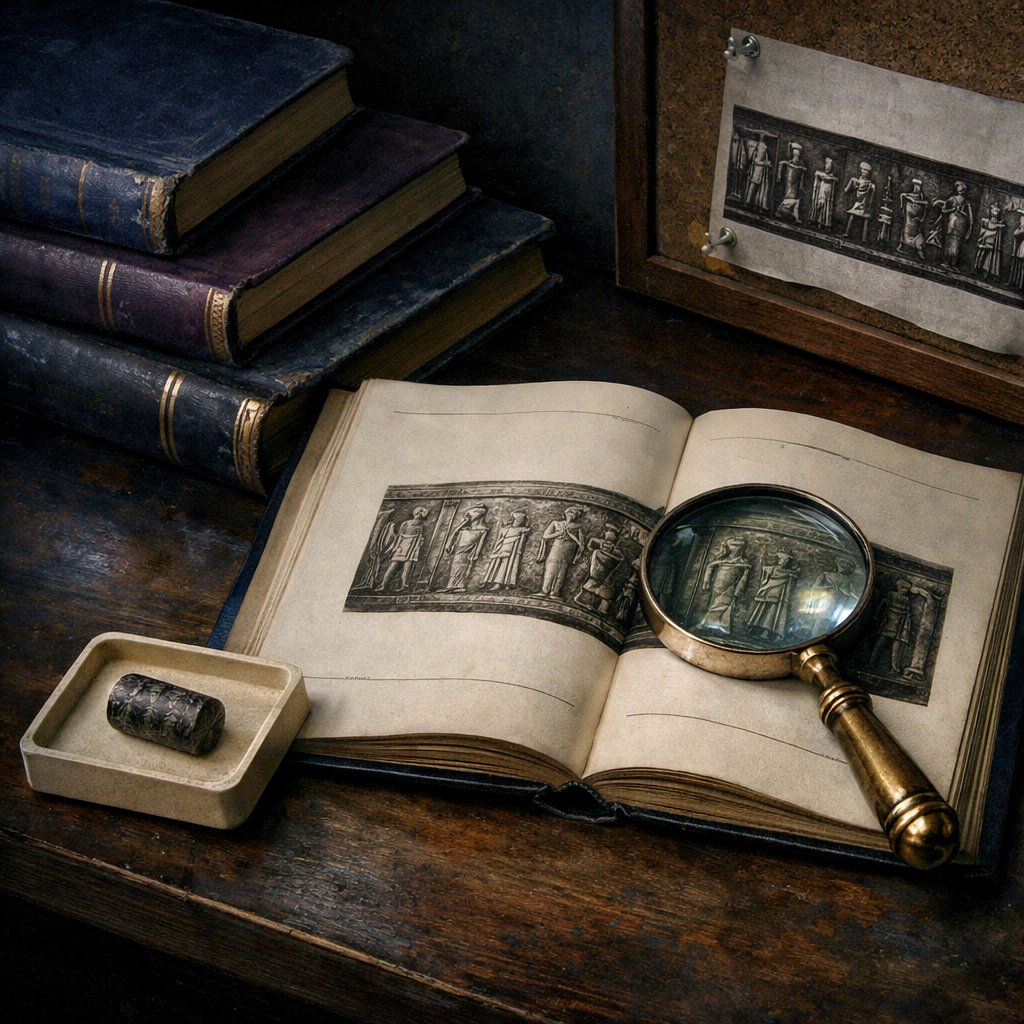
Babylonian astronomical texts have long been available in critical editions, and the word nibiru in them has a specific meaning unrelated to a twelfth planet. The Chicago Assyrian Dictionary compiles its known occurrences, and all its senses relate to “crossing” or a “crossing point”; in astronomical texts it names Jupiter, the star of Marduk, and once Mercury [14]. The largest corpus of Babylonian observations, the Astronomical Diaries and Related Texts from Babylonia, edited by Abraham Sachs and Hermann Hunger (Austrian Academy of Sciences, from 1988), covers diaries from 652 to 61 BCE, with related texts reaching from the eighth century BCE to the first century CE [15].
The astronomical compendium MUL.APIN, probably compiled around 1000 BCE and known from copies made from 686 BCE onward, links Nibiru with Jupiter: one big star “divides the sky in half and stands there: that is, the star of Marduk, Nibiru, Jupiter.” Its second tablet tracks the appearances and disappearances of Venus, Jupiter, Mars, Saturn, and Mercury [16].
The conflation worth resolving: Sitchin treated nibiru as a proper noun for an outer planet; the surviving cuneiform texts use it for a “crossing” and, in astronomy, mostly for Jupiter. No known cuneiform astronomical text lists more than the five planets visible to the naked eye (Mercury, Venus, Mars, Jupiter, Saturn), or seven if the Sun and Moon are counted [17].
The Decades-Long Debate: How the Claim Survives
Since Sitchin’s 1976 publication, the academic response has been thin in volume but consistent in content, while the popular version has kept circulating: replicas of VA 243 are still sold as the “Seal of the 12th Planet.” The best-known rebuttals were written for general readers: Heiser’s papers on the seal and on Nibiru, the astronomer Tom van Flandern’s critique of the seal’s “planets,” and Robert Todd Carroll’s entry on Sitchin in The Skeptic’s Dictionary [18].
The asymmetry is partly structural. Specialists in Akkadian seal iconography produce technical literature for a specialist audience; the Sitchin framework circulates in trade paperback, cable documentary, and social-media short-form. The seal photograph survives the medium translation; the museum’s cataloguing detail does not. The museum’s own catalogue entry, last updated in July 2026, describes VA 243 as an Akkadian introduction scene with a star surrounded by dots, and says nothing about planets [19].
No museum or Assyriological catalogue cited here reads VA 243 as a planetary diagram. The “ancient solar system” claim survives as a popular-culture artifact, not as an evidentiary one.
What the Audit Yields: Where the Record Lands
The audit of VA 243 between 1976 and 2024 produces a clear evidentiary verdict: the seal is a documented Akkadian-period introduction-scene cylinder carrying a star emblem, and there is no surviving textual, iconographic, or astronomical evidence from Mesopotamia that supports a twelve-body solar-system reading. The argument rests on a single object’s star and dots, set against the conventions of Mesopotamian art and the corpus of cuneiform astronomy.
What the case study illustrates is the gap between a single visually compelling artifact and the documentary apparatus around it. Sitchin’s reading worked because a small photograph of an exotic-looking carving travels farther than a museum catalogue card. The corrective work — Moortgat’s 1940 reading of the inscription, Heiser’s papers, van Flandern’s astronomical critique, the museum’s own catalogue entry — sits in the documentary record but rarely reaches the audience that received the original claim. For more grounded explorations of how artifact-based extraterrestrial-contact claims are made and tested, see our pillar overview at the Alien and Extraterrestrial Mysteries hub.
The seal sits in Berlin. The inscription names Dubsiga. The symbol is a star. The audit, as of the 2024 public record, finds no twelfth planet on the cylinder.
Sources
- Staatliche Museen zu Berlin, Vorderasiatisches Museum, Einführungsszene, Ident. Nr. VA 00243, online collection record (object description by Anja Fügert, last updated 29 July 2026). id.smb.museum
- Staatliche Museen zu Berlin, Vorderasiatisches Museum, Einführungsszene, Ident. Nr. VA 00243, online collection record (object description by Anja Fügert, last updated 29 July 2026). id.smb.museum; Michael S. Heiser, The Myth of a 12th Planet: A Brief Analysis of Cylinder Seal VA 243, SitchinIsWrong.com (PDF dated 2003). sitchiniswrong.com
- Anton Moortgat, Vorderasiatische Rollsiegel, Berlin, 1940, p. 101, as cited in Michael S. Heiser, The Myth of a 12th Planet: A Brief Analysis of Cylinder Seal VA 243, SitchinIsWrong.com (PDF dated 2003). sitchiniswrong.com; Staatliche Museen zu Berlin, Vorderasiatisches Museum, Einführungsszene, Ident. Nr. VA 00243, online collection record (object description by Anja Fügert, last updated 29 July 2026). id.smb.museum
- Zecharia Sitchin, The 12th Planet, Stein and Day, New York, 1976, as described in Michael S. Heiser, The Myth of a 12th Planet: A Brief Analysis of Cylinder Seal VA 243, SitchinIsWrong.com (PDF dated 2003). sitchiniswrong.com
- Michael S. Heiser, The Myth of a 12th Planet: A Brief Analysis of Cylinder Seal VA 243, SitchinIsWrong.com (PDF dated 2003). sitchiniswrong.com
- Zecharia Sitchin, Wikipedia (bibliography and “Influence” sections), accessed 4 October 2026. en.wikipedia.org
- Michael S. Heiser, The Myth of a 12th Planet: A Brief Analysis of Cylinder Seal VA 243, SitchinIsWrong.com (PDF dated 2003), citing Henri Frankfort, Cylinder Seals: A Documentary Essay on the Art and Religion of the Ancient Near East, Macmillan, London, 1939, pl. XXVI, and Jeremy Black and Anthony Green, Gods, Demons and Symbols of Ancient Mesopotamia, 1992. sitchiniswrong.com
- Michael S. Heiser, The Myth of a 12th Planet: A Brief Analysis of Cylinder Seal VA 243, SitchinIsWrong.com (PDF dated 2003). sitchiniswrong.com
- Michael S. Heiser, The Myth of a 12th Planet: A Brief Analysis of Cylinder Seal VA 243, SitchinIsWrong.com (PDF dated 2003), citing Black and Green (1992), p. 168. sitchiniswrong.com
- Michael S. Heiser, The Myth of a 12th Planet: A Brief Analysis of Cylinder Seal VA 243, SitchinIsWrong.com (PDF dated 2003). sitchiniswrong.com
- Michael S. Heiser, Wikipedia, accessed 4 October 2026. en.wikipedia.org; Michael S. Heiser, The Myth of a 12th Planet: A Brief Analysis of Cylinder Seal VA 243, SitchinIsWrong.com (PDF dated 2003). sitchiniswrong.com
- Michael S. Heiser, The Myth of a 12th Planet: A Brief Analysis of Cylinder Seal VA 243, SitchinIsWrong.com (PDF dated 2003), summarizing the astronomer Tom van Flandern. sitchiniswrong.com
- Michael S. Heiser, The Myth of a 12th Planet: A Brief Analysis of Cylinder Seal VA 243, SitchinIsWrong.com (PDF dated 2003), quoting Moortgat (1940), p. 101, and correspondence with Rudi Mayr. sitchiniswrong.com; Staatliche Museen zu Berlin, Vorderasiatisches Museum, Einführungsszene, Ident. Nr. VA 00243, online collection record (object description by Anja Fügert, last updated 29 July 2026). id.smb.museum
- Michael S. Heiser, The Myth of a Sumerian 12th Planet: “Nibiru” According to the Cuneiform Sources, SitchinIsWrong.com (PDF dated 2005), citing The Assyrian Dictionary of the Oriental Institute of the University of Chicago, vol. N/2, pp. 145–147. sitchiniswrong.com
- Babylonian astronomical diaries, Wikipedia (list of the volumes of Abraham Sachs and Hermann Hunger, Astronomical Diaries and Related Texts from Babylonia, Austrian Academy of Sciences, 1988–2022), accessed 4 October 2026. en.wikipedia.org
- Hermann Hunger and David Pingree, MUL.APIN: An Astronomical Compendium in Cuneiform, Archiv für Orientforschung Beiheft 24, Horn, 1989, as quoted in Michael S. Heiser, The Myth of a Sumerian 12th Planet: “Nibiru” According to the Cuneiform Sources, SitchinIsWrong.com (PDF dated 2005). sitchiniswrong.com; MUL.APIN, Wikipedia, accessed 4 October 2026. en.wikipedia.org
- Michael S. Heiser, The Myth of a Sumerian 12th Planet: “Nibiru” According to the Cuneiform Sources, SitchinIsWrong.com (PDF dated 2005). sitchiniswrong.com
- Michael S. Heiser, The Myth of a 12th Planet: A Brief Analysis of Cylinder Seal VA 243, SitchinIsWrong.com (PDF dated 2003). sitchiniswrong.com; Michael S. Heiser, The Myth of a Sumerian 12th Planet: “Nibiru” According to the Cuneiform Sources, SitchinIsWrong.com (PDF dated 2005). sitchiniswrong.com; Robert Todd Carroll, Zecharia Sitchin and The Earth Chronicles, The Skeptic’s Dictionary, last updated 7 November 2015. skepdic.com; Kenyon College, Blick-Harris Study Collection, Sumerian Cylinder Seal VA 243 (replica), purchased 2025. digital.kenyon.edu
- Staatliche Museen zu Berlin, Vorderasiatisches Museum, Einführungsszene, Ident. Nr. VA 00243, online collection record (object description by Anja Fügert, last updated 29 July 2026). id.smb.museum