In May 2026, Ohio legislators introduced a bill to designate the Loveland Frogman — a four-foot bipedal amphibian reported near the Little Miami River in 1955 and 1972 — as the state’s official cryptid. The move follows West Virginia’s tourism playbook and recasts a 71-year-old folk report as civic symbolism. Eso Vitae’s Cryptids and Mythical Creatures pillar tracks the precedent.
Published: 2026-05-18. Last reviewed: 2026-05-18.
What the 2026 Ohio Bill Actually Proposes
Ohio state representatives introduced legislation in spring 2026 to designate the Loveland Frog, also called the Loveland Frogman, as the state’s official cryptid, with the bill assigned to a House committee during the 136th General Assembly [1][2]. The proposal cites two sighting reports — the 1955 Charles Hofer account near the Little Miami River and the 1972 Ray Shockey patrol-car incident inside Loveland city limits — as the historical anchor for state recognition [1][3]. Statehouse News Bureau coverage on May 1, 2026 framed the bill as both a folklore designation and a tourism instrument, noting that two annual Loveland Frogman festivals already operate in the Cincinnati metro [2][4].
A field biologist reads a bill like a permit application: which clauses bind, which are decorative, which agency picks up the operational load. State-symbol statutes in Ohio sit in Title 5 of the Revised Code alongside the white-tailed deer (state mammal, 1988) and the buckeye tree (state tree, 1953). A designation does not create habitat protection, fund research, or require survey work. It establishes language. The cryptid does not, in any biological sense, become real on signature — but it does become legible to the apparatus of state tourism, school curriculum, and merchandise licensing.
The Legislative Mechanics
The bill follows the standard symbol-statute template: short text, single-section amendment, designated section of the Ohio Revised Code, and committee referral [2]. Statehouse News reported bipartisan sponsorship with sponsors from both Cincinnati-area and rural districts [2][4]. WVXU and WOSU reporting on May 2 and May 4, 2026 noted that no fiscal note had been attached at introduction, consistent with the no-cost framing typical of symbolic designations [4][5].

Sighting Record: 1955 and 1972
The Loveland Frogman lineage rests on two principal field reports, separated by 17 years and roughly half a mile of the Little Miami River corridor. The first, attributed to traveling businessman Charles Hofer, was logged in March 1955 and described three reptilian-amphibian bipeds, approximately three to four feet tall, observed under a Loveland bridge at roughly 3:30 a.m. [3][6]. The second, attributed to Loveland police officer Ray Shockey, was logged in March 1972 along Riverside Drive and described a single crouched bipedal figure with a froglike face that stood, looked at the patrol vehicle, and vaulted the guardrail into the river [3][6][7].
On the morphology: a 1.0-1.2 m bipedal amphibian operating in temperate Ohio winters would face hard thermoregulatory constraints. Amphibians are ectotherms — their metabolism tracks ambient temperature, and Ohio’s March mean low (about 1-3°C) sits well below the activity floor for any North American anuran on the documented record. A four-foot anuran would also push past the upper anatomical limits of the order Anura; the largest confirmed extant species, Conraua goliath (the goliath frog of Equatorial Guinea), tops out around 32 cm snout-to-vent and is not bipedal [8]. The biological constraint pushes against the literal reading of the witness statements.
Charitable skepticism keeps two doors open. First, witness testimony is data even when biology rejects the literal claim — the question is what was perceived, under what light conditions, against what background. Second, the Loveland riverbank in 1972 supported nocturnal bullfrog and large iguanid pet-release populations that area naturalists later catalogued [6][9]. Officer Shockey himself reportedly revised the account in a later interview, suggesting an escaped iguana as a candidate explanation [6][9].
What the Reports Hold Up Against
Stripped of folklore, the Loveland sighting record is two witness statements, no recovered specimen, no photographs taken contemporaneously, no scat, no tracks confirmed by zoological survey. The taxonomic category is therefore cryptid in the strict Heuvelmansian sense — an animal reported but not collected — which is a status, not a verdict [10]. The 1955 report sits in folklore archives; the 1972 report sits in a police incident file. Both belong on the documentary record. Neither belongs in the taxonomy.
West Virginia: The Cryptid-Tourism Precedent
West Virginia, Ohio’s eastern neighbor, has spent roughly two decades building cryptid recognition into a measurable tourism stream, with Point Pleasant’s annual Mothman Festival drawing crowds reported at 10,000-15,000 attendees in recent years [11][12]. The state’s commercialized roster runs to at least five named creatures: Mothman (Point Pleasant, 1966), Flatwoods Monster (Braxton County, 1952), Grafton Monster (Taylor County, 1964), Vegetable Man (Fairmont, 1968), and a regional Appalachian Bigfoot tradition [11][12][13]. The Mothman Museum and twelve-foot stainless-steel statue, both in downtown Point Pleasant, sit at the operational center of this cluster [12].
What the West Virginia data establishes is that a cryptid does not need taxonomic confirmation to function as a tourism asset; it needs a stable referent, a recurring event, and a small built environment. Point Pleasant’s Mothman Festival, founded in 2002, posts attendance gains nearly every year and supports adjacent food, lodging, and merchandise economies in a town of roughly 4,000 residents [12]. The economic argument behind Ohio’s 2026 bill is, in effect, that Loveland — population roughly 13,000, sitting in the Cincinnati metro — could compress the same machinery into a more accessible market [2][4].
Comparing the Two States’ Cryptid Inventories
| State | Cryptid | First Report Year | Annual Festival | Official Designation Status |
|---|---|---|---|---|
| Ohio | Loveland Frogman | 1955 | Yes (two festivals) | 2026 bill introduced |
| West Virginia | Mothman | 1966 | Yes (Point Pleasant) | State tourism brand, no statute |
| West Virginia | Flatwoods Monster | 1952 | Yes (Sutton) | State tourism brand, no statute |
| West Virginia | Grafton Monster | 1964 | Local recognition | State tourism brand, no statute |
| West Virginia | Vegetable Man | 1968 | None | Regional folklore |
| West Virginia | Appalachian Bigfoot | Multi-decade | Yes (several) | State tourism brand, no statute |
A consequential distinction sits in the rightmost column. West Virginia has built its cryptid economy without a single official state-cryptid statute; the recognition is administrative and cultural [11][12]. Ohio’s 2026 bill, if passed, would be the first U.S. state statute formally designating an official cryptid. On the math: that statutory threshold is what makes the proposal genuinely novel.
Civic Designation: What State Recognition Does to Folklore
State-symbol designation moves a folkloric figure from the open commons of regional storytelling into the codified inventory of civic identity, which carries both legal and narrative consequences. The folklore commons is a non-rivalrous space — anyone in Cincinnati can sell a Frogman T-shirt, write a song, run a festival, publish a children’s book. A state-symbol statute does not by itself remove that openness, but it does install a canonical reference: the official version, against which subsequent retellings can be measured.
Two things get conflated here. The first is folkloric authenticity, which is a community property — a story belongs to the people who tell it, and its variants are part of its life. The second is civic mascotry, which is a state property — a symbol selected from above to represent a polity. When the Loveland Frogman becomes both, the question of who owns the canonical reading shifts. Folklorist Linda Dégh, working in the Indiana University folklore tradition, distinguished between legend (a story told as if true) and ostension (the legend lived out through action) [14]. A statute is an ostensive act; it performs the legend at state scale [14].
What State Recognition Does Not Do
As of May 2026, the public record shows: no biological survey of the Little Miami River corridor is funded by the bill, no taxonomic key is amended, no IUCN listing is triggered, no protected area is established [1][2]. A state cryptid designation is, in operational terms, a tourism marker and an identity gesture. The biological status of the creature — for those who hold open the possibility of an undescribed amphibian — is unchanged by the vote.
The Zoologist’s Read: Witness as Data, Biology as Test
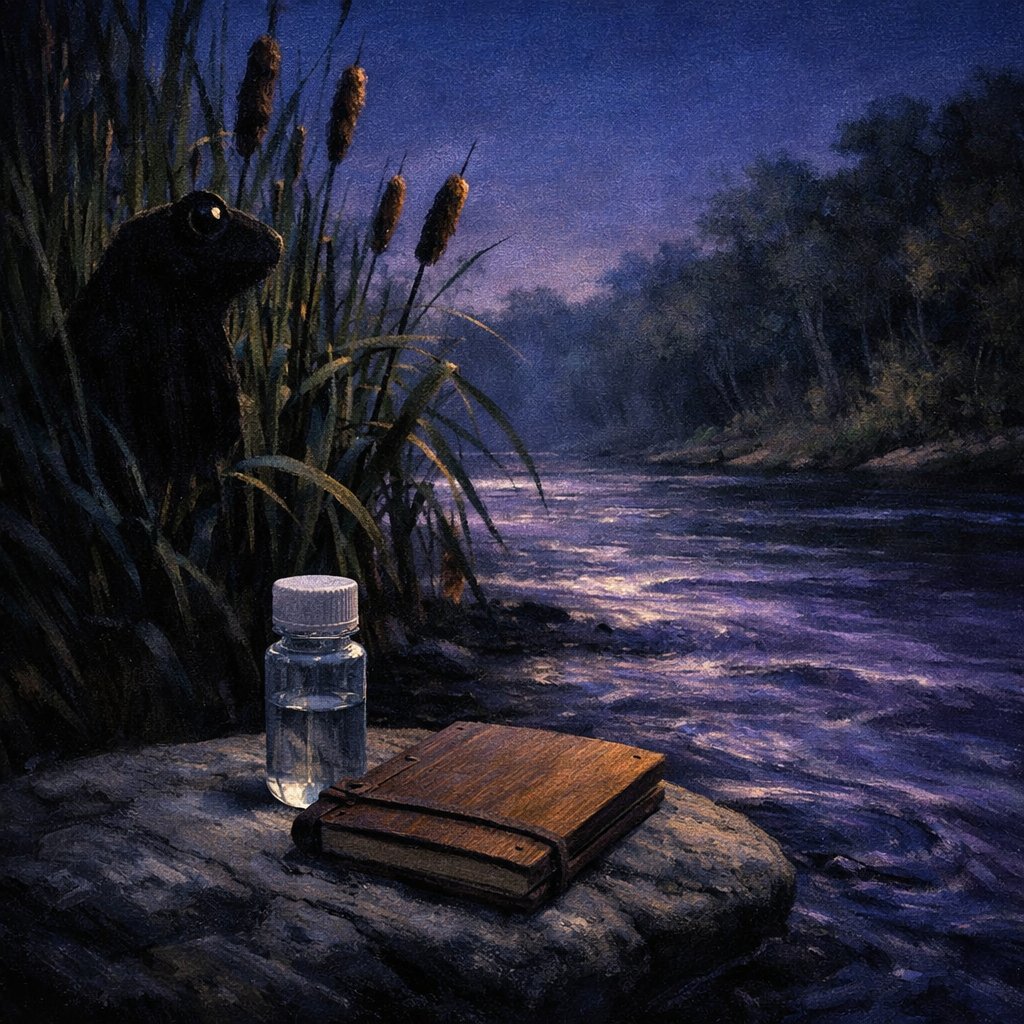
A working naturalist’s notebook keeps the Loveland file open in two columns — claims worth recording on the left, biological tests that would decide them on the right — and the 2026 bill changes only the marginalia. The claims include the 1955 Hofer report, the 1972 Shockey report, several less-documented post-1972 sightings, and the recurring folkloric envelope across Greater Cincinnati [3][6][7]. The tests would include environmental DNA sampling of the Little Miami River and tributary inlets near the historical sighting points, camera-trap arrays calibrated for anuran-sized bipedal motion, and standardized acoustic monitoring during the spring chorus window [15].
The eDNA result, if a survey were funded, would be the cleanest single test. eDNA — the trace genetic material organisms shed into water — now resolves cryptic amphibian species at the family level with high reliability, and at the genus level under good sampling protocols [15]. A bipedal four-foot anuran on the Little Miami would, if biologically real, deposit cuticle fragments, sloughed skin, and gametic material into the watershed at concentrations within current detection thresholds. A clean negative across a full survey season would not falsify the folklore, but it would meaningfully bound the biological claim.
The Graveyard Chapter, Loveland Edition
The honest cryptozoological notebook keeps a graveyard chapter — the cases that dissolved on examination. The Shockey 1972 sighting has a partial graveyard entry already: the officer’s own later attribution of an escaped iguana as a candidate explanation [6][9]. The Hofer 1955 report sits in a thinner archival state, with the original account known mostly through secondary retelling [6]. The graveyard does not close the file; it organizes it. What the 2026 Ohio bill does, in effect, is take a file with a partial graveyard chapter and stamp it with a state seal. The biology is unchanged. The civics is the new variable.
Why It Matters Beyond Ohio
Ohio’s bill is the leading indicator of a broader shift: U.S. state legislatures, after a half-century of treating cryptid folklore as embarrassing rural fringe, are beginning to read it as cultural asset. Michigan has the Dogman; New Jersey has the Jersey Devil; Vermont has Champ; Arkansas has the Fouke Monster; Maine has Pomola [13]. None has been designated an official state cryptid by statute. If Ohio passes, the precedent is set, and similar bills are likely to follow in states with comparable cryptid-tourism economies [11][12][13].
For the working zoologist, the implication is twofold. First, public-facing science communication about cryptids will become a state-touching activity in ways it has not been — biologists who consult on tourism boards, school curricula, and museum exhibits will find their work coordinated with civic symbolism rather than just hobbyist culture. Second, the funding landscape for rigorous regional biodiversity surveys may shift: a state with an official cryptid has a softer civic argument for funding the eDNA work, the camera traps, the bioacoustic stations, the indigenous-knowledge collection. The folklore opens the door the data walks through.
Loveland’s frog, biology aside, has already done what a working symbol does: it has organized a community’s attention around a stretch of river. Whether the bill passes or stalls, the Little Miami corridor is a more closely watched watershed in 2026 than it was in 1972, and any field biologist will tell you that attention is the first prerequisite of survey. The legislative act and the biological work, in the end, are not opposed; they are two columns in the same notebook.