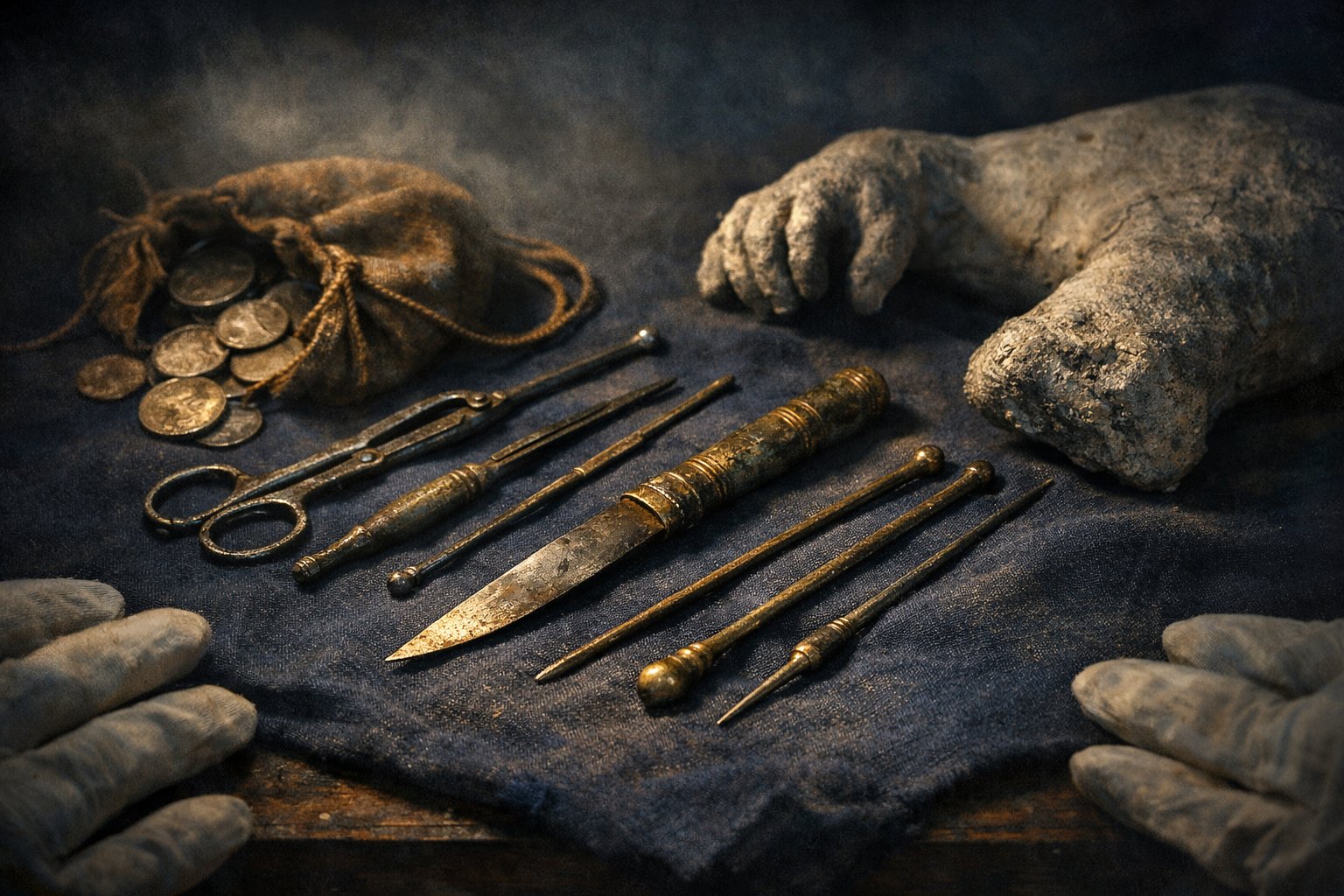
The Pompeii doctor is the working name for a victim newly identified at the Orto dei Fuggiaschi, the Garden of the Fugitives in the south-east quadrant of Pompeii, whose body cast was reanalysed in 2026 alongside a small organic-and-metal box, a fabric purse of bronze and silver coins, and a clutch of surgical instruments consistent with a first-century Roman medical kit, placing the individual among the seventeen people who died in the open vineyard during the 79 AD eruption of Vesuvius. [1][2]
Published: 2026-05-19. Last reviewed: 2026-05-19.
The Garden of the Fugitives, sixty years after the casts were poured
The Orto dei Fuggiaschi at Pompeii, Regio I Insula 21, was excavated between 1961 and 1974, and the seventeen victims were cast in plaster using the Fiorelli method first developed at Pompeii in 1863. [3] What changed in May 2026 was not the trench; it was the file. The Archaeological Park of Pompeii announced on 2026-05-15, through a press release relayed by Euronews and ANSA, that recent analyses on existing casts — not a new excavation — had allowed one of the seventeen victims to be re-read as a doctor on the run, on the basis of objects the body had been carrying when the second pyroclastic surge reached the vineyard. [1][2]
Walk the perimeter of the vineyard today and you can still see why so many people made it as far as this open ground and no further. The Orto sits at the southern edge of the city, hard against the Porta Nocera wall, with the slope of the buried ridge falling away toward what was, in 79 AD, the coastline. The fugitives were running south-east, away from the volcano, and the vineyard was the first piece of unbuilt ground after a long alley of insulae; it is a place where the architecture stops insisting and the sky opens up, which is exactly the wrong place to be standing when a 300-degree-Celsius surge rolls in off a collapsing column. The vines on the ridge are modern replantings keyed to the carbonised root-cavity grid Wilhelmina Jashemski mapped in the 1970s, and the casts themselves now lie under a protective glass shelter at the south end of the orchard. [4]
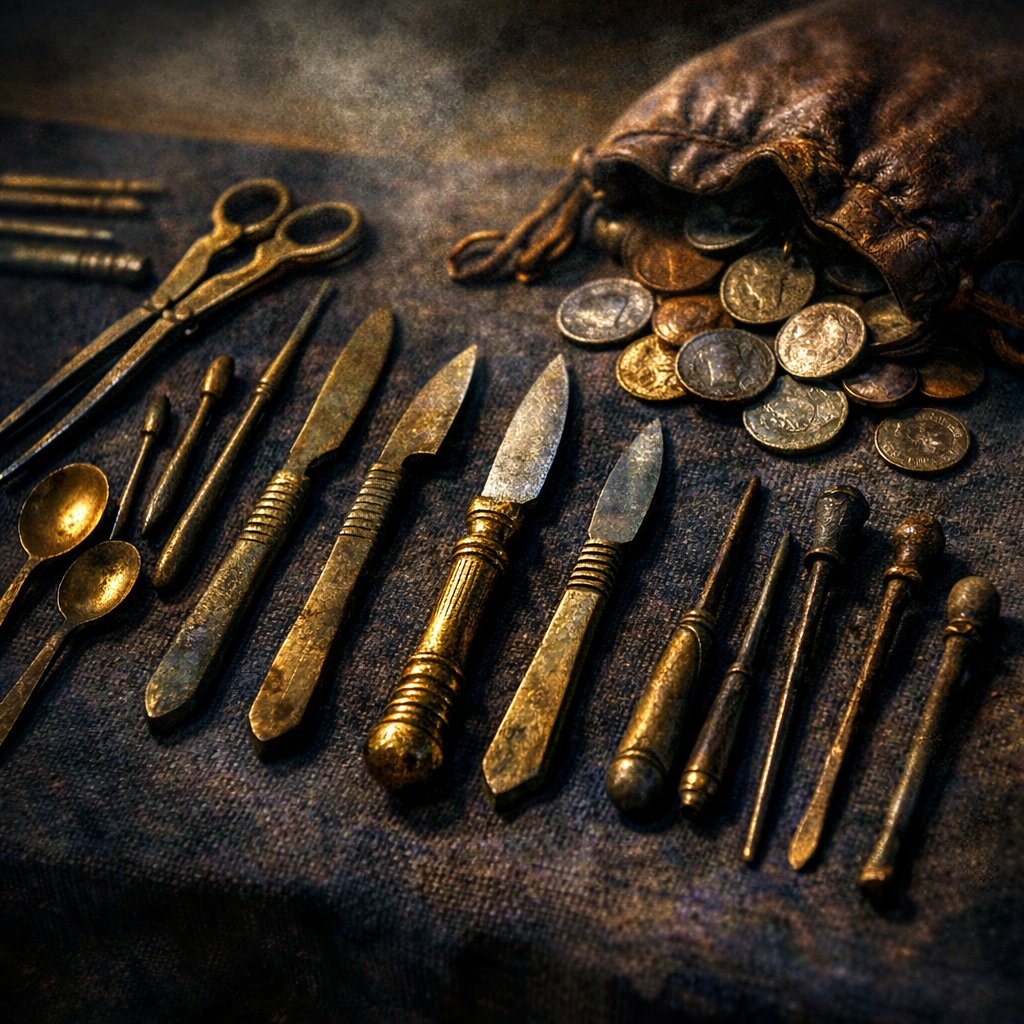
What the trousseau actually contained
The 2026-05-15 press release from the Archaeological Park of Pompeii names three find-groups recovered with the cast: a small wooden box with metal fittings, a fabric purse of bronze and silver coins, and a set of metal instruments matching the first-century Roman surgical repertoire. [1][5] The identification rests on the third group. A doctor’s box on a Roman provincial street was a kit of named tools — scalpels (scalpellum), forceps (vulsella), probes (specillum), spoons and cautery rods — and the analogues in the Orto find-group are close enough to those typologies that the Park’s director, Gabriel Zuchtriegel, characterised the cast as belonging to “a doctor caught in the act of fleeing with the tools of his trade.” [1]
The richest comparative reference is the so-called House of the Surgeon in Pompeii itself — Regio VI, Insula 1, no. 10 — excavated in the eighteenth century and named for an instrument set recovered there, now distributed between the Museo Archeologico Nazionale di Napoli and the older Bourbon catalogues; that set is itself echoed by the larger trousseau from the House of A. Pumponius Magonianus at Rimini, which yielded around 150 medical instruments in a single domus context and is held at the Museo della Città di Rimini. [6][7] What the Orto find clarifies is the mobile end of that spectrum: not the consulting room but the bag the practitioner grabbed on the way out the door.
How a cast becomes a biography: the identification methodology
Pompeian body casts are made by injecting liquid plaster, or more recently epoxy resin, into the void left in the hardened ash after a corpse decomposed, capturing posture and clothing folds while the bones stay inside the plaster matrix. [3][8] The 2026 re-identification at the Orto did not require breaking the cast. The Park’s restorers worked on the periphery of the original cast and on the items recovered in its immediate matrix during the 1961-1974 excavation, plus the contextual records preserved in the Pompeii Forma Urbis archive and the Giornali degli Scavi entries for those years. [9]
The typological argument, not a DNA result
On the methodological floor: the identification is a typological argument anchored in find-association, not a DNA result. The instruments were classified against the standard reference, Lawrence J. Bliquez’s Roman Surgical Instruments and Other Minor Objects in the National Archaeological Museum of Naples (1994), and his 2014 follow-up The Tools of Asclepius, both of which give the canonical shape-grammar for first-century Roman medical kits. [10][11] When the Park talks about a “doctor,” the underlying claim is that the toolkit’s signature is dense enough to read as professional rather than incidental — a domestic Roman could own a probe; a domestic Roman did not own a graded series of scalpels, forceps, probes, and cautery rods in one bag.
| Find-group | Material | Interpretive role | Comparative reference |
|---|---|---|---|
| Small wooden box with metal fittings | Organic core, copper-alloy or iron fittings | Probable instrument case (capsa) | Rimini domus capsa, c. 250 AD context [7] |
| Fabric purse with coins | Cloth, bronze and silver alloys | Mixed-denomination travel cash | Numismatic patterns at Herculaneum boat sheds [12] |
| Surgical/medical instrument set | Bronze, iron, occasional silver inlay | First-century Roman doctor’s kit | Bliquez 1994 / 2014 typologies [10][11] |
| Plaster cast (1961-1974) | Plaster of Paris, Fiorelli method | Posture + clothing record of fugitive | Giornale degli Scavi, Regio I, 1961-74 [9] |
Roman provincial medical practice in 79 AD
The Pompeian doctor stands inside a profession that the Roman world had imported wholesale from the Greek east and was, in 79 AD, still negotiating its own terms with. Aulus Cornelius Celsus, whose De Medicina Books V-VIII were written in the early first century, lays out the procedures a Roman surgeon was expected to know — bladder-stone removal, cataract couching, fracture reduction, wound debridement, the cauterisation of haemorrhoids — with a precision that almost certainly assumes a toolset of the shape recovered in the Orto. [13] The Bay of Naples in particular hosted a dense medical community: Pliny the Elder, who died on the Stabiae beach during the same eruption, records that Greek doctors were so numerous in Campania that Romans complained about the cost. [14]
Where the consensus and the evidence diverge: the popular picture of a Roman doctor as a “Greek freedman with a probe” obscures the layered reality of provincial practice. The Pompeian find-group implies a working practitioner — possibly free, possibly freed, possibly enslaved and renting himself out — who was integrated enough in Pompeian street-life to be running with everyone else when Vesuvius opened, and who had grabbed the most portable signifier of his livelihood on the way out. The fabric purse with bronze and silver coins is consistent with a small-business cash float, not a wealth deposit; the metallurgical analysis of Pompeian coin hoards in the 2017 American Numismatic Society survey suggests that mixed-denomination on-person purses average between 8 and 22 coins in 79 AD contexts, which is the cash a tradesperson would carry. [12]
Why this identification matters for the corpus
The Pompeian victim corpus stands at roughly 1,300 recovered bodies as of 2026, of whom only a fraction have any meaningful biographical identification beyond find-spot and posture. [15] The 2026 identification adds one named profession to that biography, which sounds modest until you notice how few of the other 1,299 can be tied to a specific occupation by find-association alone. A baker, a few priests by attire, a moneylender by wax-tablet contents at Murecine — and now a doctor at the Orto dei Fuggiaschi. [16]

A portable methodology for the rest of the corpus
The load-bearing fact: the identification is portable. It can be redone, as the Park has already signalled it intends to do, on other casts whose associated objects were catalogued in the original Giornali but never re-interrogated as professional signatures. Pompeii has a long history of finds that were classified as “domestic” and later reclassified as something more specific once a comparative typology caught up; the Orto doctor is the most recent example of that reclassification cycle, and it suggests the corpus has more biographies in it than the older catalogues credit. The reanalysis programme is being led from the Park’s Applied Research Laboratory and is documented in the Park’s open-access bulletin, the E-Journal degli Scavi di Pompei. [17]
What this means for visitors at the site
If you visit the Orto dei Fuggiaschi in 2026, the cast group is still on public view at the southern end of the vineyard, under the same protective shelter installed in the early 2000s; the doctor’s identification has not, as of the time of writing, been singled out in the on-site signage, and the Park’s staff direct interested visitors to the Antiquarium for the contextual exhibit. The local site guides — the official Park-licensed guides whose names are listed at the Porta Marina entrance — have begun adding the identification to their standard south-quadrant route. [4] Visit during the late-afternoon shadow hour if you can; the south-east light catches the cast surface at an angle that recovers the texture of the worn tunic-folds without the flatness of midday sun.
Open questions the find leaves on the table
Three questions remain genuinely open after the 2026 announcement: the doctor’s legal status, the specific surgical specialty represented by the kit, and the geographic provenance of the bronze and iron in the instruments themselves. First, the doctor’s status — free, freed, or enslaved — cannot be settled by find-association alone; the cash mix is consistent with multiple status profiles, and the cast itself does not preserve the kind of dress markers (a freedman’s pileus, an enslaved person’s collar, an equestrian’s ring) that would close the question. Second, the specific specialty within the kit is not yet published in granular form: a kit dominated by ophthalmic probes reads very differently from one dominated by lithotomy instruments, and the full instrument list will need to appear in the Park’s bulletin before that argument can be made. [17] Third, the provenance of the metal — was the bronze locally cast at Capua or imported from Pergamon? — has not yet been XRF-tested in the published documentation; that test, when done, will speak to the trade-supply chain of provincial medical kits in the mid-first century. [18]
What the site still offers a careful reader
Sixty-five years after the original excavation, the Orto dei Fuggiaschi continues to revise its own catalogue rather than freeze it. The cast under the glass shelter has not changed. The catalogues around it have. For further context on Pompeii within the wider field of Historical and Archaeological Mysteries, the parent niche page collects the comparative cases — including the Antikythera Mechanism, the Olmec colossal heads, and the Göbekli Tepe enclosures — within which provincial reidentifications of this kind sit. A reader interested in the broader question of how cast-based identification methodologies compare across regions can follow the Park’s bulletin through 2026 and 2027 as the rest of the Orto reanalysis is published.