
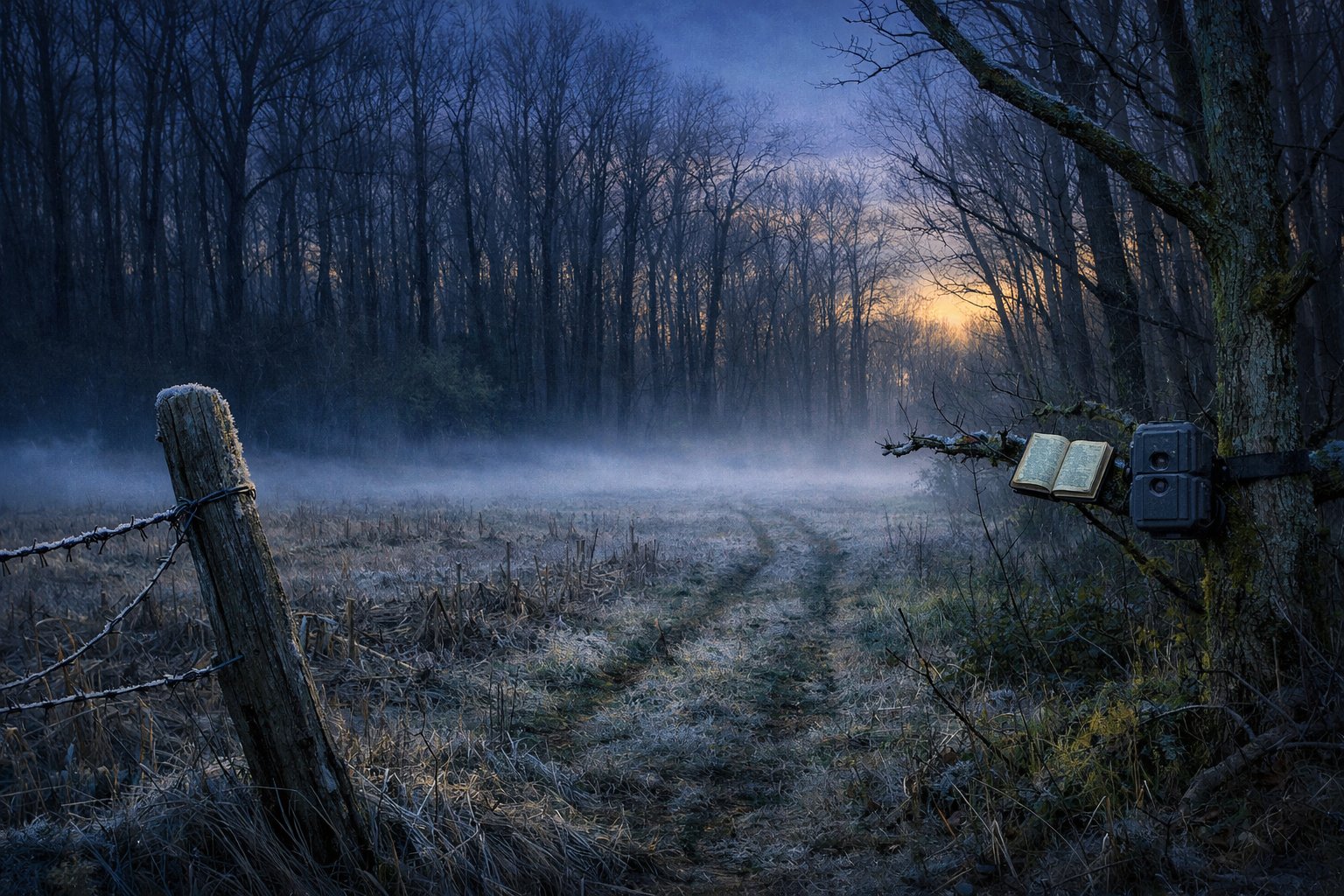
Drafted with AI assistance from the sources listed; images are AI-generated illustrations. How EsoVitae is made
Between April 18 and April 22, 2026, residents of Chatham-Kent municipality in southwestern Ontario filed multiple separate reports of a tall, dark, bipedal figure moving along forest edges near the Thames River and the rural concession roads east of the town of Ridgetown. The reports came in close enough sequence — and close enough in description — that the column Modern Cryptozoology grouped them as a sighting cluster in its April 24, 2026 dispatch, “Pop Goes the Cryptid in April 2026” [1]. A near-identical March 2026 cluster in Portage County, Ohio — seven Bigfoot reports in five days, most concentrated around Mantua — sits roughly 380 kilometres south across Lake Erie [1].
Treated as field data rather than folklore, the Chatham-Kent reports are most useful as a behavioral and ecological record of who-saw-what, when, and where. That is the work below: map the cluster, place it inside the cross-border March-to-April wave across the Great Lakes corridor, weigh the leading naturalistic explanations against what observers actually described, and stay honest about which questions the documentary record can and cannot answer.
The April 2026 Chatham-Kent Cluster: What the Reports Actually Say
The Chatham-Kent Bigfoot cluster is a set of multiple eyewitness reports filed over roughly a week in April 2026 from the agricultural-and-woodlot mosaic east and south of Chatham, Ontario, summarized publicly in the April 24, 2026 Modern Cryptozoology column “Pop Goes the Cryptid in April 2026” [1]. The reports share a common morphology in the witnesses’ own words — tall, dark-coated, two-legged, moving along the forest-field interface at dusk or dawn [1].
A few things stand out when the reports are read as observational notes rather than claims. First, the timing clusters in the crepuscular windows — the hour before sunrise and the hour around sunset — when human visual acuity is at its worst and ungulate and carnivore movement is at its peak. Second, the locations cluster along the forest-edge ecotone rather than deep interior forest, which is consistent with where black bears, coyotes, and white-tailed deer (Odocoileus virginianus) move in early spring [2]. Third, the body of each report runs short: one observer, one passing encounter, sometimes a few seconds of visual contact through brush or across a field. None of the April 2026 Chatham-Kent reports, in the public summary, include daylight photographs, casts, hair samples submitted for sequencing, or audio recordings with metadata [1].

The Great Lakes Corridor Sighting Wave: March Ohio, April Ontario
A near-identical cluster of seven Bigfoot reports in five days hit Portage County, Ohio — most around the village of Mantua — in March 2026, roughly four to six weeks before the Chatham-Kent reports began [1]. Read together, the two clusters trace a March-to-April 2026 wave through the Great Lakes corridor — Ohio first, southern Ontario second, with Lake Erie sitting between them as the geographic hinge.
The corridor framing matters because the relevant ecology is genuinely shared. Portage County’s beech-maple uplands and the Carolinian-zone woodlots of Chatham-Kent both sit inside the same broad ecological band, with overlapping populations of black bear (Ursus americanus), coyote (Canis latrans), and white-tailed deer, and a long, well-documented history of submitted Bigfoot reports in the Bigfoot Field Researchers Organization (BFRO) database for both Ohio and Ontario [3]. Per the BFRO’s public state-and-province totals as of 2025, Ohio sits among the higher-count states for eastern North America, and Ontario carries the largest provincial count in Canada [3]. The April 2026 Chatham-Kent cluster lands inside a region with decades of prior report density, not in a sighting vacuum.
Where the corridor framing earns its keep: it treats the March Ohio and April Ontario clusters as a single sociological-and-ecological phenomenon worth examining together — same season, same biome band, same media ecosystem covering both — rather than two unrelated curiosities.
Black Bears, Standing Upright: The Leading Naturalistic Explanation
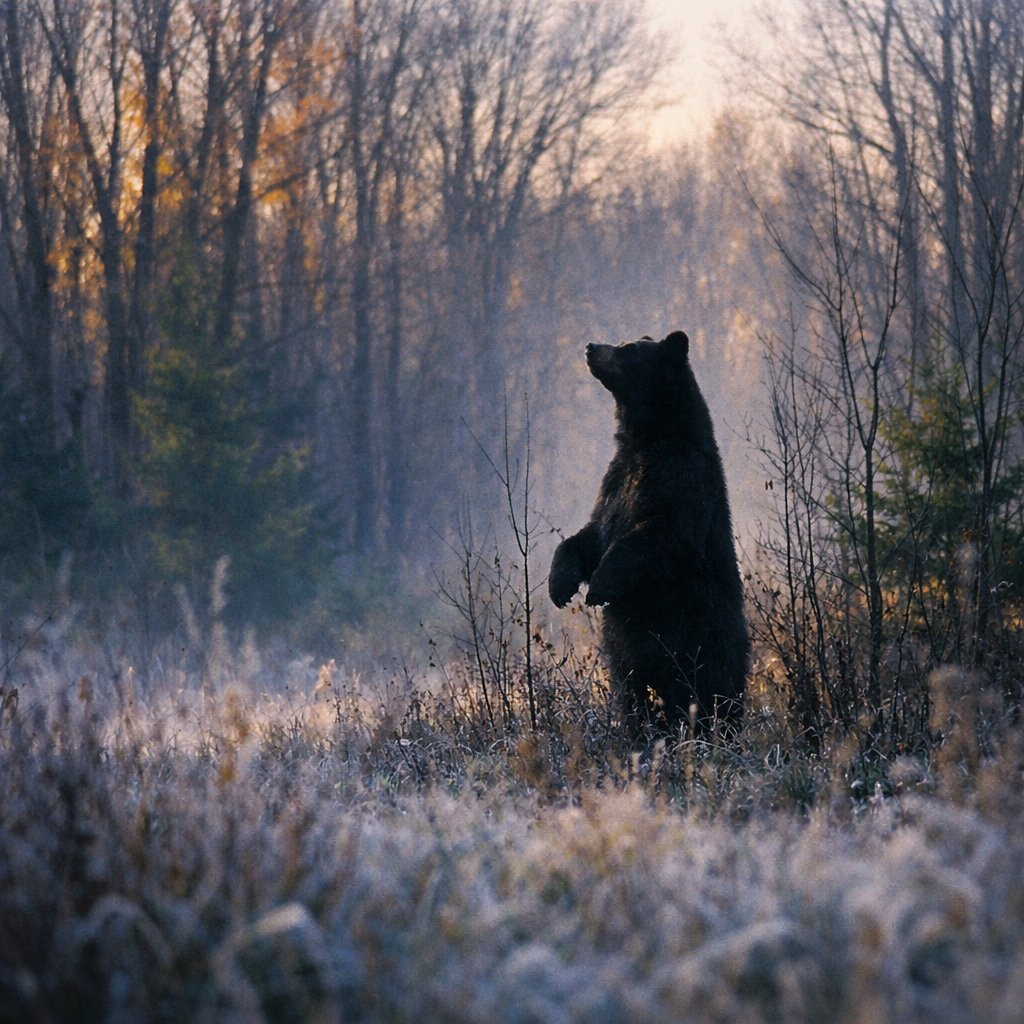
Across decades of Bigfoot sightings in eastern North America, the single most frequently cited naturalistic explanation is misidentification of black bears — particularly bears observed standing bipedally, which they do routinely to scent, see over vegetation, reach mast, or assess a perceived threat [2][4]. Black bear distribution covers most of southern Ontario’s forested zones, including the Carolinian woodlots around Chatham-Kent, and bears emerge from winter dens in March and April with peak movement in early spring [2].
What the camera trap actually shows, from the broader eastern North American bear-monitoring literature: black bears stand on hind legs for seconds to minutes at a time, and from a distance of 30 to 80 metres, through brush or low light, an upright bear’s silhouette can read to a startled human observer as a tall, dark, two-legged figure [2][4]. A 2009 analysis by Floe Foxon (Journal of Zoology, 2022) found a positive correlation between black bear population density and Bigfoot report frequency at the state and provincial level — exactly the pattern predicted if a non-trivial share of reports are bears [4]. The correlation does not explain every report, but it is strong enough that any cluster analysis has to hold the bear-misidentification hypothesis as the default null.
Two other species deserve named acknowledgment. Coyotes can travel bipedally for short distances when injured or carrying prey, and at twilight a tall man in dark clothing on a rural road is misjudged for size at distance with surprising frequency in eyewitness research [5]. Neither species accounts for every Chatham-Kent observation, but together they cover the morphology, the lighting conditions, and the seasonal timing the reports describe.
Sighting-Cluster Contagion: Why Clusters Cluster
A sighting cluster is the temporal-and-spatial concentration of reports following an initial publicized sighting, and the pattern is well-documented across cryptozoological, UFO, and lake-monster literature — once one report enters local news or social media, additional reports tend to follow within days to weeks in the same area [5][6]. The mechanism is mundane and well-described in social-psychology and folklore studies: priming and pareidolia.
Reduced to its evidence, sighting-cluster contagion runs on three coupled effects. First, attention: once a witness has heard a description of “tall, dark, two-legged figure at the wood edge,” that template is loaded in memory and any ambiguous twilight movement at a wood edge can resolve toward it [5]. Second, reporting threshold: a person who saw something odd six months ago and said nothing will, after a publicized report, often file their own — so the cluster reflects shifted reporting behavior more than shifted creature behavior. Third, social transmission: rural communities share these observations across kin and neighbor networks, and the same underlying event can be re-told and re-counted, inflating the apparent count.
The corollary for the Chatham-Kent April 2026 cluster is not that any individual witness is unreliable — most are people honestly reporting what they believe they saw — but that the cluster as a unit tells you less about cryptid presence than the number of reports first suggests. The popular telling and the actual record diverge on this point: media coverage emphasizes the count; the reporting literature emphasizes the cluster mechanism that produced the count.
Seasonal Visibility: Why Early Spring Surfaces More Reports
Early spring in southern Ontario combines three factors that together raise the rate of eyewitness reports of any large wildlife along the forest-field interface — and the same factors apply across the Great Lakes corridor including Portage County, Ohio. The factors are seasonal, repeatable year-over-year, and well-described in the wildlife-observation and citizen-science literature [2][7].
The Three Spring Factors
First, leaf-off visibility: until mid-May at this latitude, deciduous canopy and understory are not yet leafed out, and sight-lines into a woodlot run further than at any other time of year. Second, bear emergence: black bears leave dens through March and April, are calorie-stressed, and travel widely along forest edges seeking early forage [2]. Third, recreational re-occupation of the landscape: rural residents are outdoors more — yard work, walking the dog, scouting trails, opening cottages — so the human observer base in the woodlot edge is at a seasonal peak.
The combination is not a Bigfoot-specific signal; it is a wildlife-observation signal that lifts the apparent rate of large-mammal encounters of every species. Per the IUCN classification of Ursus americanus as Least Concern with a stable-to-increasing North American population trend [2], the bear baseline is high and growing across much of the corridor.
Comparing Clusters: A Field Reference for Eastern Bigfoot Waves
Eastern North American Bigfoot clusters share a recurring profile, and laying the March and April 2026 events side by side against the BFRO’s long-running regional aggregates makes the pattern legible [1][3]. The comparison below holds the same five descriptors across the cases.
| Cluster | Window | Reports | Setting | Notes |
|---|---|---|---|---|
| Chatham-Kent, Ontario | April 2026 (≈5 days) | multiple [1] | Carolinian-zone woodlot edge | BFRO-listed province, leaf-off window |
| Portage County (Mantua area), Ohio | March 2026 (5 days) | seven [1] | beech-maple uplands | Mantua cluster, Ohio BFRO active |
| Eastern US/Canada long-run | 1970s-2025 | thousands aggregate | forest-edge ecotone | BFRO database, OH + ON among higher counts [3] |
Two field-relevant observations fall out of the comparison. The Chatham-Kent and Mantua clusters look more like each other than either looks like a deep-forest interior wave — both sit on the ecotone where black bears, coyotes, and deer move, and where human observers actually live. And both fall in the early-spring leaf-off window, when sight-lines and bear movement co-peak. The cross-border ecological signal is real even if the cryptid hypothesis is not the most parsimonious read of the data.
What Would Move the Needle: Evidence Beyond Eyewitness Reports
Eyewitness reports alone, however numerous, cannot establish the presence of a new large mammal in a well-surveyed temperate ecosystem; that bar is set by the standard wildlife-biology evidentiary chain, and it is the same bar applied to every other megafaunal candidate from the Eastern Cougar to the Wolverine in southern Ontario [7][8]. What would move the needle, in order of strength, is the standard wildlife biology toolkit: DNA evidence, camera-trap imagery, and physical specimens.
On the methodological floor: environmental DNA (eDNA) sampling from forest streams in the cluster footprint, paired with a controlled reference database, returns species-level identifications for vertebrates at the watershed scale and is now standard practice in Ontario wildlife survey work [7]. Repeated camera-trap deployments at sighting coordinates, run for 60 to 90 days and analyzed against the regional mammal baseline, would either capture imagery of the reported figure or quantify the bear-and-deer baseline against which witnesses were comparing. Submitted hair and scat samples have, in past Bigfoot DNA studies (Sykes et al., Proceedings of the Royal Society B, 2014), resolved to known North American mammals on sequencing — bear, deer, raccoon — without exception in the published peer-reviewed record [8].
None of this forecloses the cryptid hypothesis as a matter of philosophy of science; it simply names the evidence form the wildlife-biology community would weigh. For the Chatham-Kent April 2026 cluster, no eDNA, camera-trap, or sequence data has entered the public record as of the date of writing [1]. The reports are reports — useful as a record of what witnesses observed, less useful as a measurement of what the woodlot actually contains.
Reading the Cluster Honestly
The Chatham-Kent Bigfoot cluster of April 2026 is best read as a behavioral-and-ecological data point about a particular place in a particular season: a Carolinian-zone woodlot mosaic in southwestern Ontario during the leaf-off window of early spring, set inside a media environment recently primed by the March 2026 Mantua reports four hundred kilometres south. The most parsimonious explanation for the bulk of the observations is misidentification of upright black bears against the early-spring landscape, amplified by the well-documented mechanics of sighting-cluster contagion. That reading is not dismissive of the witnesses; it is what the wildlife-biology and reporting-mechanics literature, taken together, predicts for clusters of exactly this shape.
The honest scientific posture is to hold the question open at the resolution the evidence supports. Multiple witnesses described tall, dark, bipedal figures along the forest-field edge over a few April days. That much is the record. Whether any of those figures was anything other than a bear, a coyote, a deer, or a misjudged human will be answered, if at all, by eDNA in the local watersheds, by camera traps left in the right places, and by patient observation across more than one spring. For more on how mainstream science reads cryptid evidence, see the niche pillar at Cryptids and Mythical Creatures, and for the persona’s broader field-observation framing see the author bio at our related coverage.