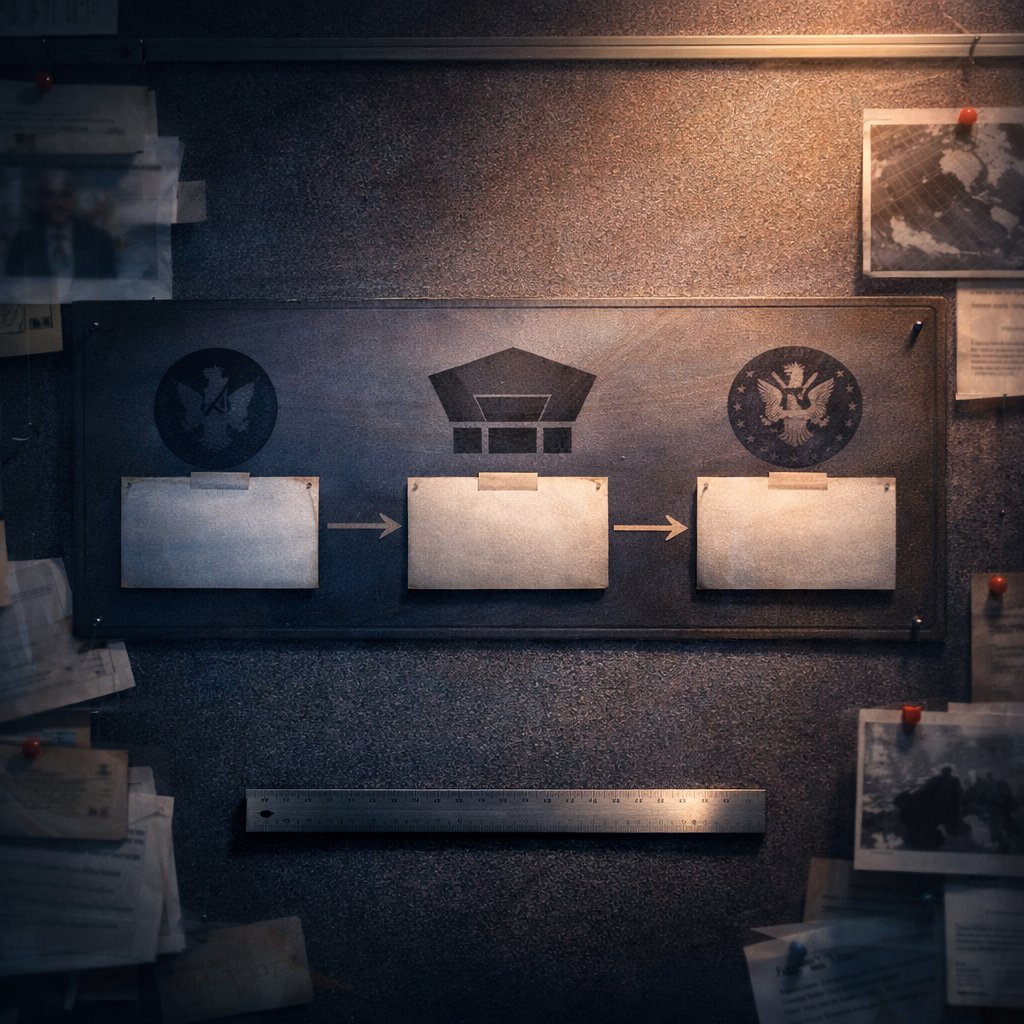
Three Pentagon programs, not one, sit behind the modern UAP record. AAWSAP, AATIP, and AARO ran on different mandates, different budgets, and different parents — Defense Intelligence Agency, then Office of the Under Secretary of Defense for Intelligence, then Office of the Secretary of Defense. The lineage matters because each program was authorized to investigate something slightly different, and the public framing has flattened those differences into one continuous story they were never meant to tell.
Published: May 18, 2026. Last reviewed: May 18, 2026.
The Pentagon UAP Lineage in One Paragraph
Between September 2008 and the present, three separately authorized Department of Defense efforts handled what the public calls UFO investigation: AAWSAP (Advanced Aerospace Weapon System Application Program, 2008–2010, Defense Intelligence Agency contract), AATIP (Advanced Aerospace Threat Identification Program, the name carried forward in some DoD correspondence after 2010), and AARO (All-domain Anomaly Resolution Office, established by statute in 2022). Each succeeded the last in subject matter, but the chain is not bureaucratic inheritance — it is a sequence of distinct congressional and executive authorizations, with different signatures and different scopes [1][2][3].
The conflation that does the most damage is treating AAWSAP and AATIP as the same program under two names. They are not. AAWSAP was a procurement vehicle — a DIA solicitation answered by Bigelow Aerospace’s BAASS subsidiary, with a roughly $22 million ceiling earmarked at the urging of then–Senate Majority Leader Harry Reid [4]. AATIP, as Luis Elizondo and the Department of Defense Public Affairs office later described it, was an internal threat-identification effort whose precise legal authorization and budget line have never been independently produced on the record [5][6].
AAWSAP, 2008–2010: A DIA Contract, Not a UFO Office
The Advanced Aerospace Weapon System Application Program ran from September 22, 2008 through fiscal year 2010 as a Defense Intelligence Agency contract awarded to Bigelow Aerospace Advanced Space Studies (BAASS), with a ceiling of approximately $22 million and a stated purpose of surveying foreign and emerging aerospace weapon systems [4][7]. The earmark originated with Senator Harry Reid of Nevada; the contract vehicle ran through DIA’s Defense Warning Office.
On the documentary record: the AAWSAP solicitation language framed the work as foreign-aerospace-threat assessment, with thirty-eight Defense Intelligence Reference Documents (DIRDs) produced as deliverables across topics from warp drive metrics to traversable wormholes [8]. None of the DIRDs is a UFO incident catalogue in the popular sense. The program closed in 2010 after a DIA program review concluded the deliverables were not sufficiently aligned with intelligence community priorities to warrant continuation [4].
What AAWSAP was not mandated to do is as load-bearing as what it produced. It was not chartered to investigate UAP incidents against US military assets in any operational sense, and it was not a Special Access Program. Witness testimony collected by BAASS at Skinwalker Ranch and elsewhere was contracted work product, not a Pentagon investigation in the colloquial sense [9].
AATIP, 2010–2012: The Naming Question
The Advanced Aerospace Threat Identification Program entered public discourse on December 16, 2017, when The New York Times reported a $22 million Pentagon program led by Luis Elizondo within the Office of the Under Secretary of Defense for Intelligence [5]. The reporting conflated AAWSAP funding figures with AATIP organizational identity, and the Department of Defense has never fully reconciled the record.
Where the consensus and the evidence diverge: Pentagon spokesperson Susan Gough, in correspondence with multiple journalists between 2019 and 2021, stated that Luis Elizondo had no assigned role or responsibilities for AATIP during his tenure at OUSD(I) [6]. Elizondo and supporters produced a 2017 DoD letter referencing his “duties involving threats posed by aerospace platforms,” which Elizondo has cited as confirmation of his AATIP role; Gough has characterized the language as administrative rather than substantive [10].
The dispute hinges on a distinction between program-name continuity and program-authority continuity. AATIP as a name appears in internal DoD email through approximately 2012; whether it described a distinct funded program with separate authority, or a residual designation for unliquidated AAWSAP deliverables under OUSD(I), has not been resolved by any released audit. The Office of the Inspector General’s 2024 report on DoD UAP-related programs noted “ambiguity in the authorization basis” for AATIP as a successor program [11].
The Bridge Years, 2012–2020: UAPTF and Senate Pressure
From 2012 through August 14, 2020, no publicly acknowledged Pentagon office held the UAP portfolio under a single named authority. The vacuum closed when Deputy Secretary of Defense David Norquist formally established the Unidentified Aerial Phenomena Task Force (UAPTF) under the Office of Naval Intelligence, with a mandate to detect, analyze, and catalog UAP encounters against US military assets [12].
The UAPTF inherited a backlog of Navy F/A-18 sensor encounters from the 2004 USS Nimitz strike group operations off Catalina Island and the 2014–2015 USS Theodore Roosevelt deployments off the Atlantic coast [13]. The June 25, 2021 Office of the Director of National Intelligence Preliminary Assessment: Unidentified Aerial Phenomena documented 144 reported incidents between 2004 and 2021, of which 143 remained unexplained as of report submission [14].
Senator Marco Rubio, Senator Kirsten Gillibrand, and Senator Mark Warner drove the legislative pressure that converted the UAPTF into a statutorily-required office. The fiscal year 2022 National Defense Authorization Act, signed December 27, 2021, directed the Secretary of Defense and the Director of National Intelligence to establish a permanent office within sixty days [15].
AARO, 2022–Present: Statutory Authority and All-Domain Scope
The All-domain Anomaly Resolution Office was created on July 15, 2022 by Deputy Secretary of Defense Kathleen Hicks under the authority of Section 1683 of the William M. (Mac) Thornberry National Defense Authorization Act for Fiscal Year 2022, with Sean Kirkpatrick of the Defense Intelligence Agency named first director [16][17]. AARO initially reported to the Under Secretary of Defense for Intelligence and Security; the office sits within OUSD(I&S) to the present day.
The 2022 NDAA language expanded scope beyond the UAPTF’s military-airspace remit. AARO’s statutory mandate covers “transmedium objects or devices” — phenomena moving between air, space, sea, and underwater domains — and any object or phenomenon “of unknown origin” detected in restricted airspace, special use airspace, or against national security assets [18]. The “all-domain” descriptor in the office name is not stylistic; it reflects the statutory expansion.
Per the AARO statement of work, the office’s three mission lines are: detection and reporting integration with military service intelligence components; scientific and technical analysis of reported events; and historical-record review of legacy US government UAP-related programs from 1945 forward [17]. The third line produced the two volumes of the Historical Record Report.
Directors of Record
Sean Kirkpatrick led AARO from July 2022 until his retirement on December 1, 2023, after which Tim Phillips served as acting director [19]. The Department of Defense announced Jon Kosloski as the second permanent AARO director on July 16, 2024; Kosloski came to the role from the National Security Agency and remains in post as of May 2026 [20].
The AARO Historical Record Reports, 2024
AARO published the Report on the Historical Record of U.S. Government Involvement with Unidentified Anomalous Phenomena, Volume I on March 8, 2024, covering executive branch UAP programs from 1945 through October 31, 2023 [21]. Volume II, addressing the remaining classified material and additional witness interviews under the AARO Secure Reporting Mechanism, was released in classified form to Congress in 2024 with a public unclassified summary [22].
The central finding in Volume I: AARO interviewed more than thirty witnesses who came forward through the Secure Reporting Mechanism, reviewed program records from across the intelligence community, and found “no empirical evidence” for claims of a US government reverse-engineering program or extraterrestrial-origin material in US custody [21]. That conclusion is the report’s most-cited line and its most-contested.
| Program | Active | Parent | Authority | Reported Budget |
|---|---|---|---|---|
| AAWSAP | 2008–2010 | DIA Defense Warning Office | Reid earmark / DIA contract | ~$22M ceiling [4] |
| AATIP | ~2010–2012 (disputed) | OUSD(I) | Internal designation | Not separately disclosed [11] |
| UAPTF | 2020–2022 | Office of Naval Intelligence | DepSecDef memo, Aug 14 2020 | Not publicly itemized [12] |
| AARO | 2022–present | OUSD(I&S) | NDAA FY22 §1683 | FY23 ~$11M reported [17] |
AARO and PURSUE, May 2026
On May 8, 2026, the White House announced the Program for Unidentified Records and Sensitive Unclassified Evidence (PURSUE), an inter-agency declassification effort directed by executive order to accelerate document review across DoD, DOE, NRO, and CIA holdings related to UAP [23]. AARO is the designated technical lead for sensor-record assessment within PURSUE; the National Declassification Center coordinates document review.
PURSUE is best read as a declassification mechanism, not a new investigative program. It does not displace AARO’s statutory mandate under NDAA Section 1683; it adds a parallel declassification track that feeds records into AARO’s historical-record line. As of May 2026, the first PURSUE document tranche has not yet released; AARO Director Jon Kosloski’s statement of May 12, 2026 placed the initial release window in Q3 FY26 [24].
What Each Program Was Not Authorized to Do
The mandate-vs-output distinction is what most popular accounts collapse. AAWSAP was authorized to survey foreign aerospace weapon systems; whatever its contractor produced about ranch-anomalies and metamaterials was incidental work product, not chartered output [4][9]. AATIP, if it existed as a distinct entity, was not authorized to publicly disclose or to provide briefings outside DoD chains of command [6][11].
UAPTF was authorized to detect and catalog, not to declassify; its 2021 preliminary assessment was a congressional deliverable, not a public-disclosure document, even though it was released publicly [14]. AARO is authorized to investigate, analyze, and report; it is not authorized to confirm or deny extraterrestrial origin of phenomena absent empirical evidence, and its statute does not require it to find a particular answer [18].
The conflation worth resolving: when commentators speak of “the Pentagon UFO program,” the singular collapses four distinct authorizations into one, and the question “what has the Pentagon found?” misframes a sequence of programs that were each chartered to find different things. The public record from 2008 to 2026 is a record of evolving authority, not of accumulating disclosure.
How To Read the Public Record Going Forward
Three primary sources reward sustained attention: AARO’s Historical Record Report Volume I, the ODNI Preliminary Assessment of June 25, 2021, and the AARO annual reports submitted under NDAA Section 1683(k). Each reflects a different reporting standard — historical synthesis, intelligence assessment, statutory compliance — and each must be read against the authorization that produced it.
Secondary sources worth tracking include DefenseScoop’s continuing AARO coverage, the Government Accountability Office’s 2023 review of UAP information-sharing across federal agencies (GAO-23-105939) [25], and the unclassified portions of House Oversight and Senate Armed Services committee hearings on UAP. The record is large, contradictory in places, and far from complete. The discipline is to read what it actually says, name the redactions where they appear, and resist the gravity of either disclosure-celebration or reflexive dismissal until the documents speak.