The Momo Challenge was a viral hoax, not a coordinated game. Its face came from a 2016 Japanese sculpture called Mother Bird, and no police force or child-safety charity ever verified a death caused by it. The harm was real, but it lived in the panic, not the dare.
Published: June 5, 2026. Last reviewed: June 5, 2026.
What Was the Momo Challenge?
The Momo Challenge was an online urban legend, circulated mainly between July 2018 and March 2019, claiming a bulging-eyed avatar named Momo contacted children through WhatsApp and YouTube and pushed them toward escalating dares that ended in self-harm. As PolitiFact documented in March 2019, no playable version of the game was ever found.
The story had the shape of a classic creepypasta, the internet-folklore genre where a horror premise spreads as if it were reported fact. You add a contact, Momo answers with violent images, refusing an order earns a threat against you or your family. It read as a screen-native ghost story, which is exactly why it traveled. The premise fit a fear parents already carried about what their kids do alone with a phone, and it slotted neatly into the broader landscape of contemporary mysteries and theories that thrive in that gap between what we can see and what we imagine.
Where Momo Actually Came From
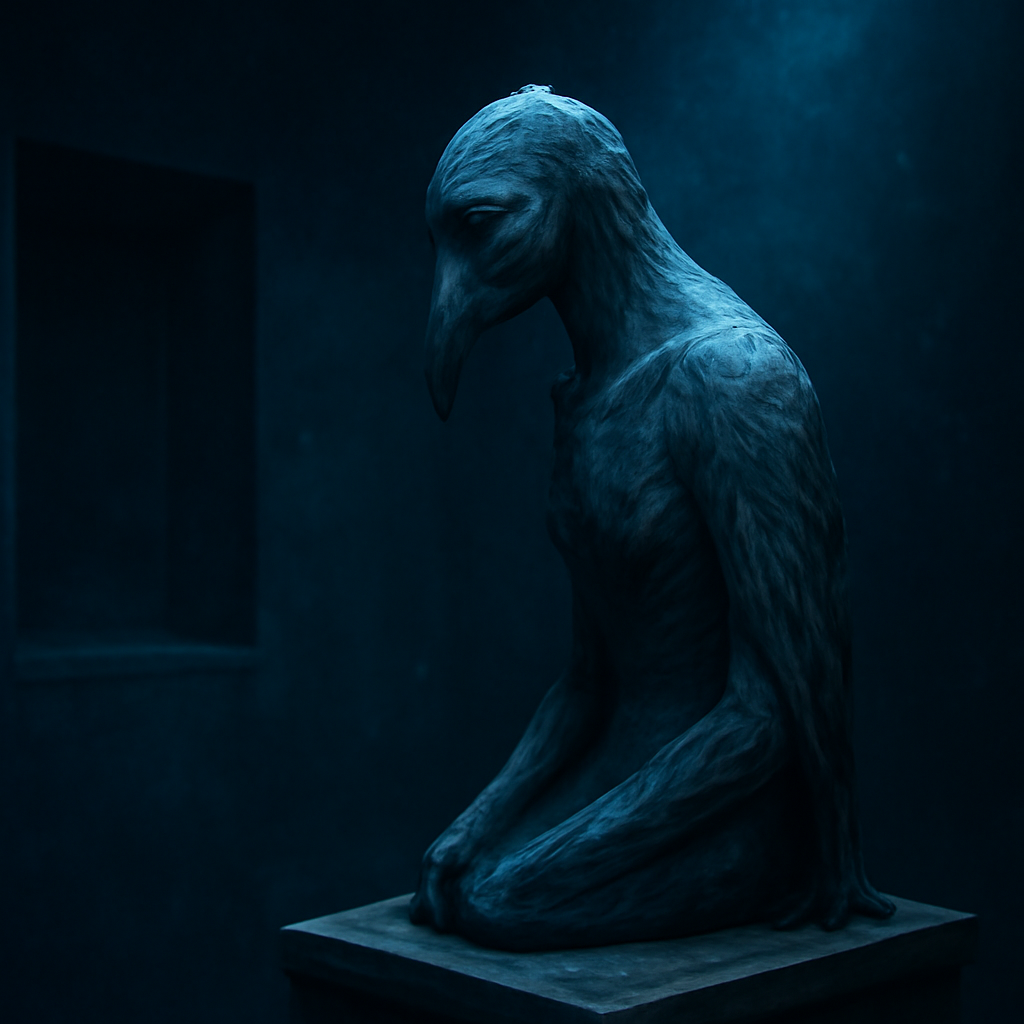
The Momo face is a cropped photograph of Mother Bird, a latex-and-resin sculpture built in 2016 by Japanese special-effects artist Keisuke Aiso of the studio Link Factory, and first displayed at the Vanilla Gallery in Tokyo. It was a horror-art piece, never an avatar.
Keisuke Aiso sculpted the piece for a gallery show, not for the internet. Aiso later told The Japan Times he was baffled that his work had become the face of a panic about children, and that he felt “a little responsible” for how it was used. In 2018 he threw the sculpture away after its materials decomposed. Speaking to reporters in March 2019, he offered an oddly comforting line for frightened kids: Momo is dead, she no longer exists, and the curse is gone.
The Ubume Behind the Image
Aiso modeled Mother Bird on the ubume, a figure from Japanese yokai folklore traditionally tied to a woman who died in childbirth. The wide mouth, stretched eyes, and bird-like lower body are deliberate folklore design, not a digital glitch. Stripped of folklore, the image is a museum prop photographed under gallery lighting and then re-captioned by strangers who never saw the placard next to it.
How a Sculpture Photo Became a “Challenge”
Momo crossed from gallery art to internet legend in mid-2018, when a close-up of the sculpture was reposted to the subreddit r/creepy and YouTube commentators including ReignBot and GloomyHouse built videos around an alleged WhatsApp account that supposedly answered with violent images.
Work the chain backward and the provenance is clear. The picture circulated on Japanese social media after the 2016 show, surfaced on Instagram and r/creepy in 2018, then picked up a backstory: a WhatsApp contact, “Momo,” reachable through phone numbers carrying Japanese, Mexican, and Colombian country codes. What the screenshot actually captures is the gap in this story: a folklore sculpture, cropped tight, with no museum context and no verifiable account behind it. The numbers people shared mostly went dead or unassigned, and the “game” existed as warnings about a game rather than as anything anyone could play.
The WhatsApp Number That Anchored the Legend
Every retelling needed a number to call, and that detail is where the legend gives itself away. The shared contacts rotated constantly, swapped between posts, and rarely resolved to a live account on inspection. A creepypasta only needs the idea of a reachable contact to feel true, not a working one. Reporters and amateur investigators who actually dialed or messaged the circulating numbers mostly hit silence, automated errors, or unrelated strangers. The interactive horror lived in the description of Momo, not in any account a child could open and chat with.
The 2018 Cases Police Could Not Confirm
In July 2018, police in Argentina investigated the death of a 12-year-old girl in Ingeniero Maschwitz, near Buenos Aires, for a possible link to Momo, and authorities in West Bengal and Mumbai issued warnings that same summer after two reported teen deaths in India.
Between August and September 2018, police forces in Argentina, Germany, Spain, Mexico, Canada, and the United States issued public Momo warnings, each amplifying the legend further. On the documentary record, India’s Central Bureau of Investigation in West Bengal stated on August 29, 2018 that the claims linking the teen deaths to Momo were “far fetched and devoid of any evidence.” By that autumn most of the circulating phone numbers were out of service, and coverage faded almost as fast as it had spread. Investigators could establish that children had died; they could not establish that a game named Momo had killed them.
February 2019: The Second Wave and the YouTube Kids Scare
The Momo panic returned in February 2019 with claims that Momo clips were spliced into YouTube Kids videos, a wave amplified by a Police Service of Northern Ireland Facebook warning and a Kim Kardashian Instagram message asking YouTube to act.
This second wave spread through worried adults, not through any hidden video network. Schools sent letters home, parent groups reshared the same cropped face, and local news ran segments warning of clips hidden inside Peppa Pig and Fortnite uploads. Reporters who actually searched for the spliced footage could not find it. The warnings, screenshotted and forwarded, were the thing going from phone to phone. A legend about a contagious video became a genuinely contagious message, carried by the very people trying to stop it. The mechanism is worth naming: a panic about kids watching unmoderated clips spread fastest through the adults moderating them, each share adding reach the original image never earned on its own.
What the Evidence Actually Showed
By late February 2019, the Samaritans, the NSPCC, the UK Safer Internet Centre, and YouTube each stated there was no verified evidence that the Momo Challenge had caused any child’s death or self-harm. The threat that mobilized millions of parents could not be located.
The popular telling vs the actual record: in the popular telling Momo was hunting kids inside their cartoons; on the record, the Samaritans told The Guardian it was “not aware of any verified evidence in this country or beyond linking Momo to suicide,” and the NSPCC noted it had fielded more calls from journalists than from concerned parents. YouTube stated on February 27, 2019 that it had “seen no recent evidence of videos promoting the Momo Challenge.” The UK Safer Internet Centre called the scare “fake news,” and Anne Longfield, then Children’s Commissioner for England, urged the media to stop amplifying it. London’s Parent Zone warned that the warnings themselves were what frightened children.
| Date | Event | What the record shows |
|---|---|---|
| 2016 | Mother Bird sculpture shown at Vanilla Gallery, Tokyo | Art piece by Keisuke Aiso, no game attached |
| July 2018 | First viral wave on Reddit and YouTube | Photo detached from its source |
| Aug 29, 2018 | India’s CBI reviews Momo death claims | Called them “far fetched and devoid of any evidence” |
| 2018 | Aiso destroys the decaying sculpture | The “monster” no longer exists |
| Feb 2019 | Second wave: YouTube Kids splicing claim | YouTube: “no recent evidence” of such videos |
| 2019 | Fact-checkers and charities tally outcomes | Zero deaths verified as caused by Momo |
Why Momo Spread: A Moral Panic in a Group Chat
Folklorist Benjamin Radford classified the Momo Challenge, alongside the earlier Blue Whale Challenge, as a textbook moral panic, the concept sociologist Stanley Cohen defined in 1972 as collective alarm wildly out of proportion to any verifiable threat. Momo fit the template almost exactly.
A moral panic needs a folk devil, a trusted amplifier, and a fear already in the room. Momo supplied the folk devil through Aiso’s ubume sculpture; police forces, schools, and a celebrity Instagram account supplied the amplification; and the underlying anxiety about children and unsupervised screens supplied the fuel. The Blue Whale Challenge had run the same loop two years earlier on equally thin evidence. The lesson for anyone reading the next one is a provenance habit: trace the origin post, check whether the artifact predates the legend, and ask whether the “challenge” exists outside the warnings about it. Momo’s most lasting victim was an artist who destroyed his own work, and the children scared less by a game than by the adults sounding the alarm. For more reporting that follows internet legends back to their first post, see Riley Tanaka’s work on mysterious internet phenomena and the wider archive of contemporary mysteries and theories.
Frequently Asked Questions
Was the Momo Challenge real?
No verified version of the Momo Challenge was ever found. Researchers, charities, and YouTube located warning posts and news segments, but not an actual game contacting children. The threat existed as an urban legend, while the panic around it was very real.
Where did the Momo image come from?
The image is a cropped photo of Mother Bird, a 2016 sculpture by Japanese artist Keisuke Aiso of the studio Link Factory, exhibited at the Vanilla Gallery in Tokyo. It depicts an ubume, a figure from Japanese yokai folklore, and had no connection to any online challenge.
Did anyone die because of the Momo Challenge?
No death has been verified as caused by the Momo Challenge. Police in Argentina and India investigated possible links in 2018, but India’s Central Bureau of Investigation called the claims “far fetched and devoid of any evidence,” and no agency confirmed a direct connection.
Was Momo really hidden in YouTube Kids videos?
No spliced Momo footage was ever found in YouTube Kids videos. The February 2019 claims spread through parent warnings and news reports. YouTube stated on February 27, 2019 that it had seen no recent evidence of videos promoting the challenge on its platform.
Who created the Momo sculpture?
Japanese special-effects artist Keisuke Aiso, working with the studio Link Factory, created the sculpture in 2016 for a horror-art exhibition. He destroyed it in 2018 after its materials decomposed and said in 2019 that he felt some responsibility for how the image had frightened children.
What is a moral panic?
A moral panic is a wave of collective fear, defined by sociologist Stanley Cohen in 1972, in which a perceived threat to social values is amplified far beyond its real scale. Folklorist Benjamin Radford described both Momo and the Blue Whale Challenge as classic examples.
How is the Momo Challenge related to the Blue Whale Challenge?
Both were online scares blamed for child suicides on thin evidence. The Blue Whale Challenge spread in 2016 and 2017, and Momo followed the same pattern in 2018 and 2019. Researchers treat them as paired case studies in internet-era moral panic.
What should parents actually take from the Momo story?
Child-safety researchers, including the Cyberbullying Research Center, advise focusing on general online-safety conversations rather than any single named scare. Forwarding the warnings often reaches and frightens more children than the original story ever did. Verifying a claim before sharing it is the practical defense against the next viral panic, and it costs nothing but a search.