By Wren Ashby · Published June 14, 2026 · Updated September 2, 2026
Bird flight formations are the visible geometry of collective travel: energy-saving V-shapes and echelons, and shape-shifting starling murmurations. Beneath the pattern runs navigation, a light-sensitive magnetic compass, time-compensated sun and star cues, and learned maps that together steer whole flocks across hemispheres, often without a single fixed leader.
Published: June 5, 2026. Last reviewed: June 5, 2026.
What Bird Flight Formations Actually Are
Bird flight formations fall into two families: drag-reducing line shapes such as the V-formation and the echelon, used by heavy migrants like geese and pelicans, and dense aggregations such as the starling murmuration, where thousands of birds move as one responsive sheet. The two solve different problems. A line shape is an aerodynamics problem. A murmuration is a problem in collective decision-making.
Watch a skein of geese pass overhead and the geometry is doing work. Each bird sits slightly behind and to the side of the one ahead, riding the rising air it leaves behind. Watch a winter murmuration over a reedbed and the work is different: there is no leader to follow, no fixed shape to hold, only a rule each bird applies to its closest neighbors, repeated thousands of times a second until a cloud of starlings turns like a single animal.
Both patterns sit on top of the same deeper machinery. A formation only matters if it is pointed somewhere, and the question of how a bird knows where “somewhere” is has occupied ethologists for more than half a century. This piece treats the shape and the steering as one subject, because in the field they are never separate. The formation is the body; navigation is the intent. For readers tracking the broader field, this sits within other dispatches on animal anomaly mysteries and the wider Eso Vitae record of mysteries and anomalies.
Why Birds Fly in a V: The Aerodynamics of Formation
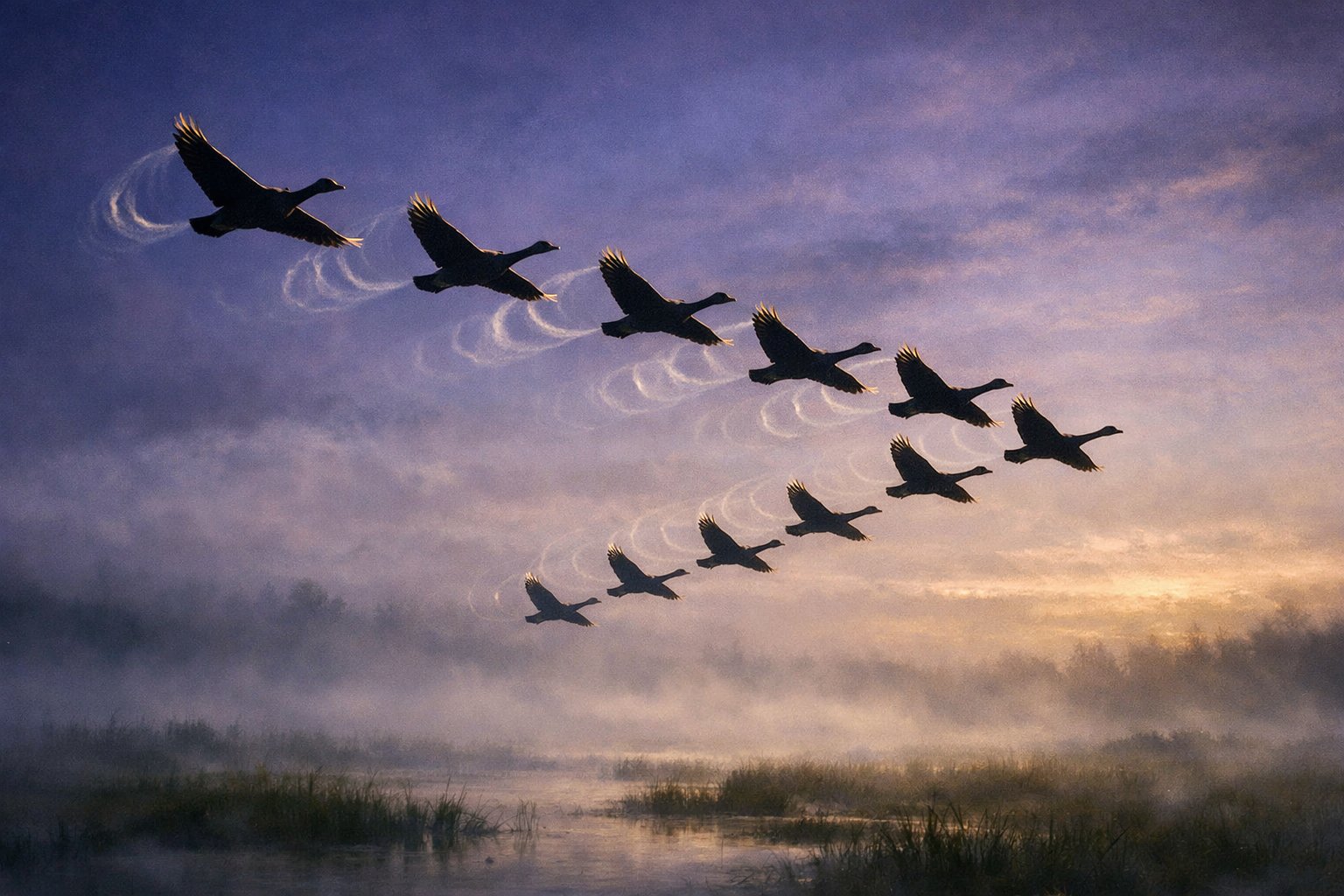
Birds fly in V-shaped and echelon formations to capture the rising upwash shed by the wingtips of the bird ahead, a benefit that Peter Lissaman and Carl Shollenberger first quantified in Science in 1970, estimating a 70 percent range extension for a 25-bird flock [1]. Their paper became the gold standard against which every later study was measured.
The physics is specific. A flapping wing sheds a pair of trailing wingtip vortices, swirls of air that sink in the middle and rise at the edges. A trailing bird that tucks into that rising edge gets free lift; a bird directly behind, in the sinking center, gets pushed down instead. So the optimal position is offset, slightly back and to one side, which is exactly the geometry the V draws in the sky. On the math: field and modeling estimates for geese cluster around a 10 to 14 percent energy saving per bird in good formation, modest per wingbeat but decisive across a thousand-kilometer migration [1].
Lissaman and Shollenberger also overturned an intuition. The lead bird does not hold the hardest position; the saving is shared unevenly along the arms, and birds at the very back of each arm can do better than the point. That single counterintuitive result is why the V keeps surprising people, and why it took live measurement, not theory alone, to confirm what the birds were doing.
The Ibis That Proved the Physics
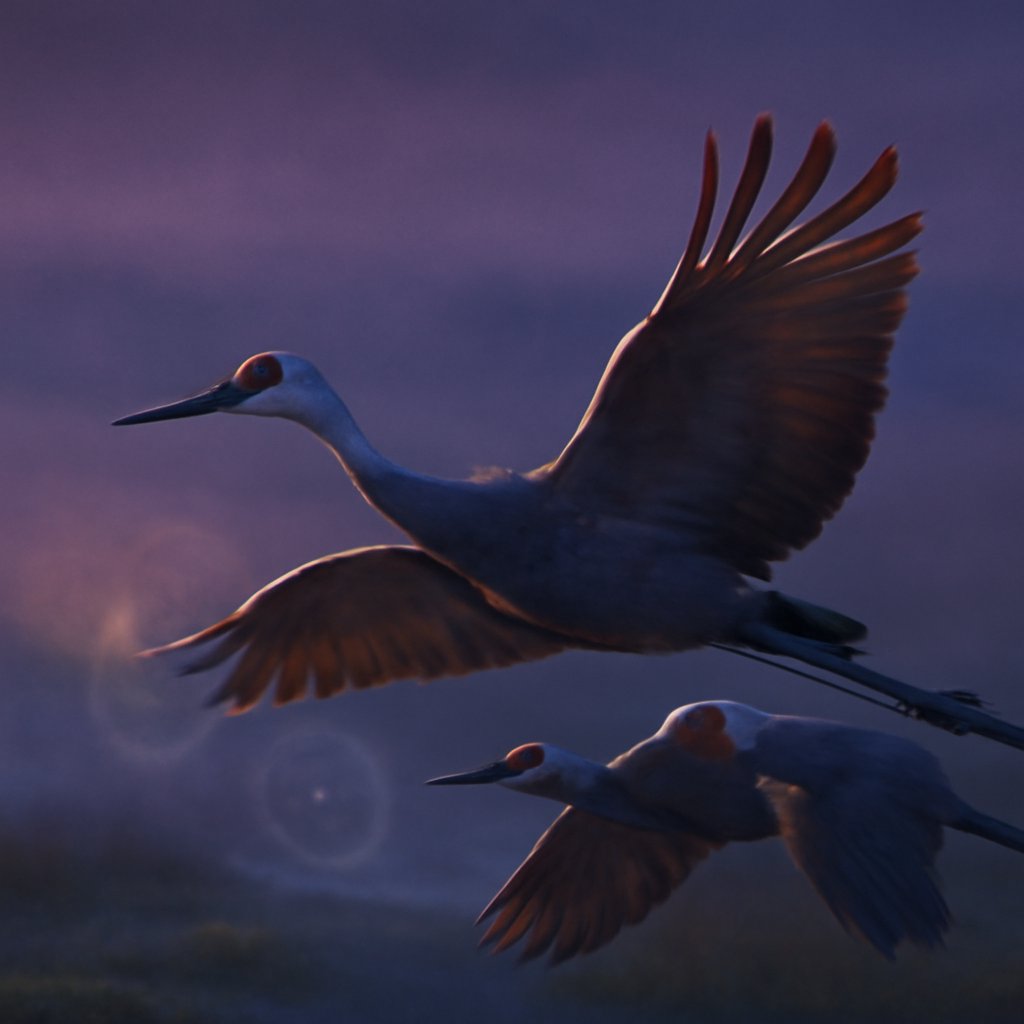
The northern bald ibis settled a decades-old debate in 2014, when Steven Portugal’s team at the Royal Veterinary College fitted 14 hand-reared juveniles with GPS and inertial loggers accurate to within 30 centimeters and watched them slot into the exact positions aerodynamic theory predicted [3]. The birds, Geronticus eremita, were following a microlight on a human-guided reintroduction flight run by the Austrian Waldrappteam.
The loggers caught something theory had not: the ibises did not just choose the right place, they timed their wing-beats to it. A trailing bird phased its flap to path-match the leader, keeping its own wingtip in the rising upwash through the whole stroke. When a bird sat directly behind another, it flipped to the opposite phase, beating in anti-phase to dodge the downwash. That is real-time aerodynamic bookkeeping, performed wing-stroke by wing-stroke [3].
The Pelican Heart-Rate Evidence
An earlier study had measured the payoff directly. Henri Weimerskirch strapped heart-rate loggers to eight great white pelicans trained to follow an aircraft for a wildlife film, and found that birds in formation cut their heart rate and flapped less, gliding more, for an energy saving of 11.4 to 14.0 percent [2]. A 2015 follow-up on the same ibis project showed the birds take turns, matching the time each spends in the costly lead and the cheap draft, a textbook case of direct reciprocity [4].
| Study | Year / Journal | Species | Core finding |
|---|---|---|---|
| Lissaman & Shollenberger | 1970 / Science | Geese (modeled) | ~70% range extension predicted for a 25-bird V |
| Weimerskirch et al. | 2001 / Nature | Great white pelican | 11.4–14.0% energy saving; lower heart rate, more gliding |
| Portugal et al. | 2014 / Nature | Northern bald ibis | Wing-beat phasing matches theoretical optimal positions |
| Voelkl, Portugal et al. | 2015 / PNAS | Northern bald ibis | Birds take turns leading; direct reciprocity |
Murmurations: Geometry Without a Leader
A starling murmuration coordinates through topology rather than distance: each bird tracks roughly seven nearest neighbors, a rule that Michele Ballerini and the STARFLAG project measured over Rome and published in 2008 [5]. Because the rule counts neighbors rather than meters, the flock holds together whether it is packed tight or stretched thin.
That topological rule explains the shape, but not the eerie speed of it. A team led by Andrea Cavagna reported that velocity correlations in starling flocks are scale-free: the range over which one bird’s turn influences others grows with the size of the flock instead of fading at a fixed distance [6]. In practice, a swerve at one edge ripples to the far side faster than any single bird could see and react, because the correlation is a property of the whole group, not a relay of individual responses.
There is usually a reason the cloud is dancing. A hunting peregrine falcon turns a loose evening roost-gathering into a tightening, folding sheet, and the same scale-free coupling that makes the display beautiful also makes it hard to single out one target. Two things get conflated here: the pattern is often read as decoration, when the field evidence frames it as an anti-predator response with measurable geometry [6]. The murmuration is not a flourish. It is a defense with the mathematics of a critical system.
How Birds Navigate Beneath the Formation
Beneath every formation runs a navigation system with at least three redundant senses, a magnetic compass, a sun compass, and a star compass, first teased apart through caged-bird experiments beginning with Wolfgang Wiltschko’s 1966 work on the European robin. No single cue does the whole job; birds weight them against each other and recalibrate one against the next.
The Magnetic Compass and the Radical Pair
The leading explanation for the magnetic compass is the radical-pair mechanism, a light-triggered quantum reaction in cryptochrome proteins in the retina. When blue light hits the protein, it creates a pair of molecules with linked electron spins whose chemistry is nudged by the Earth’s field, in effect letting the bird “see” magnetic direction. In 2021 a team showed that cryptochrome-4a from the migratory European robin is markedly more magnetically sensitive than the same protein from non-migratory pigeons and chickens [7]. A second, contested hypothesis points to magnetite, tiny iron-mineral crystals linked to the trigeminal nerve, though magnetite has proven hard to pin down in birds. The two ideas are not exclusive; a compass and a map can use different organs.
Sun, Stars, and Learned Maps
The sun compass is time-compensated, meaning a bird corrects for the sun’s movement across the sky using its internal clock, a mechanism Gustav Kramer first demonstrated in caged starlings. The star compass is learned, not innate: Stephen Emlen showed in the 1960s, using the funnel cage that now bears his name, that indigo buntings read direction from the rotation of the night sky around the celestial pole and will reorient if a planetarium’s “north” is moved. Homing pigeons stitch these compasses to a map, the “map-and-compass” model, with strong evidence that part of the map is built from atmospheric odors learned at the loft. The formation, in other words, is steered by a stack of senses, not one.
Formations That Cross the Planet
A juvenile bar-tailed godwit known as B6 flew 13,560 kilometers from Alaska to Tasmania in 11 days and one hour during October 2022, the longest non-stop flight ever recorded for any bird [9]. The four-month-old shorebird carried a five-gram solar-powered satellite tag and never touched down once on the open Pacific.
On the migratory record: a godwit burns through more than half its body weight on such a crossing, flying day and night with no chance to feed, which is why the pre-departure fattening on Alaska’s Kuskokwim Delta is itself a feat of physiology. Birds like B6 do not hold a tight goose-style V across the ocean; many long-haul shorebirds travel in looser lines and skeins, a reminder that “formation” is a spectrum, not a single template. The Arctic tern stretches the distance further still: geolocator tracking by Carsten Egevang’s team in 2010 found an annual round trip of more than 71,000 kilometers, pole to pole and back, the longest migration of any animal, with a lifetime total that can exceed 2.4 million kilometers [8].
These records matter for the formation question because they show what the navigation system is rated for. A compass that drifts by a few degrees would put a godwit thousands of kilometers off an island the size of Tasmania. The precision of the arrival is the strongest field evidence we have that the underlying sense is real, redundant, and astonishingly well calibrated.
Why the Patterns Still Hold Open Questions
Bird flight formations remain an active research front in 2026, with open questions spanning quantum biology, collective-behavior physics, and the conservation status of the very species that taught us how formations work. The answers are partial in the way working biology is always partial.
The radical-pair compass is still being pinned to a specific molecule; the magnetite map remains a hypothesis in search of an organ; and the murmuration’s scale-free coupling, while measured, is not yet fully explained at the level of what each starling computes. Per the IUCN classification: the northern bald ibis that proved the aerodynamics was once Critically Endangered and, after intensive reintroduction by groups like the Waldrappteam, was downlisted to Endangered in 2018, a rare improvement that depended on humans flying microlights ahead of the birds to teach a lost migration route.
That last detail is the one I keep returning to. We learned how an ibis exploits a vortex by teaching ibises to follow us. The formation overhead is not a decoration on migration; it is the migration, made legible. Watch the shape, then watch where it is pointed, and the anomaly resolves into something better than a mystery: a measurement of the world the bird is moving through. More field notes from field naturalist Wren Ashby follow the same method, one careful observation at a time.
Frequently Asked Questions
Why do birds fly in a V formation?
Birds fly in a V to save energy. Each bird rides the rising upwash shed by the wingtip of the bird ahead, gaining free lift. Aerodynamic theory predicts up to a 70 percent range extension for a large flock, and measured energy savings in geese cluster around 10 to 14 percent per bird.
Do birds take turns at the front of the V?
Yes. A 2015 study of northern bald ibis found the birds match the time each spends in the demanding lead position with time spent drafting behind, a pattern researchers describe as direct reciprocity. No single bird is forced to bear the cost of leading the whole way.
How do starling murmurations move so fast without a leader?
Each starling tracks about seven nearest neighbors rather than every bird in the flock, and velocity changes are correlated across the entire group in a scale-free way. A turn at one edge propagates to the far side faster than any individual bird could see and react, so the cloud behaves like a single coordinated system.
How do birds navigate over thousands of kilometers?
Migratory birds use several overlapping cues: a light-dependent magnetic compass, a time-compensated sun compass, a learned star compass keyed to the rotation of the night sky, and, in homing pigeons, a map partly built from learned atmospheric odors. They weight these senses against one another and recalibrate as conditions change.
What is the radical-pair mechanism?
It is the leading explanation for the avian magnetic compass. Blue light striking cryptochrome proteins in the retina creates pairs of molecules with linked electron spins, and the Earth’s magnetic field subtly alters their chemistry, giving the bird a directional signal. Cryptochrome-4a from migratory robins is especially magnetically sensitive.
Which bird holds the record for the longest non-stop flight?
A juvenile bar-tailed godwit tagged B6 flew 13,560 kilometers from Alaska to Tasmania in 11 days and one hour in October 2022 without landing, the longest non-stop flight documented for any bird. It was tracked by a five-gram solar-powered satellite transmitter.
Which bird has the longest annual migration?
The Arctic tern. Geolocator tracking published in 2010 recorded annual round trips exceeding 71,000 kilometers between Arctic breeding grounds and Antarctic waters, with some individuals surpassing 80,000 kilometers. Over a lifetime, an Arctic tern may fly more than 2.4 million kilometers.
Do all migrating birds fly in formation?
No. Tight V-formations are typical of large, heavy birds such as geese, pelicans, and ibis, where the aerodynamic payoff is greatest. Many shorebirds travel in looser lines or skeins, and some long-distance migrants, including the record-setting bar-tailed godwit, cross oceans largely alone.