By Wren Ashby · Published June 18, 2026 · Updated September 2, 2026
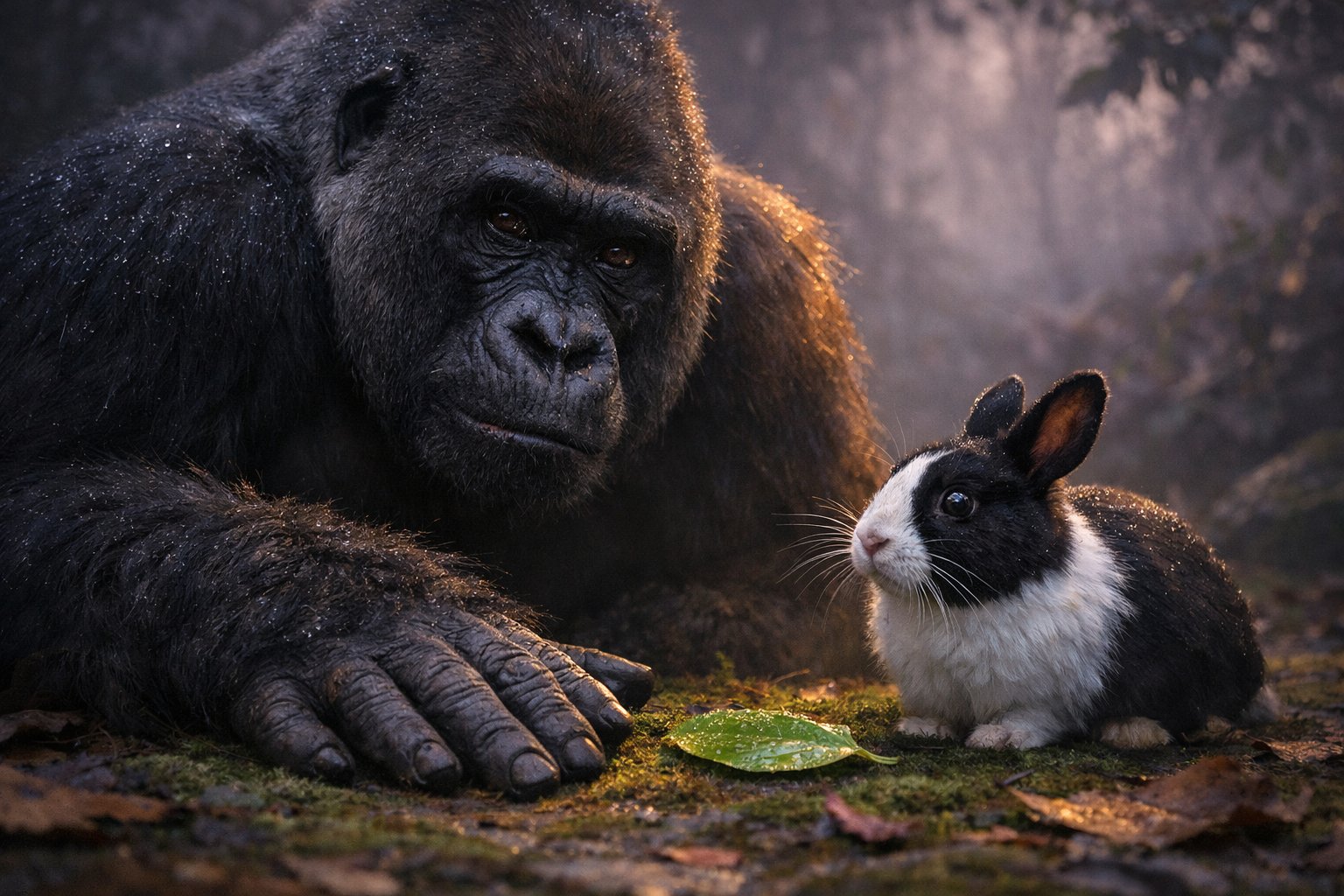
A gorilla and rabbit friendship is a documented cross-species bond, recorded most clearly at Pennsylvania’s Erie Zoo in 2012, where Samantha, an elderly western lowland gorilla, groomed and shared food with a Dutch rabbit named Panda. Ethologists read the pairing as affiliative behavior, not sentiment projected onto animals.
Published: June 5, 2026. Last reviewed: June 5, 2026.
A gorilla and a rabbit named Panda
In February 2012, keepers at the Erie Zoo in Pennsylvania introduced Samantha, a western lowland gorilla reported at about 47, to a black-and-white Dutch rabbit named Panda, and the two animals settled into daily company within weeks. The match drew wire coverage because it looked improbable. A great ape and a small lagomorph are separated by tens of millions of years of divergence, and nothing in their natural histories puts them in the same frame.
Samantha had lost her longtime companion, a male gorilla named Rudy, in 2005, and she lived alone for roughly seven years afterward. Her keepers judged her too old and too fragile to introduce to another gorilla, where dominance disputes can turn rough. A rabbit carried none of that risk. Panda could relieve the solitude without contesting Samantha for space, food, or rank.
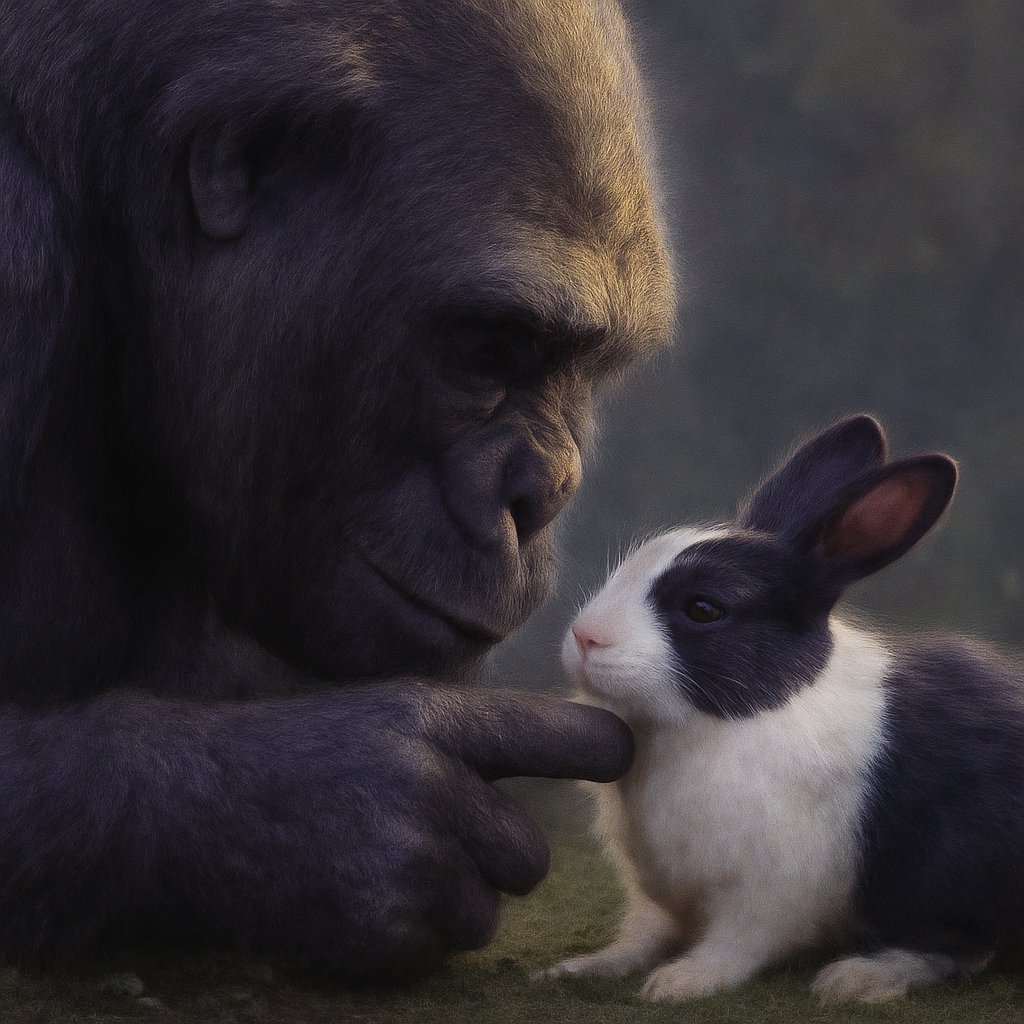
On the documentary record: the behaviors keepers reported are the kind an ethologist files as affiliative. Samantha scratched the rabbit under the chin. She shared her food. The Erie Zoo’s chief executive, Scott Mitchell, described how protective she became, noting that Samantha pushed a favorite stuffed toy aside so Panda could pass [1][2]. Samantha was euthanized in December 2012 after congestive heart failure, one of the oldest gorillas in North America at the time of her death.
What the keepers actually saw
Watch the animal, and watch what the animal does with its hands. A gorilla’s hand is a precision instrument, and chin-scratching is not random contact. It is directed grooming, the same gentle, repeated touch gorillas use on one another. Food-sharing is rarer still. Gorillas do not casually surrender food, so a gorilla setting some aside for a rabbit is a measurable departure from baseline feeding behavior.
Timing matters too. The bond did not appear the instant the rabbit arrived. Keepers introduced Panda gradually over weeks, which is the cautious, correct way to test whether two animals will tolerate each other. Rushed introductions fail, sometimes badly. This one was given room to either take or not, and it took.
None of this requires us to assume Samantha understood Panda as a friend in the human sense. It requires only that we record what she did: she tolerated proximity, she initiated gentle contact, and she modified her own resource behavior around a much smaller animal. Those are the observations. The interpretation comes second, and it comes carefully.
What counts as a cross-species friendship
A cross-species friendship, in ethology, is a nonsexual bond between animals of different species that is mutual, repeated, and stable over time, which separates it from a one-off encounter or a simple feeding arrangement. The bar is deliberately high. Bidirectional affiliation has to recur often enough to count as a relationship rather than an accident of an enclosure.
Barbara Smuts, a primatologist at the University of Michigan, gave the field its working method. In her 1985 study, Sex and Friendship in Baboons, she used grooming and physical proximity to decide which animals were friends, treating affiliation as something you measure rather than something you assume [5]. Anne Innis Dagg later gathered the cross-species cases into a single volume, Animal Friendships, in 2011, and argued that these bonds are far more common than the old instinct-only models predicted [6].
The distinction matters for how we read the Erie Zoo pairing. A single photograph of a gorilla beside a rabbit proves nothing on its own. What lifts it from a charming image to a behavioral observation is repetition: the same two animals, choosing proximity, day after day, with one of them adjusting its behavior to make room for the other.
Friendship versus mutualism
The popular telling vs the actual record: most “animal friendship” headlines describe mutualism, not friendship. A cleaner fish and a grouper cooperate because both gain a clear, practical benefit. That is an ecological partnership, and it explains itself. What Samantha and Panda had offered no obvious payoff. Neither animal got food, safety, or reproductive advantage from the other.
That absence of benefit is exactly what makes the pairing interesting, and exactly why a working biologist slows down before naming it. When the easy explanations are gone, what remains is affiliation for its own sake, which is the harder and more honest thing to study.
There is a quieter benefit a behaviorist will name without overclaiming. Company itself can be reinforcing for a social animal. A gorilla evolved to live in a group, and a stable, undemanding presence nearby may lower stress even when it offers nothing an economist would log. That is not mutualism. It sits closer to comfort, and comfort is a real variable.
Why a gorilla and a rabbit can get along
A gorilla and a rabbit can coexist calmly because neither animal reads the other as predator, prey, or rival: gorillas are herbivores with no prey-capture drive, and a rabbit has no reason to compete with one. That single fact removes the barrier that blocks most odd-couple pairings. A bond between a carnivore and a small mammal fights against a hunting instinct. A bond between a gorilla and a rabbit does not.
Gorillas are folivores, built around leaves, stems, pith, and fruit. The European rabbit, Oryctolagus cuniculus, is itself a generalist herbivore and the only lagomorph humans have ever domesticated, bred in southern France within roughly the last 1,500 years [13]. In the wild a rabbit is prey for eagles, lynx, and foxes. A gorilla is none of those things, so the rabbit’s deepest alarm response simply never fires.
Size helps as much as diet. Panda was small enough to pose no threat and quick enough to leave when she chose, so the rabbit kept the one thing a prey animal needs most near something large, which is an exit. A bond an animal can walk away from is also a bond it can choose to keep, and choosing is what separates a relationship from confinement.
The predator-prey axis, neutralized
Captivity supplies the rest of the conditions. Gordon Burghardt’s 2005 framework lists five criteria that separate play and relaxed affiliation from serious behavior, and the last one is decisive: the behavior appears when an animal is in a relaxed state, free of predation pressure and competition for food [8]. A well-fed gorilla in a stable enclosure meets that condition every day.
The signals line up, too. The relaxed open-mouth display, the primate “play face” first described in the ethology literature decades ago, works as a metasignal that says what follows is not a threat. Cross-species grooming, or allogrooming, reads the same way. Strip away the surprise, and the residue is a set of ordinary affiliative behaviors aimed at an unusual target.
Koko, All Ball, and the gorilla capacity for attachment
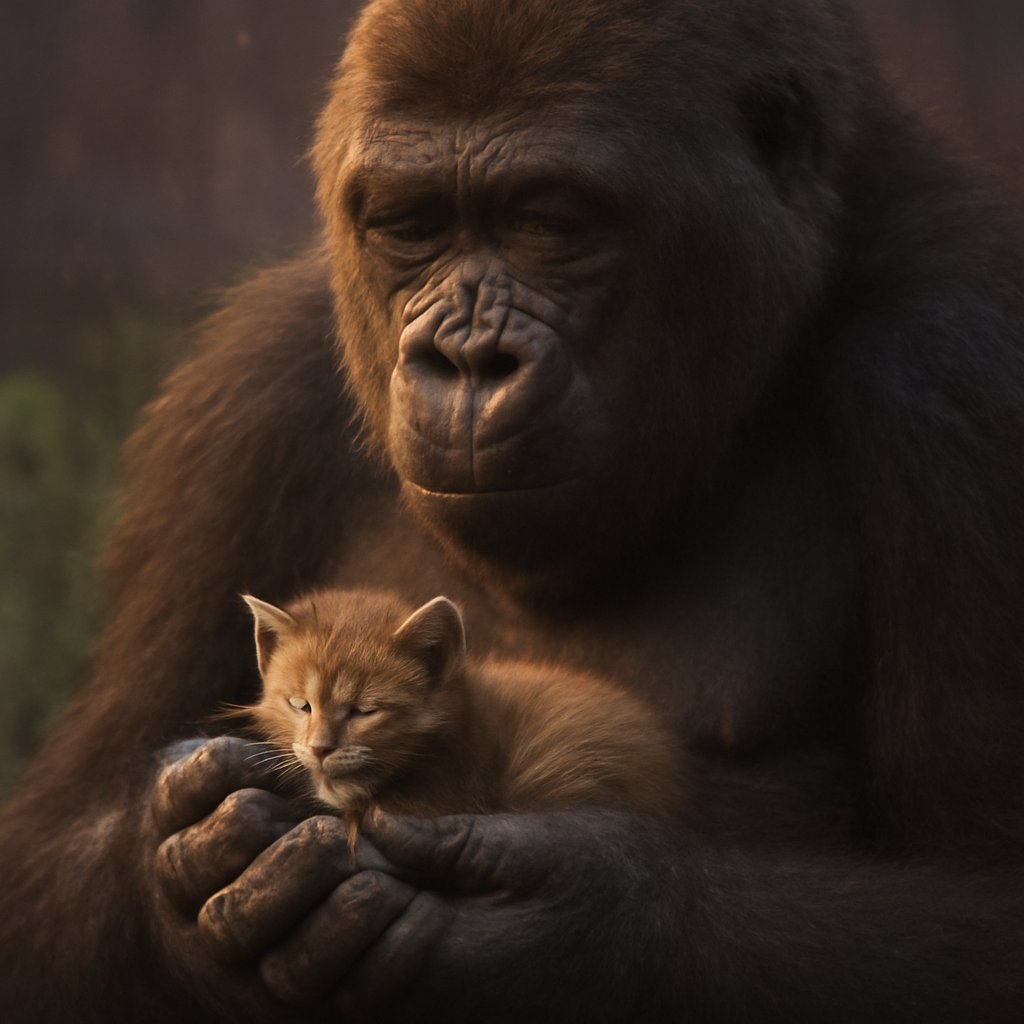
Koko, a western lowland gorilla taught sign-based communication by Francine Patterson, chose a kitten she named All Ball in 1984 and groomed, carried, and tried to nurse it as if it were an infant. When the kitten was killed by a car, Koko signed words her caregivers read as grief, including “sad” and “cry,” for months afterward [3][4]. Decades later she selected new kittens from a litter, which suggests the attachment was a trait, not a one-time accident.
What makes Koko useful as evidence is the grief, not the cuddle. Affection toward a kitten could be read as play and set aside. A months-long behavioral change after a loss is harder to dismiss, because it tracks the same pattern primatologists document when gorillas lose kin. The attachment had weight, and the weight showed when the attachment ended.
The point Koko makes is not that one gorilla was exceptional. It is that the capacity for cross-species attachment sits inside ordinary gorilla cognition, waiting on the right conditions to show. Samantha with Panda and Koko with All Ball are two readings of the same instrument.
Empathy on the record
Two other episodes anchor the point in events with witnesses. At Brookfield Zoo in 1996, an eight-year-old gorilla named Binti Jua cradled a three-year-old boy who fell into her enclosure and carried him to the keepers’ door [7]. At the Dian Fossey Gorilla Fund’s Karisoke Research Center in 2012, juveniles Dukore and Rwema, working with a young male named Tetero, dismantled poacher snares days after a snare killed an infant gorilla named Ngwino [9]. One is care directed outward; the other is cooperative problem-solving. Both widen the range of what gorillas plausibly do.
| Gorilla | Companion or subject | Place | Year | Behavior recorded |
|---|---|---|---|---|
| Samantha | Panda (Dutch rabbit) | Erie Zoo, Pennsylvania | 2012 | Chin-grooming, food-sharing, protective proximity |
| Koko | All Ball (kitten) | The Gorilla Foundation | 1984 | Nurturing, carrying, signed grief after loss |
| Binti Jua | Three-year-old child | Brookfield Zoo, Illinois | 1996 | Cradled and carried the child to keepers |
| Dukore, Rwema, Tetero | Poacher snares | Karisoke, Rwanda | 2012 | Cooperative dismantling of snare traps |
Reading the bond without overreading it
Careful ethology holds two ideas at once: a gorilla and a rabbit can form a real affiliative bond, and a human watching it will be tempted to narrate more meaning than the behavior supports. Both errors are easy. One sentimentalizes the animal into a furry person; the other denies it any inner life at all.
Two things get conflated here: affiliation, which we can observe and count, and friendship as humans mean it, which we can only infer. Frans de Waal spent a career warning against the second error in its negative form, which he called anthropodenial, the refusal to grant animals capacities the evidence supports simply because the animals are not human [7]. E.O. Wilson framed the human side of the pull as biophilia, the innate tendency to focus on life and lifelike processes [12]. We are wired to watch this, which is a reason to watch it honestly.
Companionship, welfare, and what is at stake
There is a welfare reading worth keeping in view. A rabbit is companionship for a solitary, aging gorilla, not a replacement for her own kind. The pairing relieves loneliness; it does not undo the loss of a conspecific. The western lowland gorilla is listed by the IUCN as Critically Endangered, with a population estimated around 316,000 and declining by roughly 2.7 percent a year toward a projected loss of more than 80 percent across three generations [10][11]. The same species that charms us with a bunny in Erie is disappearing from the forests of Central Africa.
So watch Samantha and Panda for what they were: two animals that found calm in each other’s company under conditions that made calm possible. That is enough. For more field readings of animals doing the unexpected, see the broader study of Animal Anomaly Mysteries, the related notes in Wren Ashby’s field work, and the other cases catalogued across our animal anomaly archive. The animals earn the courtesy of accurate observation before any human conclusion.