By Emilia Wellesley · Published May 4, 2026 · Updated May 13, 2026
Last reviewed: May 4, 2026.
The Sumerian King List stands as a pivotal document for both historians and archaeologists, providing a chronicled record of rulers that shaped early Mesopotamian civilization. This text not only details kings and their reigns but also intertwines mythology with historical fact, offering a unique glimpse into Sumerian culture and governance.
Composition and Discovery of the Text
Origin and Material
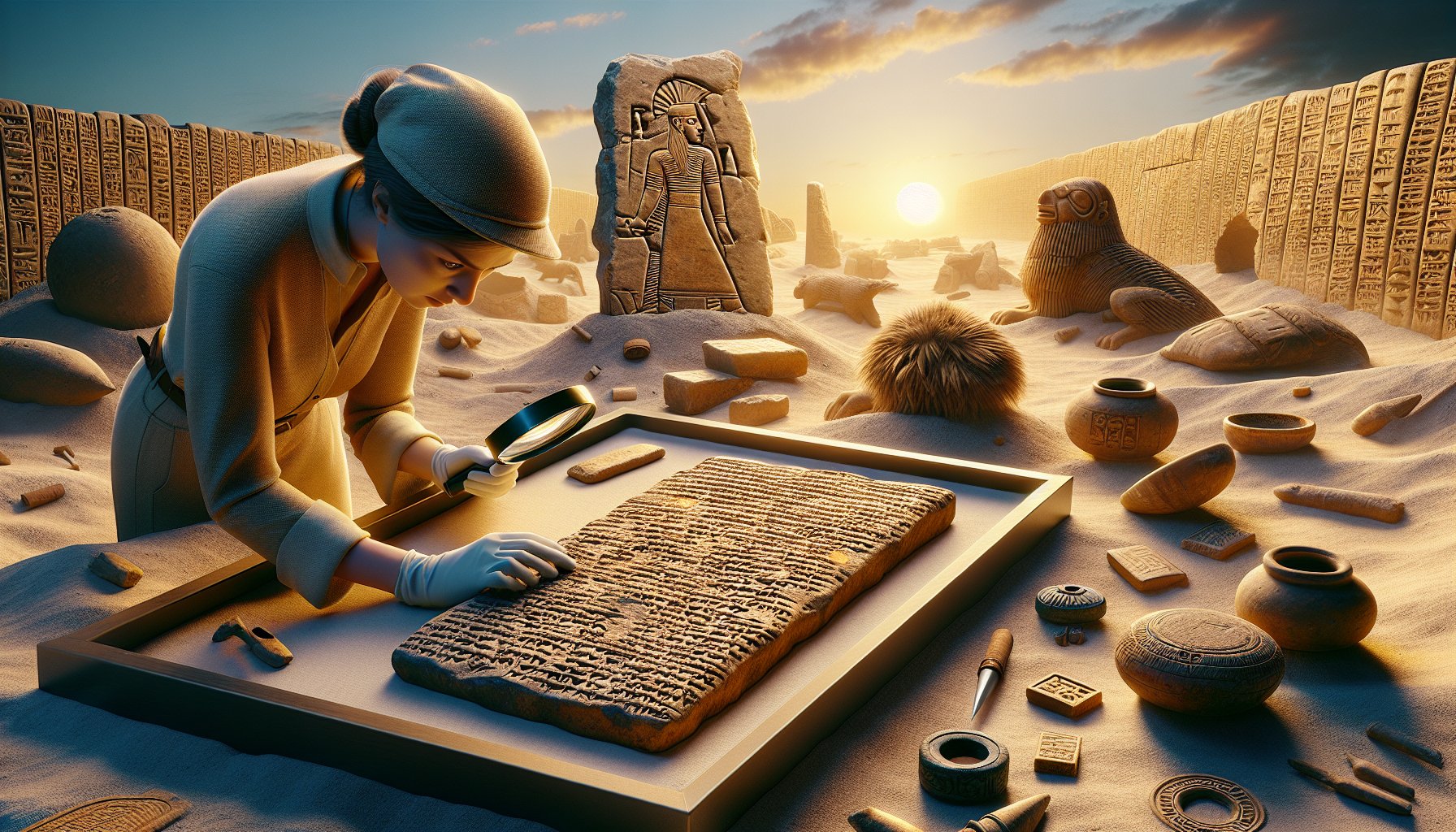
The enigma of the Sumerian King List begins with its material composition, primarily consisting of clay and stone. These materials not only underline the durability intended by its creators but also reflect the technological capabilities of ancient Sumer. The list, being a significant historiographical compilation, was meticulously inscribed in cuneiform, the wedge-shaped script that was among the earliest writing systems in the world. Here, the script did more than just convey information; it preserved a cultural legacy that has transcended millennia.
Archaeological Findings
The proliferation of the King List's fragments across various locations underscores the expansive reach and influence of Sumerian civilization. These fragments have been unearthed from Ashur to Nippur, and most notably at sites such as Warka—ancient Uruk; each new discovery adds a piece to the puzzle of Sumerian historiography. Particularly riveting was the find at the ancient site of Larsa, which unveiled a well-preserved segment of the list, almost as if it were waiting to fill in the blanks of historical narratives long considered complete. This pattern of discovery not only highlights the King List’s geographical spread but also the interconnectedness of various Sumerian city-states, weaving a tapestry of a civilization highly advanced for its time.
Structure and Features of the King List
Listing Methodology
The Sumerian King List employs a straightforward yet sophisticated method of documenting the chronology of rulers. Organized primarily by dynasty and city-state — from Uruk to Ur and beyond — each section typically begins with the phrase, "When (city) was the kingship seat," transitioning into a list of monarchs and the duration of their reigns. The meticulous recording of regnal years serves not only as historical data but also as a tool to measure the ebb and flow of political power across regions and time periods. It's crucial to recognize the implications of these recorded reign lengths; they often extend beyond mere temporality, hinting at the stability or volatility of the period.
Integration of Mythology
Distinctly notable in the Sumerian King List is the interweaving of mythology with factual history, creating a rich tapestry that reflects the Sumerians' worldview. The List does not shy away from featuring mythical rulers such as Etana, the shepherd who ascended to heaven, alongside verifiably historical figures like Ur-Namma, the originator of the earliest law code. This amalgamation underscores the Sumerians' perception of divine kingship, where the mandate to govern was often intertwined with mythical heroism and divine descent. Analyzing these elements allows us to delve into how legends and real events collectively shaped the cultural and sociopolitical fabric of ancient Sumer.
Through this exploration of listing methodologies and the integration of myth within the Sumerian King List, we gain profound insights into the administrative, cultural, and spiritual nuances of ancient Mesopotamian civilization. This document is not merely a list but a mirror reflecting the complexities and depths of Sumerian society.
The section on the "Historical Context and Significance" delves deeply into the multifaceted implications of the Sumerian King List, unraveling how it not only chronicles a lineage of sovereigns but also subtly enmeshes the cultural and political ethos prevalent during the ancient Sumerian era. This part of the article spans across various aspects ranging from divine kingship to the educational outcomes steered by the king list in historiographical practices.
Divine Kingship and Governance
One cannot overstate how pivotal the concept of divine rule was in defining the rulership and administrative structure of ancient Mesopotamian civilizations. The Sumerian King List is sprinkled generously with rulers presented not just as sovereigns but as semi-divine entities, holding reign lengths that span into millennia. This hyperbolic depiction goes beyond mere record-keeping; it was a tool, a means to enshrine and rationalize the divine right of kings to govern. By embedding such mythical kingship alongside historical figures, the list blurred the lines between myth and reality, creating a dynastic narrative that justified and perpetuated the sanctity and supremacy of current rulers. Analyzing key figures like Alulim and Urukagina within the list illuminates their roles not merely as leaders but as ordained by divine forces, thereby validating their rule as a continuance of a celestial mandate.
Tool for Legacy and Legitimization
Beyond its role in cultural transmission, the Sumerian King List functioned significantly as a political instrument. Successive dynasties utilized the list to legitimize their rule amidst the fragmented political landscapes of ancient Mesopotamia. For instance, rulers from the Ur dynasty saw themselves as direct successors to the influential figures listed, thus appropriating the ancient sanctity and regnal validation the list afforded. It transcended the boundaries of a mere historical record, evolving into a living document that endorsed new reigns under the guise of ancestral approval. In essence, each ruler who took the throne and was added to the list wove themselves into the very fabric of Sumerian divinity and heritage, ensuring their governance was seen as a continuation of divine will as much as a conquest or inheritance.
Together, these discussions spotlight how the Sumerian King List is more than a static artifact; it's a dynamic testament to the intertwined realms of religion, politics, and history in ancient Mesopotamia. By charting the divine qualifications of royalty and their politically motivated legacies, the List offers a lens through which the structure and evolution of one of the world's earliest civilizations can be comprehensively understood. This analysis not only adds depth to our understanding of Sumerian political doctrine but also enriches the broader discourse on how ancient societies utilized narrative to govern and justify power.
Key Figures in the Sumerian King List
The Sumerian King List delineates a fascinating tapestry that extends from mythical to established historical rulers. Through its accounts, the list not only offers a chronological sequence of monarchs but also serves as an interpretive prism through which the perception of kingship, both divine and terrestrial, can be glimpsed in ancient Mesopotamian culture.
Legendary Rulers
At the outset, the Sumerian King List introduces a sequence of antediluvian kings, famed not merely for their purportedly mythical attributes but also for their extraordinarily elongated reigns. For instance, Alulim, the first king of Eridu, is reputed to have ruled for a staggering 28,800 years. Such durations, while confounding to modern scholars, underscore the integration of the mythical within the historical framework used by the Sumerians, perhaps intended to amplify the divine origin or supernatural qualities of these early monarchs.
This segment of the list reiterates not only the monarchs’ superhuman lifespans but also their assignments in prominent cities like Eridu and Uruk, pivotal in the development of early Mesopotamian civilization. The narratives encapsulating figures like King Etana of Kish, known mythologically for his ascent to heaven in search of the plant of birth to grant him a son, further blur the lines between the celestial and the civic duties of kingship.
Historical Kings
Transitioning from the antediluvian to the postdiluvian rulers provides a narrative shift towards a semblance of historical tangibility. Following the mythical Great Flood, which serves as a delimiter in the King List, the text records kings whose reigns assume more plausible durations and whose contributions are verifiable through archaeological records.
The era post-flood witnesses monarchs like King Ur-Namma of Ur, heralded for instituting one of the earliest known law codes predating Hammurabi’s. This codification marked a significant advancement in the structuring of societal norms and underscored the shift from divine rule to temporal governance, though still perceived as divinely sanctioned. His inclusion in the King List ties the theological with legislative advancements, indicating a move towards civilization characterized by organized and sanctioned rule.
The historical segment further outlines the dynastic successions in regions documented within the King List, such as Uruk under King Gilgamesh, who later figures prominently in Mesopotamian mythology through the Epic of Gilgamesh. These narratives highlight not only the king’s heroic feats but also his diplomatic engagements and urban development initiatives, reflective of the multifaceted roles these ancient monarchs played.
This section of the Sumerian King List reflects a pivotal transition from mythical sovereignty to recorded history, offering invaluable insights into the cultural and political milieu of ancient Mesopotamia. Through figures both legendary and historically attested, the list encapsulates the evolution of kingship, anchoring it in both the celestial realm and grounded reality, thereby providing a comprehensive view of the ancient political landscape shaped by these formidable rulers.
Comparative Analysis with Other Ancient Texts
Similarities with Other King Lists
Carving deeper into the bedrock of ancient documentation, a comparative glance at Akkadian and Babylonian King Lists unveils a fascinating tapestry of ancient regnal documentation. Both the Akkadian and Babylonian realms, much like their Sumerian predecessors, left behind chronicles of their royal heritage. However, while the Sumerian King List integrates kings from diversified city-states under a quasi-mythical umbrella of divine kingship, Akkadian and Babylonian lists often delineate a more streamlined genealogical approach primarily focusing on territorial expansions and military exploits.
The Babylonian King List, for instance, lacking the mythological elements that are prevalent in the Sumerian documentation, chooses instead to focus on empirically verifiable sovereigns, thus portraying a transition from divine right towards a temporal leadership legitimacy. This shift highlights a broader Mesopotamian evolution from theocratic to more secular governance systems where divine mandates are less emphasized in the face of growing urban-political landscapes.
Interconnections with Global Mythologies
Strikingly, the Sumerian King List's mention of the Great Flood — a cataclysmic event separating its antediluvian and postdiluvian chapters — echoes similar narratives found across various global cultures, making it a point of pivotal academic interest. The flood myth, deeply embedded in the Sumerian cultural subconscious also features prominently in the Epic of Gilgamesh, a literary masterpiece that transcends its geographical origins, resonating with other legendary deluges such as those described in the Hindu texts, Greek mythology, and even the Biblical story of Noah's Ark.
These narratives, while geographically and culturally disparate, converge on themes of divine retribution and subsequent renewal, providing a comparative framework that helps scholars understand how ancient civilizations perceived and internalized natural catastrophes. Such myths served to knit communities together, offering shared moral and ethical concerns that arguably laid down the foundational premises of societal law and order as seen in later historical periods.
Addressing Comprehensive Narratives and Chronological Overlaps
In these intertextual comparisons, overlaps in royal chronology often represent not merely a succession of rulers but also reflect dynamic shifts in cultural narratives, societal structure, and political dominion. For instance, to understand the reigns described within the Sumerian texts, one might look at the overlapping periods in the Akkadian Empire lists, where names of rulers and their deeds often serve as historical corollaries, emphasizing the interconnectedness of Mesopotamian city-states.
By juxtaposing these lists, historians and archaeologists can piece together a more holistic view of ancient Near Eastern monarchies, noting where narratives align or diverge, and thus shedding light on the fluid nature of historical truth versus mythological embellishment. This comparative analysis not only enriches our understanding of Sumerian historical context but also enhances our appreciation for the broader cultural and political landscape of ancient Mesopotamia.
Through meticulous cross-referencing and nuanced interpretations, this section has provided an expansive view into the complex narrative tapestries woven by ancient civilizations. This deep dive into comparative mythology and historical documentation underscores our perpetual quest to decipher the truths buried within the annals of time, offering a mirror into the past that reflects back profound insights into our collective cultural heritage and historical consciousness.
Scholarly Interpretations and Debates
Interpretation Challenges
Interpreting the Sumerian King List is no walk in the park. Scholars grapple with several hurdles when deciphering its ancient script. Firstly, transliteration—converting cuneiform into readable text—is fraught with difficulties due to the nuanced nature of the script and the potential for multiple interpretations of a single symbol. This variability can lead to significant discrepancies in the understanding of names and titles of the rulers listed, complicating the clear-cut reconstruction of Sumerian history.
Timelines present another thorny issue. Pinning exact dates to the reigns described poses a tough challenge, especially given the mythical durations attributed to antediluvian kings. For instance, King Alulim’s reign is described as lasting 28,800 years! Historical chronology often bumps heads with mythology here, leading to vigorous scholarly debate about whether these durations should be read symbolically rather than literally.
Modern Relevance
Despite these challenges, the King List remains a cornerstone document for both historiography and Assyriology. It provides invaluable insights into the structure and evolution of early Mesopotamian government and society. The concept of divine kingship, implicit through the regnal years and divine ancestry listed, helps modern scholars grasp the intertwining of the temporal and the spiritual in Sumerian governance.
Moreover, the King List has had a lasting impact on the field of Assyriology, offering a framework for understanding not just the political history of Sumer, but also its cultural and spiritual life. It serves as a primary source in the comparative analysis of ancient civilizations, shedding light on how power and heritage were recorded and legitimized.
These academic explorations not only enrich our understanding of Sumerian culture but also underpin the methodologies used in modern historiography. Discussions in archaeological journals and major international conferences often hinge on interpretations of such texts, informing broader theories about how ancient societies were organized and how they evolved.
In essence, the challenges of interpretation and the debates they engender are crucial for a dynamic and evolving understanding of ancient Mesopotamian civilizations. They spur ongoing research and discussion, ensuring that the Sumerian King List remains relevant in both scholarly circles and broader discussions about the origins of recorded human history.
Implications for Cultural Heritage
The Sumerian King List, beyond its immediate scholarly appeal, carries significant weight in the discourse surrounding the preservation of cultural heritage. This ancient compendium of kings serves not just as a historical record but as a bridge connecting contemporary societies with their ancient forebears. The implications of this connection are profound, particularly in the domains of cultural preservation and education.
Preserving the Threads of Ancient Narratives
Given its age and the fragility of materials like clay and stone, the Sumerian King List is vulnerable to both natural decay and human interference.
- Concerted Preservation Efforts: Institutions like the British Museum and the University of Pennsylvania Museum of Archaeology and Anthropology are at the forefront, utilizing minimally invasive conservation techniques to stabilize and preserve the inscriptions while maintaining their originality.
- Digital Archiving Initiatives: Projects that create digital scans and 3D models of the King List tablets allow for wider accessibility and help protect the physical artifacts from overexposure to handling and environmental factors.
Educational Engagement and Historical Literacy
The role of the Sumerian King List in education extends beyond the confines of archaeology and history classes.
- Broad Educational Tool:
- It serves as a compelling tool for engaging students with concepts of governance, mythology, and historiography in ancient civilizations.
- Integration into curricula helps provide a tangible connection to the past, fostering a deeper appreciation for the continuity and evolution of human societies.
- Use in Higher Education:
- In courses on the Ancient Near East, the King List helps illustrate dynastic succession, the intertwining of myth and history, and divine rule concepts, enriching students' understanding of these elements.
- Through comparisons with other ancient texts, like the Babylonian King List or biblical genealogies, students engage in comparative historical analyses, developing critical thinking skills.
Challenges and Opportunities in Cultural Transmission
The transmission of knowledge from the Sumerian King List also faces challenges, particularly in the realm of language barriers and the specialized nature of cuneiform translation.
- Enhancing Accessibility: Efforts to make these texts accessible through translations and detailed commentaries are crucial in bridging the gap between specialist knowledge and public understanding.
- Educational Programs: Workshops designed to teach the basics of cuneiform writing to a broader audience can demystify this ancient script, making the texts more approachable and less esoteric.
In conclusion, the Sumerian King List is more than a simple list of names and reign lengths; it is a cornerstone of cultural heritage that offers insights not only into ancient kingship but also into the values and organizational structures of one of history's earliest civilizations. Through preservation and educational efforts, this valuable historical resource continues to enlighten and inspire, proving that the ancient texts still hold relevant lessons and endless intrigue for the modern world.