By Emilia Wellesley · Published May 4, 2026 · Updated May 13, 2026
Last reviewed: May 4, 2026.
The Ark of the Covenant holds significant religious symbolism as a sacred artifact of ancient Judaism, believed to house the Ten Commandments. As both a historical mystique and biblical artifact, it has intrigued scholars and believers worldwide.
The Biblical Account of the Ark
Construction and Craftsman
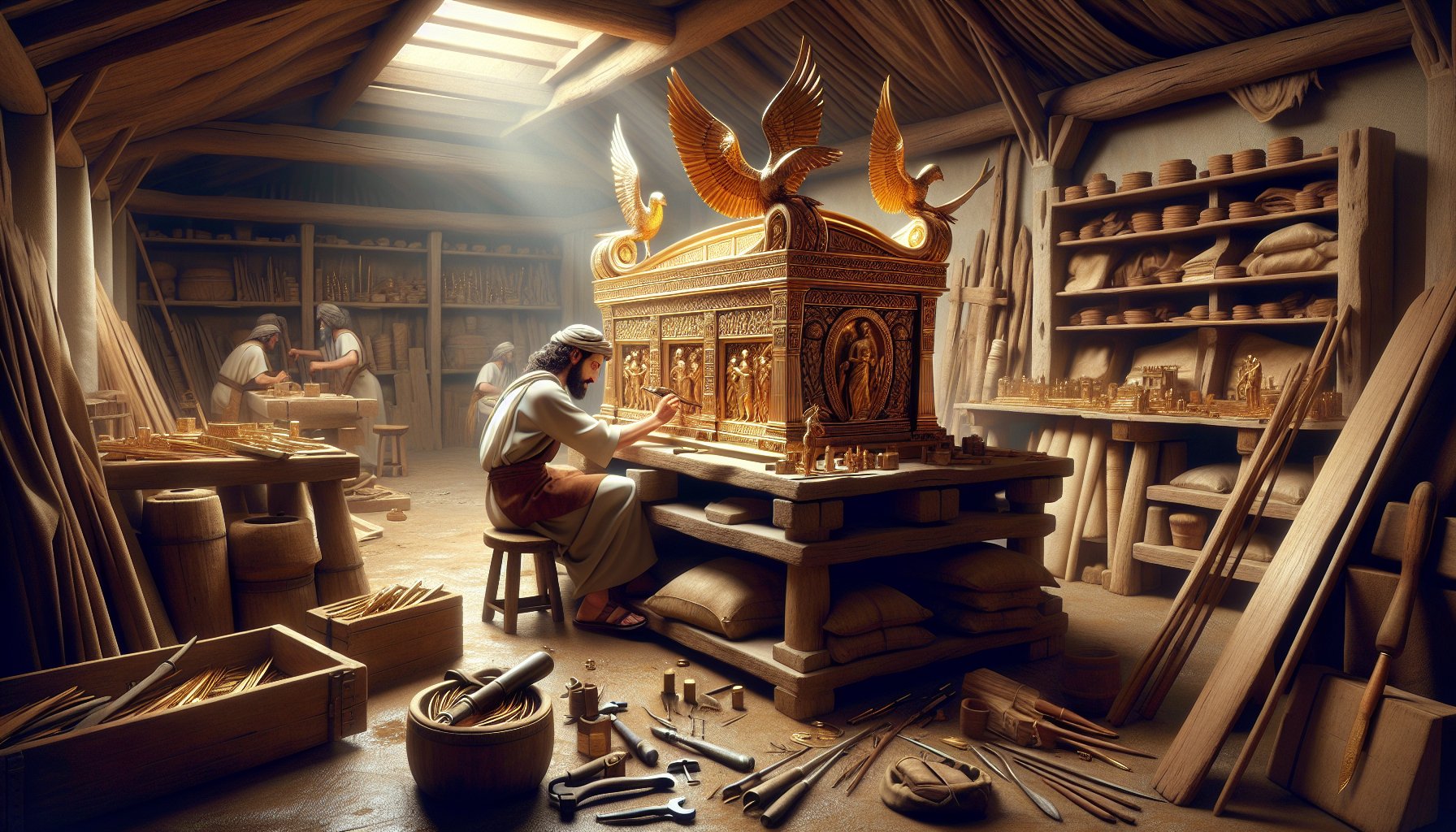
Bezalel, appointed as the chief artisan by divine command, was tasked with constructing the Ark of the Covenant, with strict instructions provided directly by God. This critical piece of biblical history, described in the Book of Exodus, outlines the meticulous specifications for the Ark:
- Materials Used: Constructed from acacia wood.
- Dimensions:
- Length: 2.5 cubits
- Width: 1.5 cubits
- Height: 1.5 cubits
- Design Features:
- The Ark was to be overlaid inside and out with pure gold.
- Adorned with a golden crown border around it.
- Decorative Elements: Two gold-plated cherubim with outspread wings, facing each other, were to sit atop the Ark, shadowing the mercy seat—an ornate lid regarded as God's throne.
Features and Significance
The Ark of the Covenant wasn't just a mere container; it was emblematic of the Divine presence and served as a tangible illustration of God's covenant with the Israelites. It housed several profoundly significant items:
- Tablets of Stone: On these were inscribed the Ten Commandments, symbolizing God’s law and His agreement with Moses and the Israelites at Mount Sinai.
- Additional Sacred Objects:
- A golden jar holding manna
- Aaron's staff that budded
These items underscore the Ark's critical role not just as a religious symbol but as a cornerstone of faith, law, and divine leadership in ancient Judaism.
Its significant presence and role in various biblical events highlight its importance:
- Battle of Jericho: It is believed that the presence of the Ark alone led to the miraculous collapsing of the city's walls after it was carried around them by priests for seven days.
- Crossing the Jordan River: The Ark was present during the crossing into the Promised Land, symbolizing God’s ongoing guidance and support.
- Resting Place: The Ark was kept in the Holy of Holies in Solomon's Temple, further elevating its status and intertwining it with the very identity and spiritual journey of the Israelites.
Thus, the Ark represents not only religious tradition and the direct word of God but also a historical lineage and the eternal covenant between God and His people.
The Ark's Journey and Purpose
As the heart of numerous biblical events, the Ark of the Covenant's trajectory through time is marked not only by its geographical journey but also by its defining role in the spiritual and communal life of the ancient Israelites.
Historical Journey
Originating at the revered Mount Sinai, where amid thunder and lightning, Moses received the divine commandments, the Ark's very essence was forged in the presence of God. According to scriptural accounts, particularly from the Book of Exodus, the Ark was constructed by Bezalel and Oholiab who followed God's intricate instructions.
Its primary intent was:
- To house the Tablets of Stone inscribed with the Ten Commandments, serving as a tangible embodiment of the divine pact between God and His people.
From Sinai, the Ark was carried through arduous desert travels encased within the Tabernacle, a mobile sacred sanctuary. This journey was:
- Not merely a physical relocation but a spiritual expedition
- Solidified the Israelites' faith and unity
Eventually, the Ark found its way to the Holy of Holies in the Temple of Solomon in Jerusalem, where it was revered and maintained as the core of Israelite worship.
Religious and Ceremonial Role
The Ark's presence was pivotal in several biblical events, underscoring its role as much more than an ornate container. It served as:
- A war chest leading Israelites to miraculous victories
- A sacred artifact that induced both reverence and fear
Significant events include:
- The Battle of Jericho: Walls collapsed following the Ark’s seven-day procession.
- Turmoil on the Philistines: Showcases its formidable divine association upon its capture.
Throughout varied ceremonies, the Ark was a central figure. Its mere presence was considered a direct conduit to the divine, with the Shekinah Glory, or the manifested presence of God, appearing as a cloud above the mercy seat. It represented:
- God’s guidance
- Favor
- Judgment when necessary
Acting as a powerful religious symbol, it reminded the Israelites of their covenant with God. The Ark's influence waned only with its mysterious disappearance post the destruction of Solomon's Temple, leaving behind a historical and theological void that has intrigued scholars, believers, and adventurers alike for millennia.
Through these narratives and roles, the Ark of the Covenant has been cemented as a cornerstone of Judaic heritage, continuing to inspire exploration and reverence within religious and historical contexts.
Speculations and Theories on the Ark's Location
Historical Theories
Now, here's where the tale spins a web of intrigue and mystery. The Ark of the Covenant, a central artifact of ancient Judaism and arguably one of the most compelling religious symbols, has left historians scratching their heads over its possible resting places over the centuries. From the moment it left King Solomon's Temple, where it was reportedly housed in the "Holy of Holies," the narrative of the Ark evolves into a series of theories and speculation matched by few historical artifacts.
The destruction of the First Temple by the Babylonians in 587 BCE marks one of the last reliable historical mentions of the Ark. This catastrophic event stirred numerous theories about the Ark's fate—was it destroyed, hidden, or taken? Some scholars suggest that the Ark might have been spirited away to prevent its destruction by the invading forces. This theory is bolstered by the lack of any mention of the Ark in the records of the treasures looted by the Babylonians, an omission that hints at its possible removal prior to the siege.
Another scholarly pursuit points towards a hidden chamber constructed beneath the Temple Mount—King Solomon's own contingency plan to shield the Ark from potential threats. However, political and religious sensitivities surrounding this site have led to limited archaeological exploration, leaving this theory simmering in uncertainty.
Modern-Day Theories
Stepping into the present, the Ark's whereabouts ignite discussions that span from scholarly debates to public fascination. A particularly persistent theory ties the Ark to the Ethiopian Orthodox Church, which claims the Ark resides within the Chapel of the Tablet at St. Mary of Zion Church in Axum, Ethiopia. According to local tradition, it was brought there by Menelik I, the son of King Solomon and the Queen of Sheba. This narrative is deeply woven into the fabric of Ethiopian Christianity, making the location a site of pilgrimage and fervent religious activity.
The narrative then shifts to western medieval legends, where the Knights Templar are said to have been the custodians of the Ark at some point. Some propose that the Templars, renowned for their role during the Crusades, might have discovered the Ark hidden beneath the Temple Mount and transported it to an undisclosed location, possibly Europe, where it remains hidden to this day. These theories, though popular in speculative history circles, often tread on the edges of documented historical evidence and archaeological findings.
Across these discourses, the Ark remains enveloped in a cloak of mystery, not just as a lost artifact but as a profound emblem of divine presence and historical mystique. As theories abound and the search continues in both academic and adventurous spheres, the Ark of the Covenant persists as a compelling subject of ancient narratives, inspiring a blend of faith, curiosity, and scholarly exploration. Ungrounded theories aside, the quest for the Ark taps into a deeper human drive to connect with our sacred past and the profound mysteries it holds.
Artifact's Representation in Popular Culture
In the realm of popular culture, the Ark of the Covenant transcends its biblical and historic origins, gaining a status almost mythic in scale, largely due to its dramatic portrayal in the blockbuster film 'Raiders of the Lost Ark'. Directed by Steven Spielberg and debuted in 1981, this film catapults the Ark into the limelight not merely as a religious symbol but as a centerpiece of adventure and mystery. Spielberg’s rendition of the Ark, imbued with formidable and deadly powers, captures the imagination of a global audience, rendering the Ark a pop culture icon.
The visual representation in 'Raiders of the Lost Ark', complete with its supernatural phenomena, significantly amplifies the Ark's mystique and continues to influence how it is perceived by the public. Moreover, this portrayal sparks a renewed interest in the Ark’s historical and theological studies, inspiring various forms of media like books, documentaries, and even themed-entertainment experiences. Each iteration explores different dimensions of the Ark, from its historical origins to its theoretical whereabouts, reflecting an ongoing fascination with this ancient artifact.
Moreover, Indiana Jones' quest for the Ark, fraught with danger and driven by a noble purpose, mirrors the real-world intrigue and speculative adventures surrounding the Ark’s actual history. This blending of fiction and historical speculation opens up discussions and debates on what the Ark truly represents from a cultural and historical perspective, beyond its scriptural significance.
The enduring legacy of this cinematic portrayal is also evident in how it shapes the collective memory and curiosity about the Ark. Annual film screenings, fan conventions, and discussions in online forums attest to the deep-seated curiosity and entertainment value the Ark holds in popular consciousness.
As the Ark continues to be a fixture in cultural dialogues and artistic endeavors, it stands as a testament to the powerful interplay between historical artifacts and their reinterpretations in popular media. This interaction not only entertains but also educates and engages diverse audiences with the layers of meaning associated with the Ark of the Covenant, maintaining its relevance in contemporary discourse.
Theological Symbolism and Modern Representation
Religious Importance in Judaism
The Ark of the Covenant isn't just an ancient artifact; it represents a profound spiritual symbol within Judaism. Traditionally believed to house the Tablets of Stone, which Moses received from God at Mount Sinai, its presence epitomized the Divine contract with the Israelites—God's laws handed down to guide them. Every year, on Yom Kippur, the High Priest would enter the Holy of Holies where the Ark was kept. Here, amidst rituals shrouded in reverence and mystery, he would seek atonement for the people's sins, symbolizing a direct divine dialogue.
The Ark's journey through the desert, safeguarded in the Tabernacle, and its final rest in the Temple of Solomon underpin narratives of divine guidance and protection. It wasn't merely a ceremonial object but a tangible representation of God's ongoing presence and shelter to the Israelites during their formative years as a nation. Historians and theologians both point to these narratives as fundamental in understanding the covenantal relationship described in the Old Testament, thereby underscoring the Ark's enduring religious importance.
Symbolic Replicas and Cultural Adaptations
Modern interpretations of the Ark extend beyond its original religious context, permeating cultural and religious life in diverse ways. In contemporary Jewish practice, the Ark's symbolism is echoed in the synagogue's Ark (Aron Kodesh), which houses the Torah scrolls. This modern adaptation underscores the Ark's lasting legacy as a sacred object, symbolizing a living covenant between God and the people of Israel.
Replicas of the Ark also feature prominently in processions and exhibitions, serving as powerful visual reminders of spiritual heritage. These replicas, often meticulously crafted based on biblical descriptions, are not merely historical recreations but serve as focal points in religious education and celebration. They help bridge ancient traditions and modern faith practices, making the stories and laws of the Old Testament accessible and relevant to current and future generations.
Furthermore, cultural adaptations of the Ark's narrative illustrate its profound impact on broader religious and philosophical thoughts. Its depiction in literature, art, and film often explores themes of divine power and human responsibility. Each portrayal invites audiences to ponder the deeper meanings of divine presence and morality.
The Ark of the Covenant remains a vibrant symbol within Judaism and an object of fascination in wider cultural contexts, embodying both a historical artifact and a continuing narrative of faith and divine presence.
Archaeological Pursuits and Scholarly Debates
Exploration and Hypotheses
The search for the Ark of the Covenant has spawned numerous archaeological digs and investigative missions across various purported historic sites.
- Focus Areas:
- The Levant: Particularly around the ruins of ancient Jerusalem and the Temple Mount. Believed by many to have once housed the Ark in the Holy of Holies during Solomon's Temple era.
- Ethiopia: Teams are drawn by claims within the Ethiopian Orthodox Church that the Ark resides within the Chapel of the Tablet, next to St. Mary of Zion Church in Axum. A designated monk, who is the sole caretaker, reinforces these claims, with no public viewings.
Legends persist about hidden tunnels and chambers beneath the temple complex, potentially harboring sacred relics.
Scholarly Contention and Interpretations
The perennial quest to pin down the Ark's location has not only fueled expeditions but also vigorous academic debates among historians, archaeologists, and theologians.
- Destroy or Hidden?: While some scholars argue the Ark was destroyed or lost over millennia, others theorize it was hidden to prevent desecration or theft, especially during events like the Babylonian invasion, which led to the destruction of the First Temple.
- Role of the Knights Templar: A subset of historians propose that the Knights Templar, during the Crusades, could have moved the Ark to an undisclosed location. This theory often includes links to various European or even North American sites.
Discussions are often enhanced by references to the Copper Scroll and other apocryphal texts, believed by some to hold coded clues to the Ark’s final resting place.
Impacts on Religious Studies and Archaeology
These ongoing investigations and debates do more than just seek the Ark; they challenge and often question narratives held sacred in biblical scripture.
- Broader Implications: Each theory or discovery can reshape our understanding of ancient religious practices and intercultural interactions.
- Technological Advancements: Tools such as satellite imagery and ground-penetrating radar have brought scientific rigor to what was once speculative, aiding in the extraction of new data sets that support or debunk existing hypotheses.
A Fusion of Faith and Facts
In essence, the quest for the Ark represents a fascinating intersection of faith, history, and science. Each archaeological dig and scholarly debate enriches the narrative, contributing to the cultural and historical understanding of one of the most enigmatic religious symbols in human history. Whether the Ark of the Covenant is ever found or remains lost to the sands of time, its story continues to inspire, mystify, and provoke scholarly intrigue across the globe.