By Emilia Wellesley · Published May 6, 2026 · Updated May 13, 2026
What Was the Lost Franklin Expedition?
The Lost Franklin Expedition was a British naval voyage that left England in May 1845 under Sir John Franklin (1786-1847) to chart the final unmapped link of the Northwest Passage. Two reinforced ships, HMS Erebus and HMS Terror, carried 129 officers and men into the Canadian Arctic. None returned. The wrecks were located in 2014 and 2016.
For more than a century, the disappearance was treated as a sealed problem with most of its evidence missing. The Admiralty searched, the Victorian press eulogized, and the survivors of the search era wrote thick books that pieced together broken oars, scattered tins, and the cairn-stuffed Victory Point Note of 1848. What the British archive ignored, often deliberately, was the testimony of the Inuit families who had watched the expedition die. That testimony turned out to be largely correct. The 2014 and 2016 discoveries by Parks Canada, working with Inuit communities of Gjoa Haven, located both ships within a short distance of where Inuit informants had pointed in the 1860s.
The mystery is not closed. The wrecks reframed it. What killed the men, why two ships in apparently good condition were abandoned, and how the last survivors moved across the ice still belong to the broader landscape of historical and archaeological mysteries where evidence is partial and the interpretive frame matters as much as the artifact.
The Voyage of 1845
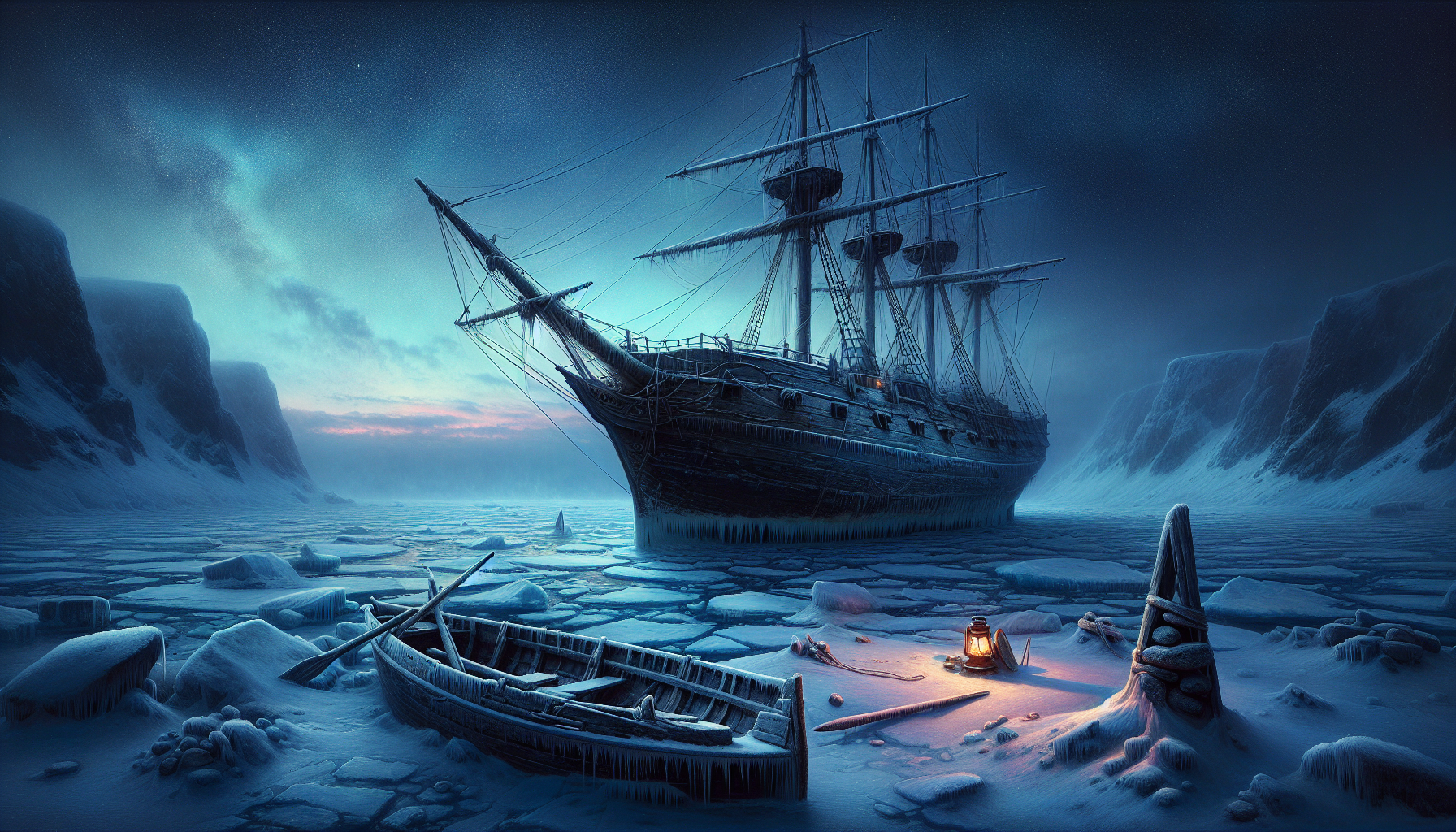
The expedition departed Greenhithe on 19 May 1845, the largest and best-equipped Arctic mission Britain had ever sent. Erebus and Terror were former bomb vessels retrofitted with iron-clad bows, auxiliary steam engines drawn from London railway locomotives, internal heating, and a desalination system. They carried provisions for three years, including roughly eight thousand tin cans of preserved meat, soup, and vegetables, supplied at low cost by Stephan Goldner. The Admiralty believed it had engineered redundancy into every system.
Command and Crew
Franklin, fifty-nine years old, had survived two earlier overland Arctic expeditions, including the disastrous 1819-1822 march in which more than half his men died. His second-in-command was Captain Francis Rawdon Moira Crozier (1796-1848), a veteran of James Clark Ross’s Antarctic voyages. Captain James Fitzjames (1813-1848) commanded Erebus under Franklin. The 129 officers and men included ice masters, surgeons, an ice-pilot, and a small library of nautical literature. The whaler Enterprise sighted the ships moored to an iceberg in Baffin Bay on 28 July 1845. After that, no European saw them again.
Beechey Island and the First Winter
The crews wintered 1845-1846 at Beechey Island in Lancaster Sound. By the time later searchers arrived in 1850 they found a tidy camp, a workshop, and three graves: Petty Officer John Torrington (died 1 January 1846), Able Seaman John Hartnell (died 4 January 1846), and Royal Marine Private William Braine (died 3 April 1846). According to the official history compiled by the Parks Canada Wrecks of HMS Erebus and HMS Terror National Historic Site, these three graves remain the only confirmed burials of the expedition. Their preserved bodies, exhumed in the 1980s, would later become the principal forensic archive.
The Victory Point Note and the Long Disappearance
After the second winter, the ships moved south into Victoria Strait and were beset by ice on 12 September 1846. They never sailed under their own power again. On 25 April 1848, the surviving 105 men abandoned the vessels under Crozier and Fitzjames and walked south toward the Back River. We know this from a single document, the Victory Point Note, recovered in a cairn on the northwest coast of King William Island in 1859 by Lieutenant William Hobson of the McClintock expedition. The note records Franklin’s death on 11 June 1847, the deaths of nine officers and fifteen men by April 1848, and the intent to march south. According to the Encyclopaedia Britannica entry, no member of the overland party survived. Skeletons, scattered relics, and one open boat at Erebus Bay were found across King William Island over the following decades.
What the Inuit Saw
The British search culture of the 1850s and 1860s treated Inuit testimony as folklore. The American journalist Charles Francis Hall (1821-1871) treated it as evidence. Hall lived among Inuit families in Cumberland Sound and on the Melville Peninsula between 1860 and 1869, working with the interpreters Taqulittuq and Ipirvik. He recorded hundreds of pages of accounts that placed the expedition’s collapse in specific bays, on specific stretches of coast, and at specific seasons.
The Testimony of Inukpujijuk and Others
The Inuk hunter Inukpujijuk, who had earlier given information to Dr. John Rae in 1854, accompanied Hall to King William Island and drew a map indicating the location of relics, bodies, and at least one ship that had been visited by Inuit and later sunk. Inuit hunters described boarding a beset vessel and finding a single deceased man on board, very tall, with long teeth. Others recounted a small group of European survivors traveling south, eventually starving on a coastline known in their accounts as the place of Tunnunirusiq. The American naval lieutenant Frederick Schwatka collected further testimony in 1878-1880, again finding accounts that named places and described events the British search teams had never reached.
David Woodman’s Reconstruction
For most of the twentieth century, professional historians treated this material with the same skepticism the Royal Navy had shown. The Canadian researcher David C. Woodman changed that. In Unravelling the Franklin Mystery: Inuit Testimony (1991, second edition 2015), Woodman cross-referenced every published Inuit account against geography and known relic finds. He concluded that the Inuit had seen the ships in 1850, that survivors had reached as far south as Starvation Cove, and that some Europeans may have lived as late as 1851 in small remnant groups. Russell Potter’s Finding Franklin: The Untold Story of a 165-Year Search (McGill-Queen’s University Press, 2016) extended the same argument to fifty separate search expeditions, demonstrating how often Inuit guidance had been the unrecognized engine of every real find.
The 2014 and 2016 Discoveries
When Parks Canada launched a sustained underwater search in 2008, the agency built its strategy on Woodman’s reading of Inuit testimony. Field operations were coordinated with the Inuit Heritage Trust and the community of Gjoa Haven, the closest settlement to the wreck zone. The Inuk historian Louie Kamookak (1959-2018) had spent decades collecting elder testimony in Nunavut and had supplied search planners with location notes that descended from the same nineteenth-century accounts Hall had transcribed.
HMS Erebus, 2014
On 1 September 2014, sonar operators aboard the Parks Canada research vessel Investigator located a wreck in shallow water in eastern Queen Maud Gulf, near O’Reilly Island. The site lay almost exactly where Inukpujijuk had pointed Hall in 1869. Divers identified the vessel as HMS Erebus the next week. The ship’s stern was crushed, but a remarkable amount of structure remained, including the lower decks, the captain’s cabin, and a deck-mounted ship’s bell raised that autumn. The Erebus had drifted south after being abandoned, then settled in shallows where Inuit hunters had observed her in the 1850s.
HMS Terror, 2016
Two years later, in September 2016, the Arctic Research Foundation vessel Martin Bergmann located HMS Terror in Terror Bay on the south coast of King William Island. The find followed a tip from Sammy Kogvik, an Inuk crew member who had seen a wooden mast protruding from the ice during a snowmobile crossing in 2010. Terror was extraordinarily intact, sitting upright on the seabed in twenty-four meters of water with hatches closed and most internal compartments sealed. Both wrecks were jointly designated a National Historic Site of Canada and placed under co-management with the Inuit Heritage Trust.
What Killed the Men? The Open Cause-of-Death Question
The forensic record of the expedition is small but unusually well-preserved, and four overlapping hypotheses now compete to explain why so many men died so quickly. None has eliminated the others.
Lead Poisoning, Beattie 1980s
In 1981, the Canadian forensic anthropologist Owen Beattie of the University of Alberta led a project to King William Island and, between 1984 and 1986, exhumed the three Beechey Island sailors. Trace element analysis of bone and hair revealed lead concentrations consistent with severe poisoning. Beattie and the historian John Geiger (born 1960) argued in Frozen in Time: The Fate of the Franklin Expedition (1987, revised 2004) that lead from poorly soldered tin cans had degraded the men’s neurological function and immune systems. The hypothesis dominated popular accounts for two decades.
The Distilled Water Counter-Argument
More recent scholarship has narrowed the lead claim. The historian William Battersby and others have proposed that the ships’ large lead-piped distillation system, intended to produce fresh water from sea ice, was a more probable lead source than the cans, since the men had drunk roughly a litre per day from it for months. A 2014 reanalysis published in Polar Record showed that lead levels in Franklin sailors did not rise over time, which is what one would expect from cumulative tin-can ingestion. Lead probably contributed to morbidity. It probably did not, by itself, kill the expedition.
Botulism, Scurvy, and Zinc Deficiency
Spores of a Clostridium species were detected in the intestine of one Beechey Island sailor, prompting the proposal that botulism from imperfectly sealed cans contributed to the early deaths. A 2016 study of Hartnell’s preserved fingernails by University of Saskatchewan researchers found severe zinc deficiency, which would have impaired immune response and wound healing. Scurvy, the classical sailor’s disease, was almost certainly present in the survivors who walked south, since the lemon juice supplied for the voyage loses ascorbic acid rapidly when stored.
The Cannibalism Question
Hall and Schwatka had recorded Inuit accounts of the survivors resorting to cannibalism. The Royal Navy and Lady Jane Franklin denounced the testimony as racist slander. In 1997, the bioarchaeologist Anne Keenleyside and colleagues published a study in the journal Arctic of nearly four hundred bone fragments from at least eleven men recovered at the NgLj-2 site on King William Island. Cut marks consistent with intentional defleshing appeared on roughly a quarter of the bones. A 2015 follow-up confirmed end-stage breakage and pot-polishing on long bones. The bone evidence vindicated the Inuit testimony that the British establishment had spent more than a century rejecting.
What the 2014-2016 Wrecks Have Already Changed
Since the discoveries, Parks Canada divers have completed dozens of seasons on Erebus and limited dives on Terror, recovering more than two hundred artifacts under joint Inuit-Canadian governance. Personal effects, navigation instruments, leather boots, ceramic plates, a pair of wool epaulets, and parts of the steam engine have come to surface conservation. In September 2024, a research team led by the University of Waterloo announced that DNA from a tooth and mandible recovered on King William Island matched a living descendant of Captain James Fitzjames, identifying him as one of the cannibalized men whose remains showed cut marks. The find combined the genetic and historical-archive records into a single attribution that even Hall could not have reached.
The work is far from finished. Terror’s interior, sealed by silt and cold, may still hold logbooks, charts, journals, daguerreotypes of the men, and Franklin’s own papers. Conservators are cautious; the wrecks are fragile and the seasons are short. The interpretive arc, however, has already turned. The Inuit families who watched the ships freeze, the men march, and the bodies fall were not telling stories. They were keeping a record. Modern scholarship has finally caught up with what they had said all along.
Frequently Asked Questions
Who was Sir John Franklin?
Sir John Franklin (1786-1847) was a British Royal Navy officer and Arctic explorer. He led three expeditions to the Canadian Arctic and served as Lieutenant Governor of Van Diemen’s Land (Tasmania) from 1837 to 1843. He died on 11 June 1847 aboard HMS Erebus, in the second year of his fourth and final Arctic expedition.
Where are HMS Erebus and HMS Terror today?
Both wrecks remain on the seabed in the Canadian Arctic. HMS Erebus lies in eastern Queen Maud Gulf, near O’Reilly Island. HMS Terror lies in Terror Bay on the south coast of King William Island. The sites are co-managed by Parks Canada and the Inuit Heritage Trust as a National Historic Site of Canada.
How were the ships finally found?
Sustained Parks Canada underwater searches were directed by Inuit oral testimony recorded in the 1860s and 1870s by Charles Francis Hall and Frederick Schwatka, and reconstructed by David C. Woodman in 1991. The Inuk historian Louie Kamookak supplied additional elder testimony from Gjoa Haven. HMS Erebus was located in 2014, HMS Terror in 2016.
Why was Inuit testimony ignored for so long?
Victorian-era British searchers and the Admiralty treated indigenous oral history as unreliable, particularly the Inuit accounts of cannibalism. Lady Jane Franklin actively campaigned against the Inuit reports gathered by Dr. John Rae in 1854. Twentieth-century historians inherited this skepticism. The 1997 Keenleyside bone study and the 2014-2016 wreck discoveries together demonstrated the Inuit accounts had been reliable.
Did the Franklin sailors really resort to cannibalism?
The bone evidence published by Anne Keenleyside in 1997 and refined in 2015 shows cut marks and intentional breakage on the remains of at least eleven men recovered on King William Island. The pattern is consistent with end-stage survival cannibalism, confirming the nineteenth-century Inuit testimony rejected by the British establishment.
What killed the Franklin Expedition?
No single cause has been confirmed. The current scholarly consensus describes a compounding sequence of starvation, hypothermia, scurvy, lead exposure, possible botulism, severe zinc deficiency, and infectious disease, accelerated by abandonment of the ships and a long overland march in poor health. Owen Beattie’s lead-poisoning hypothesis remains contributory rather than primary.
What was the Northwest Passage?
The Northwest Passage is the maritime route through the Arctic Archipelago of northern Canada that connects the Atlantic and Pacific Oceans. European explorers searched for it from the late fifteenth century onward. Franklin’s expedition was sent to chart its last unmapped section. The passage was first traversed by Roald Amundsen in 1903-1906.
Has Sir John Franklin’s body been found?
No. Franklin died on 11 June 1847 aboard HMS Erebus, before the abandonment of the ships. The Victory Point Note of April 1848 confirms his death but gives no burial location. Inuit testimony recorded by Hall describes a senior officer’s body kept on the ship. Whether his remains lie within the Erebus wreck is one of the questions the ongoing dives may eventually answer.
Who were Crozier and Fitzjames?
Captain Francis Crozier (1796-1848) was the expedition’s second-in-command and captain of HMS Terror; he assumed overall command after Franklin’s death. Captain James Fitzjames (1813-1848) commanded HMS Erebus under Franklin. Fitzjames was identified by DNA in 2024 as one of the men whose remains showed end-stage cannibalism cut marks. Crozier’s fate is unknown.
What is the Victory Point Note?
The Victory Point Note is a single sheet of Admiralty stationery left in a cairn on northwest King William Island, recording the abandonment of HMS Erebus and HMS Terror on 22 April 1848. It was deposited and later updated in two stages by James Fitzjames and Francis Crozier. It is the only known written document by the survivors of the expedition.
Who is Louie Kamookak?
Louie Kamookak (1959-2018) was an Inuk historian from Gjoa Haven, Nunavut, who spent decades gathering elder testimony about Franklin relics on King William Island. His research informed Parks Canada search strategy in the years before the 2014 discovery. The Royal Canadian Geographical Society now awards an annual Louie Kamookak Medal in his memory.