
Drafted with AI assistance from the sources listed; images are AI-generated illustrations. How EsoVitae is made
The coelacanth is the one case zoology gets to point at and say: this is what rediscovery looks like when it goes right. A lineage written off as extinct since the Late Cretaceous turned up alive in a fishing net in 1938, was handed a museum specimen, a Linnaean name, and a peer-reviewed description, and then went back to being itself in deep water off East Africa. For the broader niche, see the Cryptids and Mythical Creatures pillar.
Direct Answer: What “Living Fossil” Means for the Coelacanth
The coelacanth is a deep-water lobe-finned fish of the genus Latimeria, a lineage that survived roughly 66 million years after it disappeared from the fossil record near the end of the Cretaceous. Rediscovered alive off South Africa in 1938, it is the textbook living fossil and the best-documented Lazarus taxon in vertebrate zoology [1][3].
The 1938 Catch That Reopened a Closed File
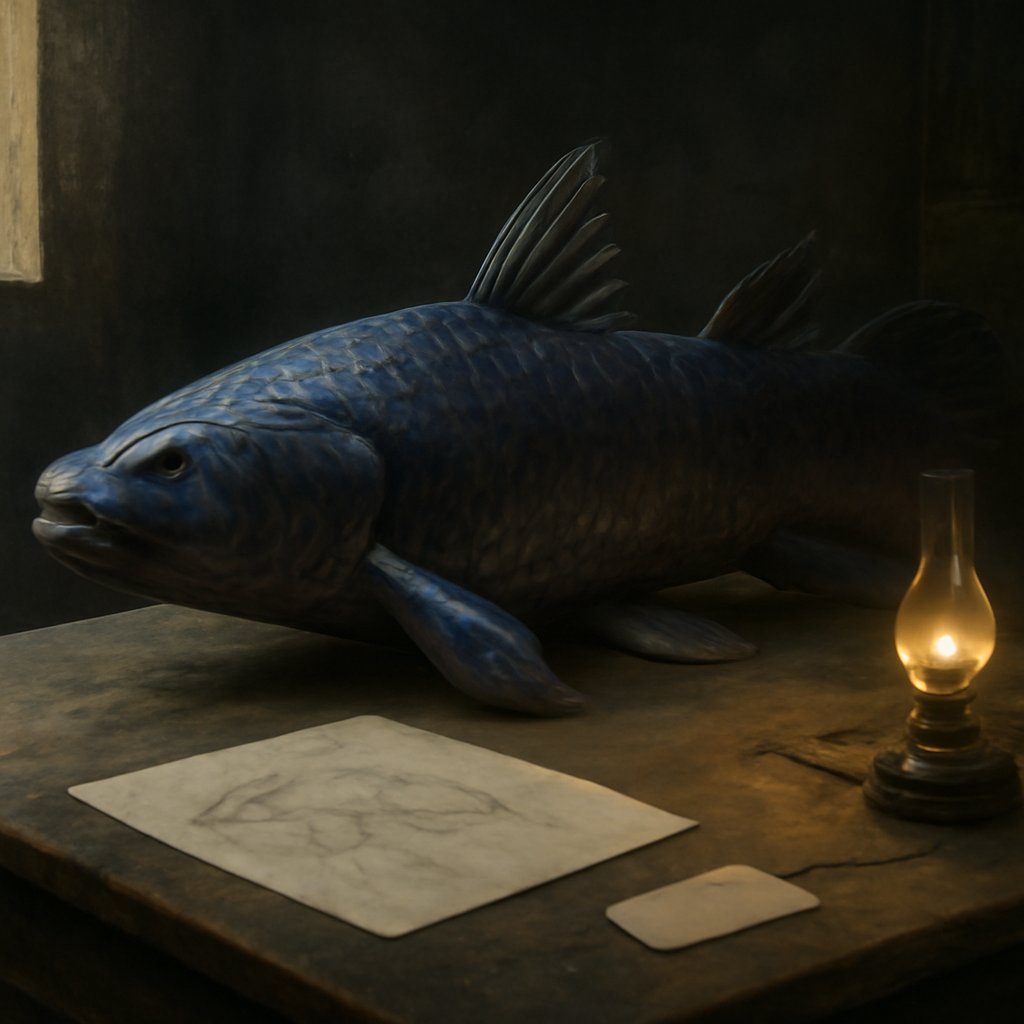
On 22 December 1938, museum curator Marjorie Courtenay-Latimer pulled a 1.5-meter steel-blue fish from the bycatch of the trawler Nerine at East London, South Africa, and recognized it as something the fossil record said should no longer exist [1]. The trawl, captained by Hendrik Goosen, had worked the seabed near the mouth of the Chalumna River. She sketched the animal, fought to keep it from rotting in the summer heat, and, unable to find a vessel of formalin large enough, sent it to a taxidermist while she wrote to the one person she thought could name it.
That person was J.L.B. Smith, an ichthyologist at Rhodes University. When Smith reached the mounted specimen in early 1939, his account is plain: “there was no doubt, it was a true coelacanth” [1]. He published the find in Nature that year and named the fish Latimeria chalumnae, the genus honoring Courtenay-Latimer and the species marking the Chalumna [2]. The group had last appeared in the rock record near the end of the Cretaceous, an extinction the Encyclopaedia Britannica places around 66 million years ago, alongside the non-avian dinosaurs [3]. The taxidermy had already cost science the soft organs, and the news traveled the world before the full anatomy could be read. Smith spent the next thirteen years hunting a complete second fish. A curator with a good eye had reopened a 66-million-year file in an afternoon, with a body on a table rather than a story around a fire.
Two Species, Two Oceans, and a 2025 Diver Photo
Two living coelacanth species are recognized today: Latimeria chalumnae in the western Indian Ocean and Latimeria menadoensis in Indonesian waters, separated by roughly 10,000 kilometers of ocean and several million years of genetic divergence [9][1]. The first took fourteen years to trace to its home.
A second L. chalumnae surfaced in December 1952 off Anjouan in the Comoro Islands. Captain Eric Hunt, who had seeded the islands with reward leaflets, telegraphed Smith, who pressed the South African prime minister D.F. Malan for a military Dakota to fly the specimen out. Smith briefly named that fish Malania anjouanae before it was folded back into L. chalumnae; the Comoros, not South Africa, proved to be the population’s true home [1][12]. Sightings later widened the map: in 2000, divers led by Pieter Venter found living coelacanths at Sodwana Bay in South Africa at around 104 meters, the first time the species was watched alive rather than hauled up dead.
The Indonesian story runs parallel. On 18 September 1997, marine biologists Mark and Arnaz Erdmann spotted a coelacanth in a market on Manado Tua, Sulawesi, and a 1998 specimen led to the 1999 description of L. menadoensis [9]. In 2025, divers photographed a living Indonesian coelacanth in North Maluku at 144 meters, the first in-situ diver images of that species [10].
| Feature | Latimeria chalumnae | Latimeria menadoensis |
|---|---|---|
| Common name | West Indian Ocean coelacanth | Indonesian coelacanth |
| Year described | 1939 (Smith) | 1999 (Pouyaud et al.) |
| Core range | Comoros, South Africa, East Africa | Sulawesi, North Maluku, Indonesia |
| Typical depth | 150-250 m by day | ~130-150 m (diver records) |
| IUCN status | Critically Endangered | Vulnerable |
What the Coelacanth’s Body Is Built to Do
The coelacanth carries three features that explain why anatomists treat it as a working model of the fish-to-tetrapod transition: lobed limb-like paired fins, a hinged skull, and an electric sense organ in its snout. None of these is a museum curiosity; each one does a job in the dark.
The fleshy, lobed pectoral and pelvic fins are what make the coelacanth a sarcopterygian, or lobe-finned fish, and they move in an alternating diagonal pattern, the same sequence a trotting salamander uses. The fish does not walk on them; it sculls and hovers, holding its heavy body neutral in the water. On the morphology: the skull is split by an intracranial joint, a hinge across the braincase that lets the front of the head lift during a feeding strike, a trait found in no other living vertebrate [6]. The rostral organ, a gel-filled cavity in the snout, works as a low-resolution electro-detector that guides that strike onto prey hidden against the seabed [6]. The 2013 genome study, published in Nature, settled a long argument by showing that lungfish, not the coelacanth, are the closest living fish relatives of tetrapods, with the coelacanth the next branch out [4]. The animal also keeps a fat-filled vestigial lung that aids buoyancy and a hollow, oil-filled notochord, the feature that gave the order its name, Greek for “hollow spine.” A mature coelacanth runs up to two meters long and around 90 kilograms, sheathed in thick, overlapping cosmoid-type scales that fossilize cleanly, part of why the lineage left such a legible record in the rock.
A Hundred-Year Fish in the Dark
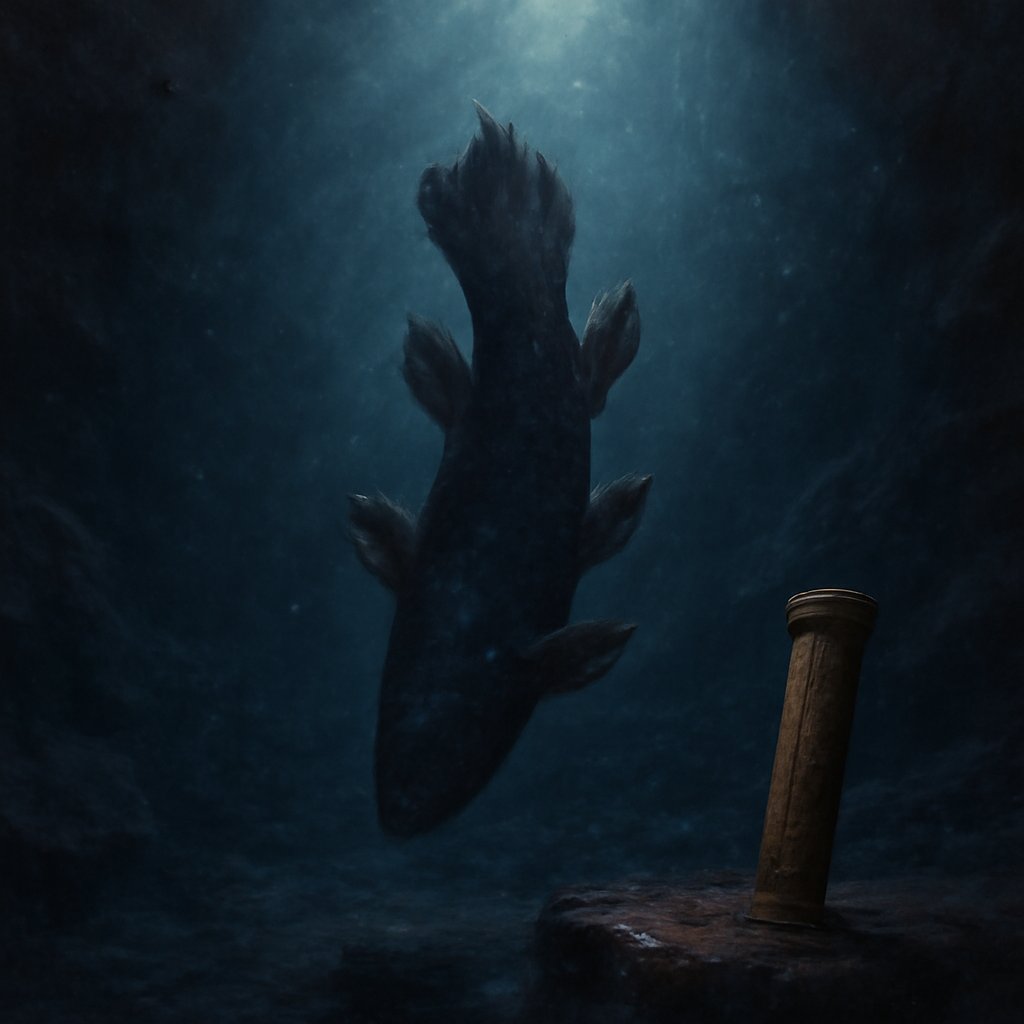
Coelacanths spend the daylight hours packed into volcanic caves between 150 and 250 meters deep off Grande Comore, then descend toward 600 meters at night to drift-hunt fish and squid [8][1]. They are animals of the slow lane, and the numbers that describe their lives are extreme.
German biologist Hans Fricke, of the Max Planck Institute, first filmed living coelacanths in their habitat in 1987, recording the headstand posture in which a fish tips nose-down and drifts across the rock, perhaps aiming that rostral organ at the substrate. His submersible team tracked the Comoros population for 21 years and found it small but stable, on the order of a few hundred animals around Grande Comore [8]. The species is also a live-bearer: a female dissected in 1975 carried five well-developed pups, confirming that coelacanths give birth rather than spawn. A 2021 analysis in Current Biology re-read growth rings on coelacanth scales under polarized light and found the species lives close to 100 years, reaches sexual maturity around age 55, and gestates its young for roughly five years, likely the longest pregnancy of any fish [5]. Their flesh is laced with oils and wax esters that make it unpalatable, so coelacanths are never a market target, only accidental bycatch on deep lines set for oilfish, which is the main human pressure on the Comoros population. A century-long life on a slow metabolism is the exact profile of an animal that can persist, unseen, in habitat almost no one visits.
Why “Living Fossil” Is a Useful Lie
Charles Darwin coined the phrase “living fossil” in On the Origin of Species in 1859, and the modern coelacanth became its most famous example, even though the animal is not a frozen relic of the Devonian [13]. The order Coelacanthiformes does stretch back roughly 410 million years, but the fish in the net is not one of those fossils.
Latimeria is its own genus, distinct from every named fossil coelacanth, and it has gone on evolving the whole time. The Swiss naturalist Louis Agassiz named the first fossil coelacanth in 1839, a century before anyone suspected the line still lived, and he named a shape, not a destiny. Two things get conflated here: morphological conservatism, meaning the body plan changed little, and genetic stasis, meaning the genome stopped changing. The 2013 sequencing showed the first is broadly true and the second is not, with some protein-coding genes evolving slowly but the genome as a whole still in motion [4]. The label survives because it captures something real, a body a Devonian fish would recognize, while quietly implying something false, a creature that stepped out of deep time unchanged. The coelacanth still earns the comparison better than almost any animal alive, which is exactly what makes the shorthand both sticky and misleading. That is why many biologists now retire the phrase, or keep it only with a warning attached, and why a careful field write-up treats “living fossil” as a headline rather than a finding.
What the Coelacanth Owes Cryptozoology, and What It Doesn’t
The coelacanth is cryptozoology’s favorite precedent, the case raised whenever someone argues that a creature presumed extinct for tens of millions of years is still alive and waiting to be documented. The Natural History Museum has called it “the fish that outdid the Loch Ness Monster” [12], and the comparison is fair on one axis and misleading on another.
It is fair because the rediscovery genuinely happened: a large vertebrate, gone from the record since the Cretaceous, was found alive, which is the strongest argument any cryptozoologist has that the search is not absurd. It is misleading because of how the case closed. The load-bearing fact: the coelacanth was confirmed by a specimen, a designated type, and a description in Nature, not by witness testimony, blurred footage, or a single track cast [2]. That is the standard most cryptid files never reach. The coelacanth rewards the boring parts of zoology and punishes the assumption that wanting an animal to exist is the same as showing it does. Both living species now sit on the IUCN Red List, L. chalumnae as Critically Endangered with likely fewer than 500 individuals and L. menadoensis as Vulnerable [11]. The Lazarus taxon that came back from the dead is now, ironically, at real risk of leaving again. The lesson it teaches is plain: rediscovery is possible, and it is still proven by a body, not a wish. For more in this vein, browse the Extinct Creatures and Cryptid Connections archive.