By Augustus Kane · Published June 10, 2026 · Updated June 10, 2026
The Mayan calendar apocalypse is a modern misreading. December 21, 2012 marked the completion of the 13th baktun in the Maya Long Count, a cyclical rollover after roughly 5,125 years. No surviving Maya inscription predicts destruction on that date; the doomsday narrative was assembled by twentieth-century writers, not Classic Maya scribes.
Published: June 5, 2026. Last reviewed: June 5, 2026.
I came to this story the way I come to most claims about a hidden prophecy: by asking which document, exactly, the prophecy is supposed to live in. The answer is unusually specific. One badly eroded seventh-century monument from Tabasco names the date. A second, fragmentary text from Guatemala mentions it in passing. Everything else, the galactic alignments, the consciousness upgrades, the rogue planet, entered the record long after the Maya stopped carving Long Count dates. Sorting the carved evidence from the paperback speculation is the whole task here, and it sits squarely inside the wider study of conspiracy theories and secret societies.
How the Maya calendar actually counts time
The Maya tracked time with three interlocking systems: a 260-day Tzolk’in, a 365-day Haab’, and the Long Count, a continuous day-tally that scribes wrote as five place values running from the k’in up to the baktun.
The Tzolk’in pairs thirteen numbers with twenty day-names, producing 260 unique days before the sequence repeats [1][2]. The Haab’ runs eighteen months of twenty days plus a five-day remainder, the Wayeb’, for 365 [2]. Lock those two wheels together and you get the Calendar Round, a 52-year span that the least common multiple of 260 and 365 fixes at exactly 18,980 days, a count still kept in the Guatemalan highlands [1][2]. None of these cycles has a built-in end. The Long Count is the one people mistook for a doomsday clock, and even it does not stop.
The Long Count is positional, like a five-digit odometer keyed to days rather than miles. Each place rolls into the next, and the baktun is simply the largest place scribes used routinely.
| Unit | Equals | Days | Approximate span |
|---|---|---|---|
| K’in | 1 day | 1 | 1 day |
| Winal | 20 k’in | 20 | 20 days |
| Tun | 18 winal | 360 | about 1 year |
| K’atun | 20 tun | 7,200 | about 20 years |
| Baktun | 20 k’atun | 144,000 | about 394 years |
| 13 baktun | one great cycle | 1,872,000 | about 5,125 years |
Why December 21, 2012 ever became a date at all
December 21, 2012 corresponds to the Long Count 13.0.0.0.0, the day the thirteenth baktun rolled over, fixed by the GMT correlation that anchors the Maya creation date to August 11, 3114 BCE.
That correlation has a paper trail of its own. Joseph Goodman first proposed it in 1905, Juan Martinez Hernandez refined it in 1926, and J. Eric S. Thompson fixed the constant at 584,283 days in 1935, which is why epigraphers call it the Goodman-Martinez-Thompson correlation [1][2]. Run the arithmetic forward from the creation date the Maya themselves recorded as 13.0.0.0.0 4 Ajaw 8 Kumk’u, and the same 13.0.0.0.0 station returns on 4 Ajaw 3 K’ank’in, our December 21, 2012 [1][2].
Here is the detail the panic skipped. The previous world-age also closed on a 13.0.0.0.0, which tells you the number marked completion and renewal, not termination. And the count kept running past 2012 without a hitch. The next baktun, Long Count 14.0.0.0.0, falls on March 26, 2407 [1][2]. A calendar that already has a 2407 date built into it is a poor candidate for a calendar that ends the world in 2012.
The single inscription that names the end date
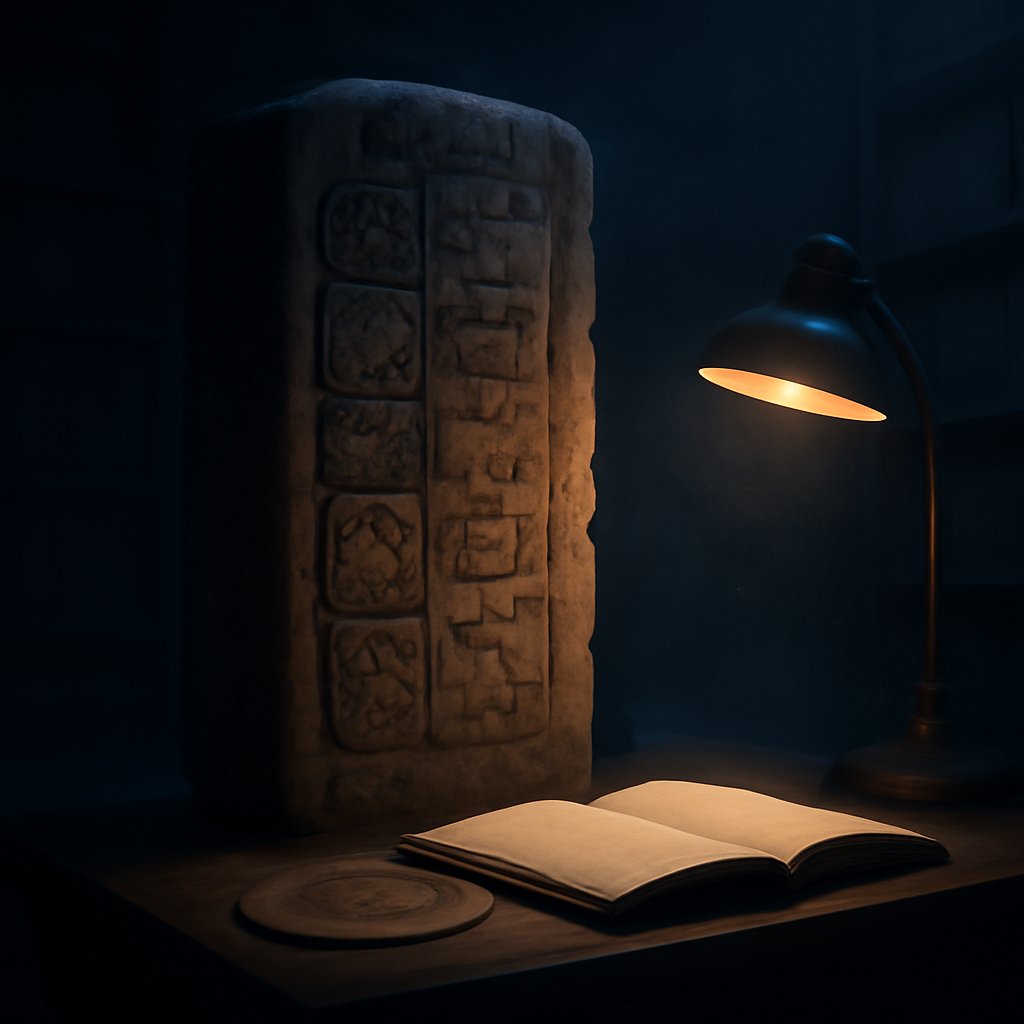
Tortuguero Monument 6, a seventh-century carved panel from Tabasco, Mexico, is the only known Classic Maya inscription that records the completion of the 13th baktun on the date we read as December 21, 2012.
The epigrapher David Stuart, in his close reading of the glyphs on Monument 6, treats the relevant passage as a plain calendrical statement: the thirteenth baktun will be finished on 4 Ajaw, the third of K’ank’in, and then comes an eroded verb followed by the descent of Bolon Yokte’ K’uh [3]. Bolon Yokte’ K’uh is a deity bound up with war, conflict, and the cycles of creation rather than with the destruction of the world [3][4]. The glyph that should tell us what the god actually does on that day is damaged, which is precisely the gap the doomsday writers filled with their own furniture.
On the documentary record, the most careful reconstruction belongs to Sven Gronemeyer and Barbara MacLeod, who in a 2010 study restored the broken phrase as an “investiture,” a ritual display of Bolon Yokte’ K’uh rather than an ending [4]. Stephen Houston has pushed the opposite way, arguing that Maya scribes invoked far-future dates mainly to flatter a present-day king by tying his reign to a grand calendrical anniversary, not to forecast events [3]. A second fragment, Hieroglyphic Stairway 12 from La Corona in Guatemala, surfaced in 2012 and likewise pairs a past k’atun ending with the future 13-baktun date, carrying no prophecy at all [3]. A worn brick from Comalcalco is the only other candidate, and it is contested. That is the entire carved corpus on 2012.
Where the apocalypse story actually comes from
The doomsday reading is a twentieth-century invention with a traceable paper trail, beginning with a single sentence in Michael D. Coe’s 1966 survey The Maya and growing through New Age publishing in the 1970s and 1980s.
Coe wrote that the completion of the great cycle might bring Armageddon to the degenerate peoples of the world, and his first edition even printed a December 1, 2011 date drawn from a different correlation [6][10]. The walked-back claim is Coe’s own: later editions corrected the date and softened the apocalyptic gloss, which tells you how unsettled even the scholarship was at the start. From there the idea left the academy. Frank Waters fused the end date with Hopi prophecy and astrology in Mexico Mystique in 1975 [7]. Jose Arguelles staged the Harmonic Convergence in 1987 and tied 2012 to a “galactic synchronization beam” in The Mayan Factor [8]. John Major Jenkins added the galactic-alignment theory, claiming the Maya foresaw the winter-solstice sun lining up with the center of the Milky Way. Roland Emmerich’s film 2012, released in 2009, then sold the whole package back to a worldwide audience as spectacle.
Trace each strand to its source and the pattern is consistent. The catastrophe lives in trade paperbacks and a disaster movie, not on any Maya stone.
What the epigraphers and the Maya themselves say
Maya scholars who read the glyphs reject the apocalypse outright, and so do the living Maya communities of Guatemala and Mexico, for whom the close of a baktun signals renewal rather than ruin.
Mark Van Stone, a specialist in Maya writing, put it bluntly: the notion of a great cycle “coming to an end” is completely a modern invention [5]. David Freidel and Linda Schele, writing in 1990, concluded that the Maya did not conceive the 2012 station as the end of creation [5]. The Smithsonian’s Living Maya Time project states flatly that no inscription, anywhere, shows the ancient Maya expecting a catastrophic end, and that the prediction is not shared by Maya people today [1]. The structure of the calendar itself, three meshed cycles designed to keep counting, points the same way [2].
The fear still had to be answered in public. NASA’s David Morrison fielded thousands of questions about a supposed rogue planet on a collision course, and the agency released a video, 12-21-2012: Just Another Day, explaining why an object near enough to strike Earth in weeks would already be the brightest thing in the night sky [9]. It was not, because it did not exist.

Reading the stone instead of the headline
On the surviving evidence, the verdict is narrow but firm: the Maya recorded a calendar rollover for December 21, 2012, named one ambiguous deity in connection with it, and prophesied no catastrophe.
That finding cuts against both of the loud positions. The flat official line, that there is “nothing here,” slightly overstates the silence, because there is one eroded clause about Bolon Yokte’ K’uh, and the Gronemeyer and MacLeod reading of an investiture is serious epigraphy that deserves to stay on the table [4]. The conspiratorial line, that the Maya predicted doom, overstates in the other direction and far more severely, since not one glyph in the corpus describes the world ending. The fact-claim vs spectacle-claim distinction is the whole matter: the fact is a date and a damaged verb, and the spectacle is everything later writers hung on it.
So the calendar did exactly what a calendar does. It turned over and kept counting toward 2407. If you want the method I bring to claims like this one, it is set out in my approach to testing conspiratorial claims against the record, and it sits alongside the rest of esovitae’s mysteries and anomalies coverage. Read the footnote before the headline, and the apocalypse turns back into arithmetic.
Frequently asked questions
Did the Maya predict the world would end in 2012?
No. The surviving inscriptions record December 21, 2012 as the completion of the 13th baktun, a cyclical milestone in the Long Count. The Smithsonian’s Living Maya Time project and most epigraphers agree that no Maya text forecasts destruction on that date.
What is the 13th baktun?
A baktun is a Long Count unit of 144,000 days, about 394 years. Thirteen baktuns make one great cycle of 1,872,000 days, roughly 5,125 years. The Maya creation date and the 2012 date both fall on a 13.0.0.0.0 station, marking completion and renewal.
What does Tortuguero Monument 6 actually say?
It is the only known Maya inscription naming the 2012 date. David Stuart reads it as stating that the thirteenth baktun will be finished on 4 Ajaw 3 K’ank’in, followed by an eroded verb and the descent of the deity Bolon Yokte’ K’uh. The action glyph is damaged, so the text predicts no specific event.
Who started the 2012 apocalypse idea?
The trail starts with Michael D. Coe, whose 1966 book The Maya mentioned Armageddon. Frank Waters expanded it in 1975, Jose Arguelles popularized December 21, 2012 through the 1987 Harmonic Convergence, and John Major Jenkins added the galactic-alignment theory. The 2009 film 2012 brought it to a mass audience.
Why December 21, 2012 specifically?
That date is the Gregorian equivalent of Long Count 13.0.0.0.0 under the Goodman-Martinez-Thompson correlation, which most Mayanists accept. It counts forward from the Maya creation date of August 11, 3114 BCE. The winter-solstice timing was a coincidence that later writers treated as meaningful.
What is the GMT correlation?
The GMT correlation links the Maya Long Count to the Western calendar using a constant of 584,283 days. Joseph Goodman proposed it in 1905, Juan Martinez Hernandez refined it in 1926, and J. Eric S. Thompson finalized it in 1935. It is the standard correlation behind the 2012 date.
Does the Maya calendar actually end in 2012?
No. The Long Count simply advances to the next baktun. After 13.0.0.0.0 on December 21, 2012, the count continues to 14.0.0.0.0, which lands on March 26, 2407. The calendar has higher units still, reaching far beyond any human timescale.
Is Bolon Yokte’ K’uh a god of the apocalypse?
Not in the destructive sense. Bolon Yokte’ K’uh is associated with war, conflict, and the turning of creation cycles. The deity appears at calendar endings and beginnings, which is why the name surfaces on the Tortuguero panel, but no text casts the god as an agent of global destruction.