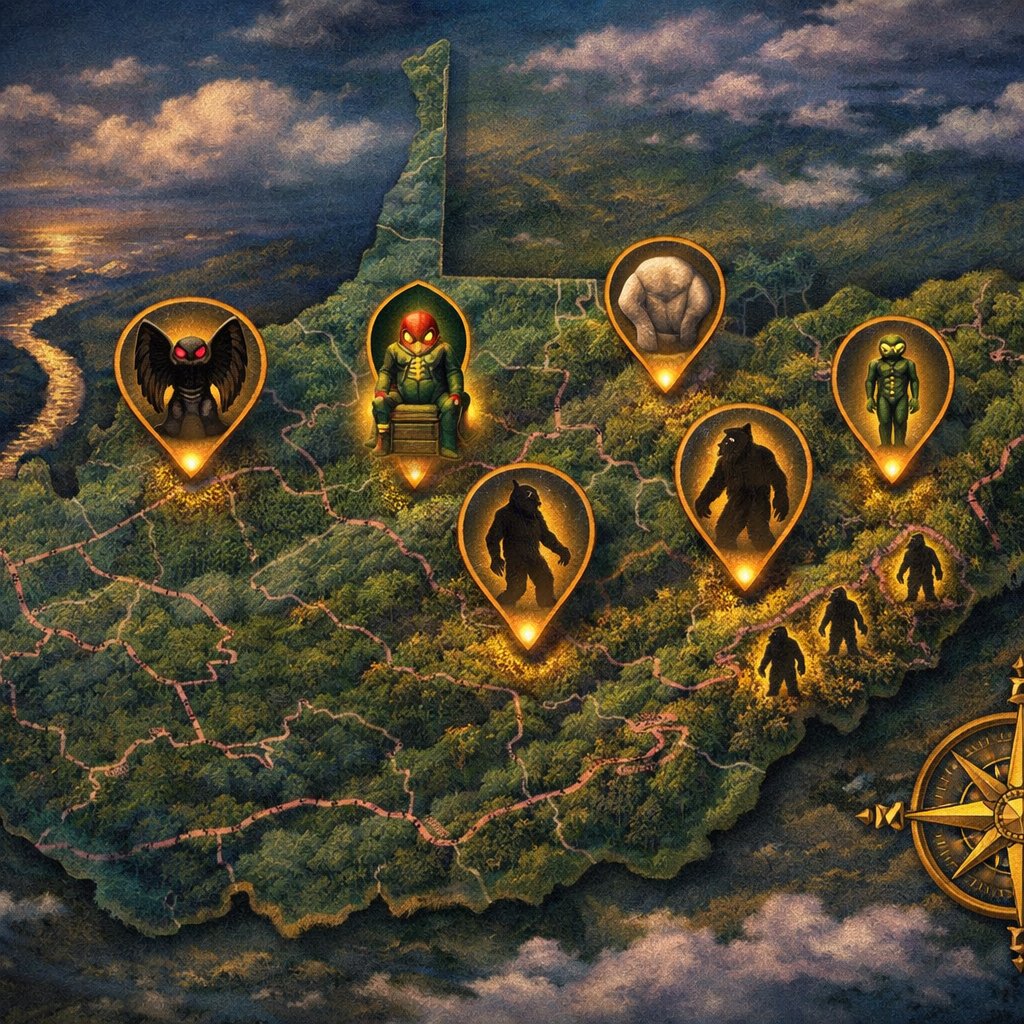
Cryptid tourism in West Virginia turns regional folklore into a measurable economy. Point Pleasant’s Mothman Festival, held the third weekend of September, draws an estimated 10,000-15,000 visitors annually and anchors a year-round museum economy. Five named cryptids — Mothman, the Flatwoods Monster, Bigfoot, the Grafton Monster, and the Vegetable Man — distribute the demand across multiple Appalachian counties.
Published: May 18, 2026. Last reviewed: May 18, 2026.
What Counts as Cryptid Tourism, and Why West Virginia Leads It
West Virginia treats its cryptid roster as a tourism asset class — five named creatures distributed across five counties, anchored by two purpose-built museums, two bronze public-art installations, and one festival weekend that the town of Point Pleasant has run continuously since 2002 [1][2]. That is the working definition I will use throughout: cryptid tourism is destination travel whose primary draw is a regionally-claimed cryptozoological subject and the built environment (statues, museums, trails, festival weekends, themed retail) the host community has constructed around it.
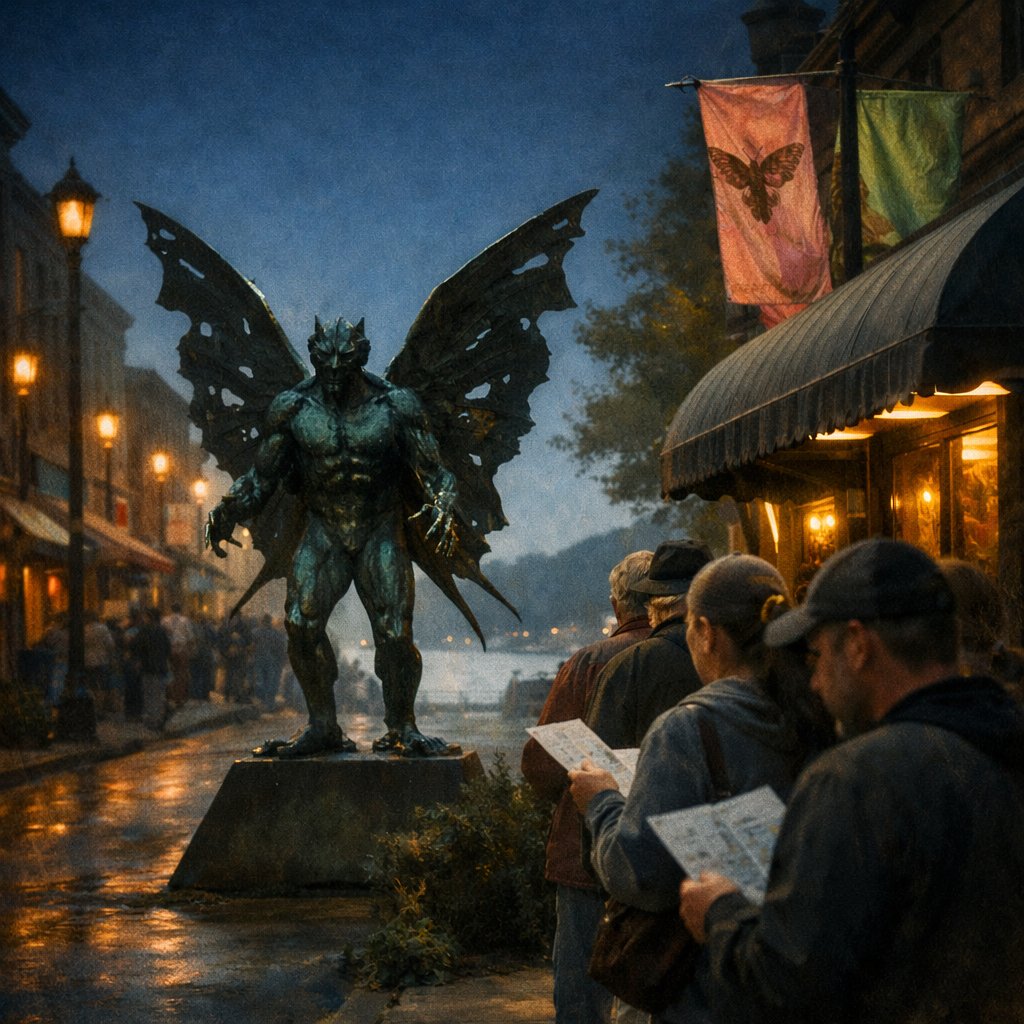
I came to this piece the way I come to any anomaly question: by watching what the population was actually doing. The animal I was watching is a human one. The signals are car counts on State Route 2 the third week of September, hotel-block sellouts in Gallipolis Ohio (across the bridge from Point Pleasant), the proliferation of cryptid-themed retail in Sutton’s main square, and the line that forms outside the Mothman Museum by 9:30 a.m. on a Saturday in autumn [3]. The behavior is consistent. The infrastructure is asset-light. The legend, in the legal sense, is public-domain.
West Virginia is the case study not because its folklore is more vivid than Pennsylvania’s or Kentucky’s, but because the state has, county by county, treated each of its cryptid sightings as a placemaking input rather than a curiosity. Point Pleasant zoned for it. Braxton County built a chair. The result, in 2026, is a regional tourism portfolio that pays for itself in tax receipts and brand-recognition that no extractive industry left behind.
The Mothman Industry: One Bridge Collapse, Two Statues, a Museum, and a Festival
The Mothman sighting cluster ran from November 1966 through November 1967 in the Point Pleasant area of Mason County, West Virginia, and was retroactively folded into the cultural memory of the Silver Bridge collapse on December 15, 1967, which killed 46 people [4]. That conjunction — a reported anomalous creature followed within thirteen months by a structural-failure mass-casualty event — is the load-bearing fact under everything Point Pleasant has built since.
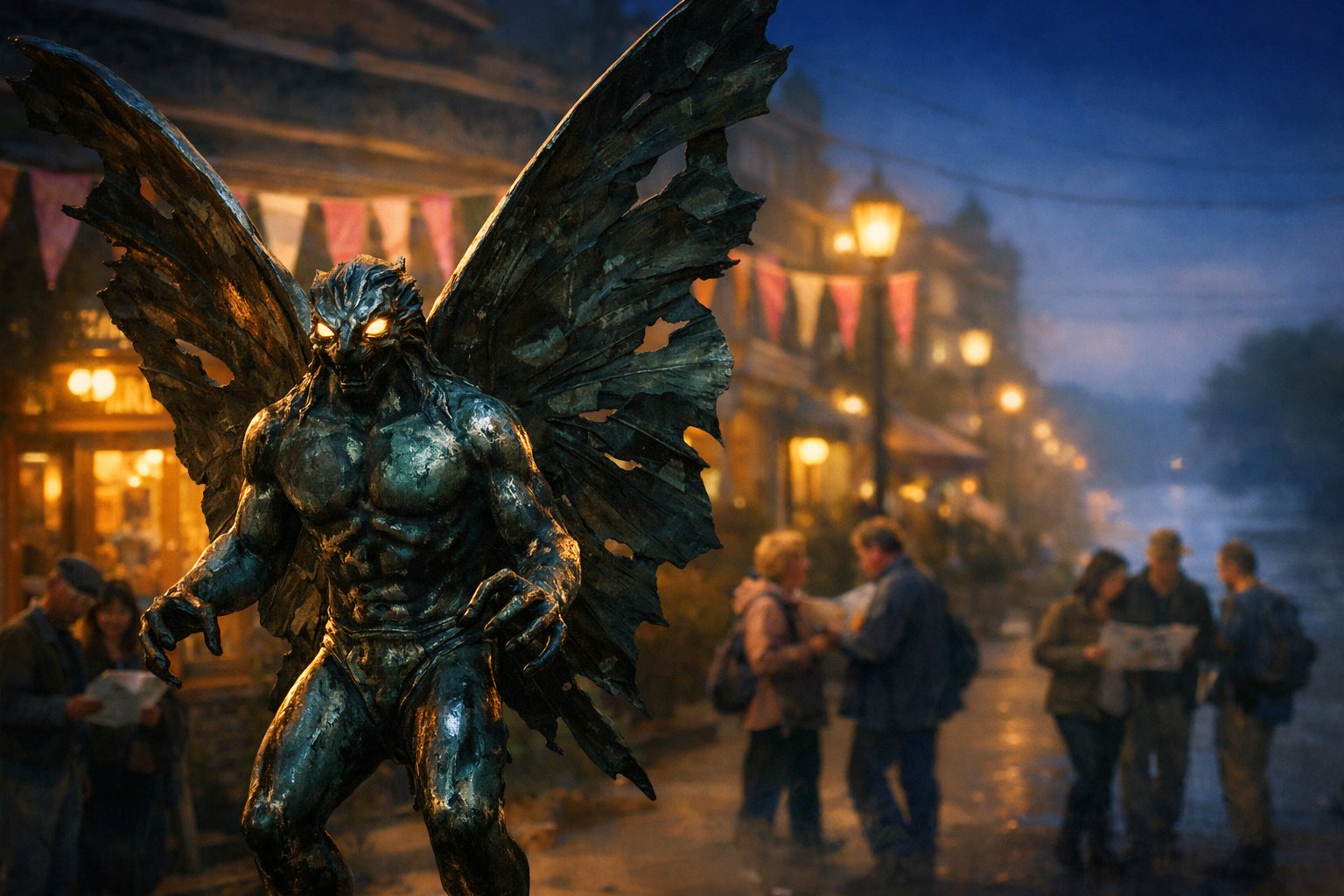
Bob Roach’s Mothman Museum opened in 2005 on Main Street in Point Pleasant, two blocks from the Ohio River and around the corner from Bob Roach’s earlier purpose: collecting the John Keel archive, the Linda Scarberry and Roger Scarberry primary-witness materials, and the 1967 newspaper run of the Point Pleasant Register [5]. The bronze Mothman statue by Bob Roach (sculptor Bob Roach is a distinct figure from the museum’s namesake; the statue’s sculptor of record is Bob Roach of Sutton, with the cast installed in 2003) anchors the corner of 4th and Main and is the most-photographed public artwork in Mason County [6].
The Mothman Festival, founded in 2002 by Jeff Wamsley (also the museum’s founder of record), occupies the third weekend of September each year. Mason County tourism reporting through 2024 has placed festival-weekend attendance in the 10,000 to 15,000 range, with the lower bound on weather-affected years and the upper bound in 2017 (the fiftieth-anniversary year) and 2022 [3][7]. For a host town of roughly 4,100 residents, that ratio — peak festival population at roughly three times the resident base — is a working definition of a placemaking success.
Flatwoods, Grafton, Vegetable Man, and Appalachian Bigfoot: Distributing the Demand
The Flatwoods Monster, reported September 12, 1952, in Braxton County by the Fisher and May families, anchors the second hub of West Virginia’s cryptid portfolio, with the Flatwoods Monster Museum in Sutton and the painted metal chair-statue installations dispersed across town as a self-guided walking trail [8]. The Braxton County Convention and Visitors Bureau lists the chair installation as a deliberate placemaking project completed in stages between 2015 and 2018, with each chair sponsored by a local business [9].
The Grafton Monster, reported June 16, 1964, by Robert Cockrell of the Grafton Sentinel, occupies a smaller niche in Taylor County but appears in the West Virginia Folklife Program’s interpretive material and in the 2022 launch of the Mountaineer Cryptid Trail, a self-guided driving route across six counties managed by West Virginia Tourism [10]. The Vegetable Man, reported July 1968 near Fairmont in Marion County, is the rarest of the named five — primarily a Jennings Frederick single-witness incident — and survives mostly as a footnote in cryptid catalogs and a niche entry on the same Mountaineer Cryptid Trail [11].
Bigfoot reports across the Appalachian range of West Virginia are catalogued continuously by the Bigfoot Field Researchers Organization, with 110 county-level reports logged in West Virginia through April 2026 [12]. Unlike the location-specific Mothman or Flatwoods events, Bigfoot tourism in West Virginia operates as a dispersed, year-round trail experience anchored by state-park-adjacent retail rather than by a single municipal hub.
The Five-County Distribution at a Glance
| Cryptid | Primary County | Anchor Year | Public Installation | Annual Event |
|---|---|---|---|---|
| Mothman | Mason | 1966-1967 | Bronze statue + Mothman Museum, Point Pleasant | Mothman Festival (third weekend, September) |
| Flatwoods Monster | Braxton | 1952 | Chair-statue trail + museum, Sutton | Flatwoods Days (September, biennial) |
| Grafton Monster | Taylor | 1964 | Mountaineer Cryptid Trail signage, Grafton | (integrated into trail) |
| Vegetable Man | Marion | 1968 | Mountaineer Cryptid Trail signage, Fairmont | (integrated into trail) |
| Bigfoot (Appalachian) | Statewide (110+ reports) | Continuous | State-park-adjacent retail; multiple festivals | Various small county events |
The Economics: Asset-Light, Post-Extractive, Proof-Agnostic
Cryptid tourism in West Virginia satisfies three economic conditions simultaneously, and the conjunction is what makes it durable. First, it is asset-light: a bronze statue costs in the tens of thousands of dollars, a chair-statue trail in the low six figures, and a small museum lease and fit-out in the same range. There is no theme park, no roller coaster, no rights-clearance bill from a studio [13]. Second, it is post-extractive: Mason and Braxton Counties carry the structural-decline signatures of mid-twentieth-century mining and chemical-industry contraction, and the cryptid economy occupies storefronts that would otherwise be vacant on Main Streets that would otherwise be losing foot traffic [14]. Third, it is proof-agnostic: the legend does not require the creature to be real for the tax receipts to clear.
The conflation worth resolving: cryptid tourism is not the same as cryptozoology. Cryptozoology is a contested field of inquiry concerning the documentation of putative unrecognized animals; cryptid tourism is a regional-economic-development category that consumes the folklore of cryptozoology as its raw material. The town does not have to take a position on the ontological status of Mothman for the festival to clear $1.5 million in regional spending across the September weekend, an estimate consistent with Mason County visitor-impact reporting for 2022 through 2024 [3][7].
The Mason County Convention and Visitors Bureau, in its 2024 annual summary, attributed roughly 18 percent of total county overnight stays to the September festival weekend alone, with the rest of the Mothman-related visitation distributed across the calendar via the museum, the riverfront mural circuit, and the Silver Bridge memorial [3]. As of April 2026, the Mountaineer Cryptid Trail’s signage program has been extended from six to nine counties, with West Virginia Tourism reporting incremental gas-tax and lodging-tax receipts in the trail counties exceeding the program’s annual signage and marketing budget by an approximately three-to-one ratio in the most recent fiscal year [15].
The Ohio Comparison: Loveland Frogman 2026 and the West Virginia Playbook
Ohio state legislators in 2026 introduced a bill to designate the Loveland Frogman — a cryptid first reported in Loveland, Ohio in 1955 and 1972 — as the state’s official cryptid, an action whose stated economic justification cites the West Virginia tourism model directly [16]. The Ohio framing treats cryptid designation as a low-cost municipal-and-state placemaking lever in line with the Appalachian precedent: declare, signpost, sculpt, and let the cryptid carry the merchandising tail behind it.
What’s actually being measured here is whether a state-level cryptid designation, absent the festival-and-museum infrastructure that took Point Pleasant twenty years to build, can produce comparable visitor impact on a shorter timeline. The honest answer is that the West Virginia model is structurally Appalachian — small towns with vacant Main Street inventory, a tourism bureau with both placemaking authority and small grant capacity, and a folklore with an existing primary-witness record. Ohio’s Loveland sits in a higher-income, lower-vacancy commuter ring of Cincinnati, which changes the elasticity of the local supply side. The cryptid-trail elements transfer; the cheap-storefront elements do not.
If you want to read the policy proposal at the source, the bill’s progress and a county-level economic analysis are tracked in our companion article on the Loveland Frogman 2026 state cryptid bill. The Ohio approach borrows the West Virginia branding logic; whether the demand-side economics carry over is the open empirical question of the 2026-2028 tourism cycle.
What the Working Tourism Economist Concludes
Per the public record: West Virginia has built a measurable, durable, multi-county cryptid tourism portfolio on a budget of statues, museums, and festival weekends, and the Ohio legislative move on the Loveland Frogman in 2026 is the first formal recognition by a neighboring state that the playbook is transferable. The empirical case for cryptid tourism rests not on the resolution of the creature’s ontological status — Mothman does not have to be a real animal for the Mason County tax receipts to clear — but on the asset-light, proof-agnostic, post-extractive structure of the underlying model.
I came at this as I would a population study. The town behaves predictably the third week of September. The infrastructure is observable; the receipts are reported; the model is, at this point, a documented economic-development case rather than a speculation. For other Appalachian-adjacent regions with thin tourism portfolios and rich folklore inventories, the West Virginia data is the prior. The deeper question — whether national-scale cryptid-tourism saturation eventually erodes the marginal returns of each new town’s designation — is the analysis the next decade of trail expansion will have to answer.
For broader context on how regional cryptid folklore connects to media, place-branding, and ongoing cryptozoological inquiry, see the Cryptids and Mythical Creatures pillar and the sibling overview on the Mothman as harbinger of doom.