

Drafted with AI assistance from the sources listed; images are AI-generated illustrations. How EsoVitae is made
A May 2026 paper in the Journal of Human Evolution redated the stone-tool floor at the Lingjing site in Henan Province, central China, to roughly 146,000 years ago, pushing prepared-core toolmaking in East Asia back by about twenty thousand years and assigning the work to Homo juluensis — an archaic human relative formally named only in 2024 [1][2].
What Was Found at Lingjing, and Why It Counts as an OOPArt
The Lingjing dig, on a fan of loess and silt outside the village of Lingjing in Henan Province, has been worked steadily for more than a decade by Chinese and American collaborators, and in May 2026 lead author Yuchao Zhao of the Field Museum and senior author Zhangyang Li of Shandong University published a recalibration of its lower tool-bearing layer using uranium-thorium dates drawn from calcite crystals embedded in butchered animal bones [1][2][3].
The site sits in the karst-laced hill country of central Henan, the kind of country where loess piles up against limestone outcrops and the surface of the land is a slow archive — older sediments pressed under younger ones, and somewhere in that quiet column, a thin band of red-brown silt that, in cross-section, glints with knapped chert. Local farmers reported the bone-rich layer in the late 1960s; the formal excavations under the Henan Provincial Institute of Cultural Heritage and Archaeology began in 2005 [4]. The newly redated horizon, Layer 11, falls inside what paleoclimatologists call Marine Isotope Stage 6, a glacial trough when much of mid-latitude Eurasia was cooler, drier, and steppe-dominated [1].
The mystery here is not the kind that asks whether visitors came from elsewhere; the mystery is the kind that asks whether a textbook needs to be rewritten. For most of the last forty years, Middle Paleolithic stone-tool teaching has run on a comfortable map: prepared-core technology — the Levallois method, in which a knapper shapes a core in advance so that a single struck flake carries a predetermined edge — is a signature of western Eurasian Neanderthals and African early modern humans, while East Asia is said to have stayed with simpler core-and-flake industries until much later [5]. The Lingjing flakes break that map. They are centripetally prepared, planned several strikes ahead, and they show up roughly forty thousand years before the western edge of the consensus permitted them at this longitude.

Walking the Site: Stratigraphy, Bones, and the Calcite Crystal Trick
Standing at the Lingjing excavation, you see less than expected — a fenced rectangle cut into pale loess, the bone layer marked with thread grids, a wood-and-tarp shelter against the rain. The drama is in the column wall, where a careful eye picks out the horizons by color: pale Holocene fill at the top, then a sequence of Late Pleistocene silts, and below them the dense, dark Layer 11 with its packed fauna of Equus, deer, and a few rhinoceros teeth [1].
The dating breakthrough was a method, not a magnetometer survey or a satellite-spotted feature. The lower Lingjing levels had always lain just beyond radiocarbon’s working ceiling of about fifty thousand years, which left earlier teams relying on bracketing arguments and a single optically stimulated luminescence run that placed the layer somewhere between 100,000 and 130,000 years old [4]. Zhao and colleagues found a deer rib with calcite crystals grown inside the marrow cavity — a natural mineral clock — and ran uranium-thorium dating on those crystals. Uranium-238 decays to thorium-230 at a known rate; if a crystal grew in a closed system, the U/Th ratio fixes its age within tight error bars. The Lingjing crystals returned a mean of 146,000 ± 6,000 years, roughly twenty millennia older than the prior best estimate [1][2].
The stratigraphy reads cleanly. The crystals lay inside the marrow cavity of a bone whose outer surface carries cut-marks and percussion notches from the same lithic toolkit found in Layer 11. That spatial fact — crystal inside the bone, bone surrounded by the tools that broke it — is what makes the U/Th age load-bearing for the artifacts. The tools cannot be younger than the bone they butchered, and the bone cannot be younger than the calcite that grew inside it. The paper’s lead figure, Figure 3, walks the reader through this chain in microscope plates that are themselves quietly persuasive [1].
The Tools Themselves: Centripetal Cores, Quina Scrapers, and Planned Strikes
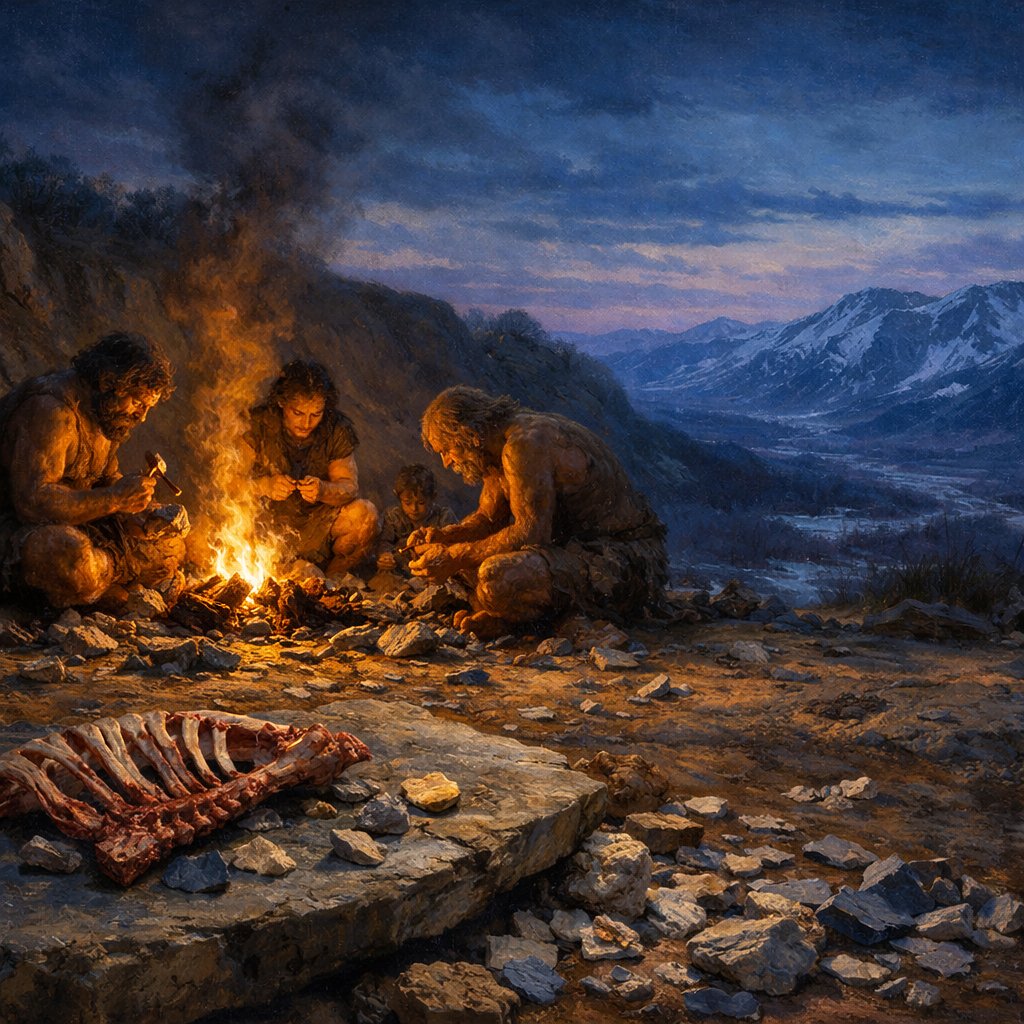
The Layer 11 assemblage is dominated by what lithic specialists call a centripetal prepared-core industry — flakes struck from cores that have been worked around their circumference in advance so that the final strike yields a flake with a sharp, controllable edge and a predictable shape [1][5]. This is the family of techniques to which the classical Levallois method belongs, and several Lingjing cores are textbook examples: clear striking platforms, faceted edges, the characteristic “tortoise back” dorsal surface where earlier preparation flakes were removed [1].
A second technology shows up alongside the prepared cores: a Quina-style scraper assemblage in which thick flakes are repeatedly resharpened along one steep edge, leaving the back of the scraper blunt and the working edge fractal-stepped. Quina scrapers were first described in the Charentian Mousterian of southwestern France, where they are associated with Neanderthal cold-climate butchery practice [6]. The reappearance of Quina-pattern resharpening in central China during a glacial period is one of the paper’s quieter surprises and the basis for its argument that Homo juluensis independently invented — rather than imported — a high-efficiency cold-weather toolkit [1][3].
Reduced to its evidence: the Lingjing knappers planned several strikes ahead, recycled their cores intelligently, and maintained their working edges across multiple use-events. Those three behaviors, taken together, are what archaeologists mean when they speak of “complex” or “advanced” Middle Paleolithic technology — not a single dazzling artifact but a sustained method.
Who Was Doing This? Homo juluensis and the Denisovan Question
The hominin remains recovered from Lingjing’s middle layers — most famously the two partial crania nicknamed Xuchang 1 and Xuchang 2, published by Wu and colleagues in Science in 2017 — were assigned in a 2024 review by Christopher Bae and Xiujie Wu to a new species, Homo juluensis, on grounds of distinctive cranial morphology (large brain case, low vault, broad face) that does not slot cleanly into either Homo erectus, archaic Homo sapiens, or Neanderthals [7][8].
The species name is contested and the relationships are unsettled. Some paleogeneticists read the Lingjing/Xuchang material as a Denisovan lineage, in part because Denisovan genomes inferred from Siberian and Tibetan finds suggest a wide East Asian range during exactly this period [9]. Others reserve Homo juluensis as a morphological designation and remain agnostic on its molecular identity. The 2026 paper does not stake a strong claim on the taxonomic debate; it argues, more cautiously, that whoever made the tools was practicing a level of forward-planning that the existing East Asian Middle Paleolithic record had not previously credited to them [1].
What’s actually being measured here is cognition, by proxy. Prepared-core knapping requires holding a target shape in working memory across a sequence of strikes whose individual outcomes only make sense in light of the final flake — a kind of structured planning that cognitive archaeologists have long used as a behavioral marker for advanced executive function [10]. The Lingjing redate moves that marker east, and roughly twenty thousand years earlier than it had previously been documented at this latitude.
Why It Matters: The “Movius Line” and the Map of Middle Paleolithic Cognition
For seventy-five years, lithic archaeology has lived under a faint pencil mark called the Movius Line, drawn by Hallam Movius in 1948 down the longitude of South Asia, with the Acheulean hand-axe industries of Africa, Europe, and the Near East on one side and a putatively simpler core-and-flake tradition on the other [11]. The Movius framing was always partly an artifact of unequal fieldwork; East Asia was less excavated. It calcified anyway into a story about cognitive lag — that the East Asian record showed fewer prepared cores because its makers were doing less prepared thinking.
By the late 2010s the Movius framing was already being chipped at from inside the discipline. The 2018 Nature paper on Guanyindong Cave in Guizhou reported Levallois flakes in southwest China dated to between 80,000 and 170,000 years ago [5]; the 2025 Quina-scraper report from Longtan, Yunnan, dated to 50,000 to 60,000 years ago, added a second non-trivial confirmation [6]. Lingjing now becomes the third major site in roughly a decade to push prepared-core or Quina-style technology into East Asia at depths once reserved for the western Eurasian record. The pattern matters more than any single date.
Table: The Three East Asian Middle Paleolithic Sites That Now Defy the Old Map
| Site | Region | Approx. Age | Technology | Probable Maker | Publication |
|---|---|---|---|---|---|
| Guanyindong Cave | Guizhou Province, SW China | 80,000–170,000 BP | Levallois prepared cores | Indeterminate archaic Homo | Hu et al., Nature, 2018 |
| Longtan | Yunnan Province, SW China | 50,000–60,000 BP | Quina-style scrapers | Indeterminate, possibly Denisovan-affiliated | Ruan et al., 2025 |
| Lingjing | Henan Province, central China | 146,000 ± 6,000 BP | Centripetal prepared cores + Quina scrapers | Homo juluensis | Zhao et al., J. Human Evolution, 2026 |
How a Recalibration Like This Travels: Press, Pushback, and the Slow Half-Life of Textbooks
As of May 2026, the Zhao et al. paper has been picked up by ScienceDaily, Discover, Popular Science, Phys.org, and the heritage press, generally framed as a story about ice-age creativity rather than about taxonomic reshuffling [2][3][12]. The press emphasis on “creativity during hard times” is true but downstream — the load-bearing finding is the date, and the secondary finding is the planning behavior the date now anchors.
Critical responses are already arriving. Some specialists argue that the U/Th age applies cleanly to the bone but that the association between the dated rib and the deepest tools should be tested with a second independent method — most likely electron spin resonance on tooth enamel from the same layer [1]. Others note that Homo juluensis as a species name is still being negotiated, and that until ancient-DNA work is published from the Lingjing crania the connection between maker and tool remains a stratigraphic inference rather than a genetic identification [9]. These are reasonable hesitations. They are not the textbook-shaped objection.
What the site teaches, in the end, is that the East Asian Middle Paleolithic was a longer and busier conversation than the Movius pencil ever permitted — and that the makers of that conversation, whatever we ultimately name them, were thinking several strikes ahead in the dark of a glacial winter, in a country of loess and limestone where their bone fragments still glitter, when you tip them right, with the crystals that finally told us when.
Standalone FAQ
What was discovered at the Lingjing site in 2026?
A May 2026 paper redated the lower tool-bearing layer at Lingjing in Henan Province, central China, to roughly 146,000 years ago using uranium-thorium dating of calcite crystals found inside butchered animal bones, pushing prepared-core toolmaking in East Asia back by about twenty thousand years [1][2].
Who made the Lingjing tools?
The Layer 11 tools are attributed to Homo juluensis, an archaic human relative formally named in a 2024 review by Christopher Bae and Xiujie Wu on the basis of distinctive cranial morphology from the Lingjing material itself, especially the Xuchang 1 and Xuchang 2 crania published in Science in 2017 [7][8].
What is the Levallois method, and is this Levallois?
The Levallois method is a prepared-core knapping technique in which a stone core is shaped in advance so that a single struck flake produces a predetermined edge. The Lingjing cores are centripetally prepared, a sister technique within the same prepared-core family; some specialists call them Levallois-like rather than classical Levallois [1][5].
Why does the 146,000-year date matter?
For most of the last forty years, prepared-core technology was thought to be primarily a western Eurasian phenomenon during the period in question. The redate places sophisticated, planned toolmaking in central China during Marine Isotope Stage 6, a glacial trough, twenty thousand years earlier than the prior East Asian record permitted [1][5].
What is uranium-thorium dating, in plain English?
Uranium-238 trapped inside a growing mineral crystal decays slowly to thorium-230 at a known rate. Measuring the ratio of the two in a closed-system crystal lets a lab calculate when the crystal formed. The method’s working range extends roughly 500,000 years, well beyond radiocarbon’s ceiling [13].
Does this finding overturn the Movius Line?
It doesn’t overturn the Movius Line on its own; it joins the 2018 Guanyindong report and the 2025 Longtan report as the third major East Asian site to host prepared-core or Quina-style technology in the Middle Paleolithic. The cumulative pattern, rather than any single date, is what is reshaping the post-Movius consensus [5][6].
Were the Lingjing makers Denisovans?
Some paleogeneticists read the Lingjing/Xuchang hominin material as part of a Denisovan-affiliated East Asian lineage, in part because Denisovan genomes recovered from Siberia and Tibet imply a wide regional range during this period. Without ancient-DNA work from the Lingjing crania, the affiliation remains a hypothesis [9].
Can the Lingjing site be visited?
The excavation is an active research site managed by the Henan Provincial Institute of Cultural Heritage and Archaeology; public access is limited. The Xuchang Museum, about thirty kilometers east of the dig, displays casts of the Xuchang crania and selected lithics, and offers the most accessible way to encounter the material [4].
What should I read first if I want to go deeper?
Start with Zhao et al. (2026) in the Journal of Human Evolution for the primary paper; pair it with Bae and Wu’s 2024 review of Homo juluensis, and with Hu et al.’s 2018 Nature report on Guanyindong for the wider East Asian Middle Paleolithic context [1][5][7].
Where Lingjing Fits in the Wider Map of Historical and Archaeological Mysteries
If you are tracing the longer arc of out-of-place artifacts and re-dating events that keep nudging the human story earlier, the Lingjing recalibration belongs on the same shelf as the 2024 Iberian Neanderthal ochre work and the still-debated 2017 Cerutti Mastodon report from California. The category — Historical and Archaeological Mysteries — is gradually filling with finds whose mystery is not their existence but their date, their longitude, and the species we now have to credit with them. The broader sub-category sits at Mysterious Artifacts (OOPArts) on the site.