
Drafted with AI assistance from the sources listed; images are AI-generated illustrations. How EsoVitae is made
Cultural myths about albino animals are the symbolic meanings people assign to rare white or unpigmented creatures. Across Lakota, Buddhist, Celtic, Chinese, and Pacific Northwest traditions, a white animal is read as an omen, a sacred messenger, or a taboo being, layering human belief over a simple pigment condition.
What the Myths About Albino Animals Actually Claim
Cultural myths about albino animals assign symbolic weight to a pigment condition, so that across at least four continents a white or unpigmented animal is read as an omen, a spirit messenger, or a creature under taboo rather than as a genetic variant. The pattern is old, widespread, and remarkably consistent in its grammar even when the species changes.
Biology draws a line the myths rarely notice. True albinism is the inherited absence of melanin, which leaves an animal white-coated with pink, blood-vessel eyes; leucism is a partial pigment loss that usually spares the dark eye. Most of the animals a culture calls sacred, the white bison and the Kermode spirit bear among them, are leucistic rather than albino, yet the reverence attaches to the whiteness, not to the gene behind it. I start with the animal and treat the story as a second, equally real layer of data, recorded with the same care as a coat color.
These beliefs sit inside the wider field of animal anomaly mysteries, where a rare phenotype and a human meaning tend to travel together, a recurring theme across this site’s coverage of albino animal phenomena and legends. The table below maps the recurring roles a white animal is asked to play.
| White animal | Tradition or region | Symbolic role |
|---|---|---|
| White bison | Lakota and Plains nations | Renewal of a sacred covenant |
| White elephant | Buddhist and Thai | Divine birth and righteous kingship |
| White stag | Celtic and Arthurian | Otherworld messenger and quest sign |
| White tiger (Bai Hu) | Chinese | Guardian of the west, mark of a virtuous ruler |
| Spirit bear (Moksgm’ol) | Tsimshian and Kitasoo/Xai’xais | Living reminder of the last ice age |
| White snake (Bai Suzhen) | Chinese | Transformed spirit and devoted lover |
Albino Animals as Omens: Fortune and Foreboding
A white animal works as an omen in two opposite directions at once, signaling fortune and fertility in one tradition and announcing death or disorder in the next, which is the first thing that makes these myths hard to flatten into a single meaning. The same pallor that promises rain in one valley reads as a shroud in the next.
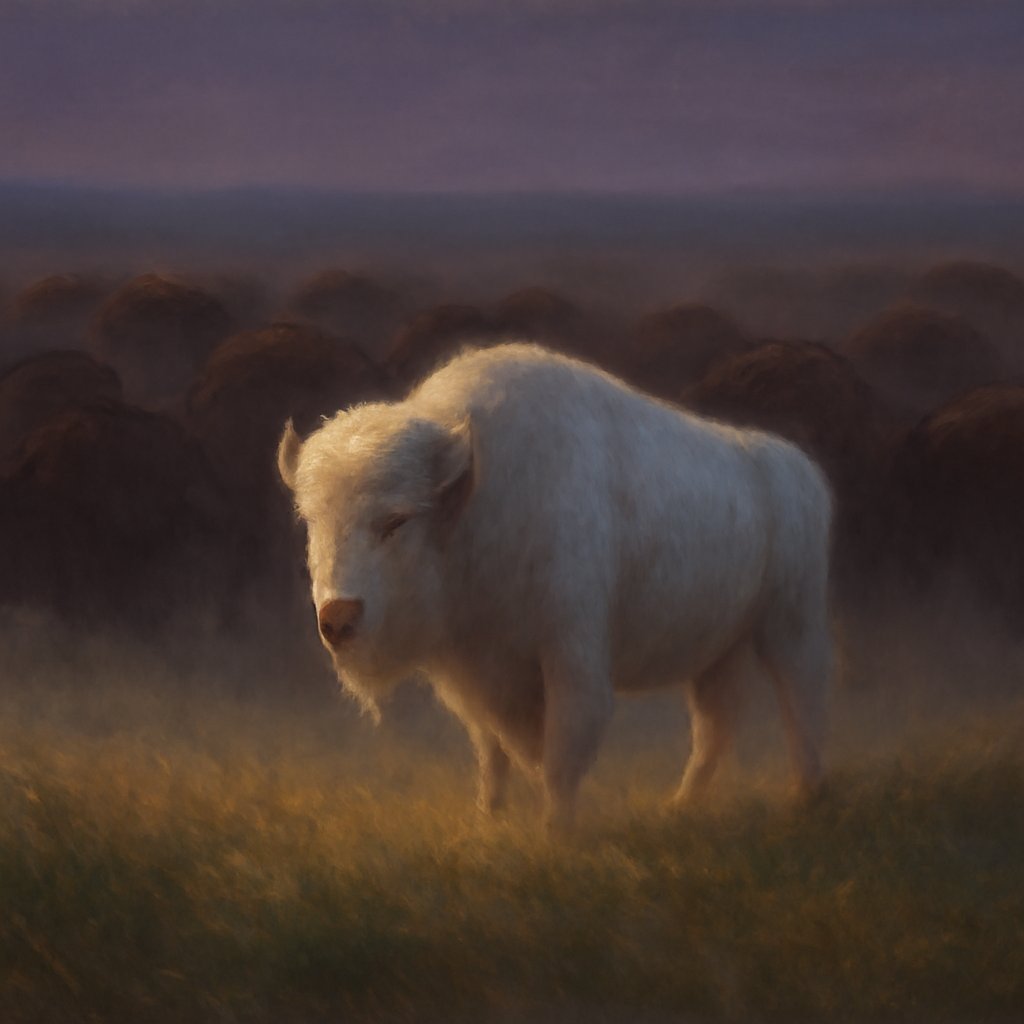
On the fortune side, the clearest case is the white bison of the North American Plains. In Lakota tradition the birth of a white buffalo calf is the fulfillment of a covenant carried by White Buffalo Calf Woman, who, according to the U.S. National Park Service account of the legend, brought the people the sacred pipe and promised to return [1]. When a white, non-albino calf named Miracle was born on a Janesville, Wisconsin farm on August 20, 1994, the pasture became a pilgrimage site that drew tens of thousands of visitors. The pattern repeated in June 2024, when a white calf in Yellowstone’s Lamar Valley was given the Lakota name Wakan Gli, meaning “Return Sacred,” in a ceremony attended by hundreds [2].
The popular telling versus the actual record diverges here in a way worth holding. Whiteness is not univocally lucky. Herman Melville built an entire chapter of Moby-Dick (1851), “The Whiteness of the Whale,” on the way the color fuses purity with dread, arguing that white can appall “by its indefiniteness” even as it crowns kings and saints [8]. In several European and Pacific traditions a white deer, a white crow, or a white serpent crossing one’s path could read as a warning rather than a blessing. The animal does not change. The frame around it does.
Sacred Messengers and Spirit-Animal Beliefs
Across the Northern Hemisphere a white animal is cast as a messenger that moves between the human world and a spirit world, carrying word, summons, or warning, and this messenger role is the single most widespread motif in the entire body of albino-animal myth. The creature is a courier, not merely a curiosity.
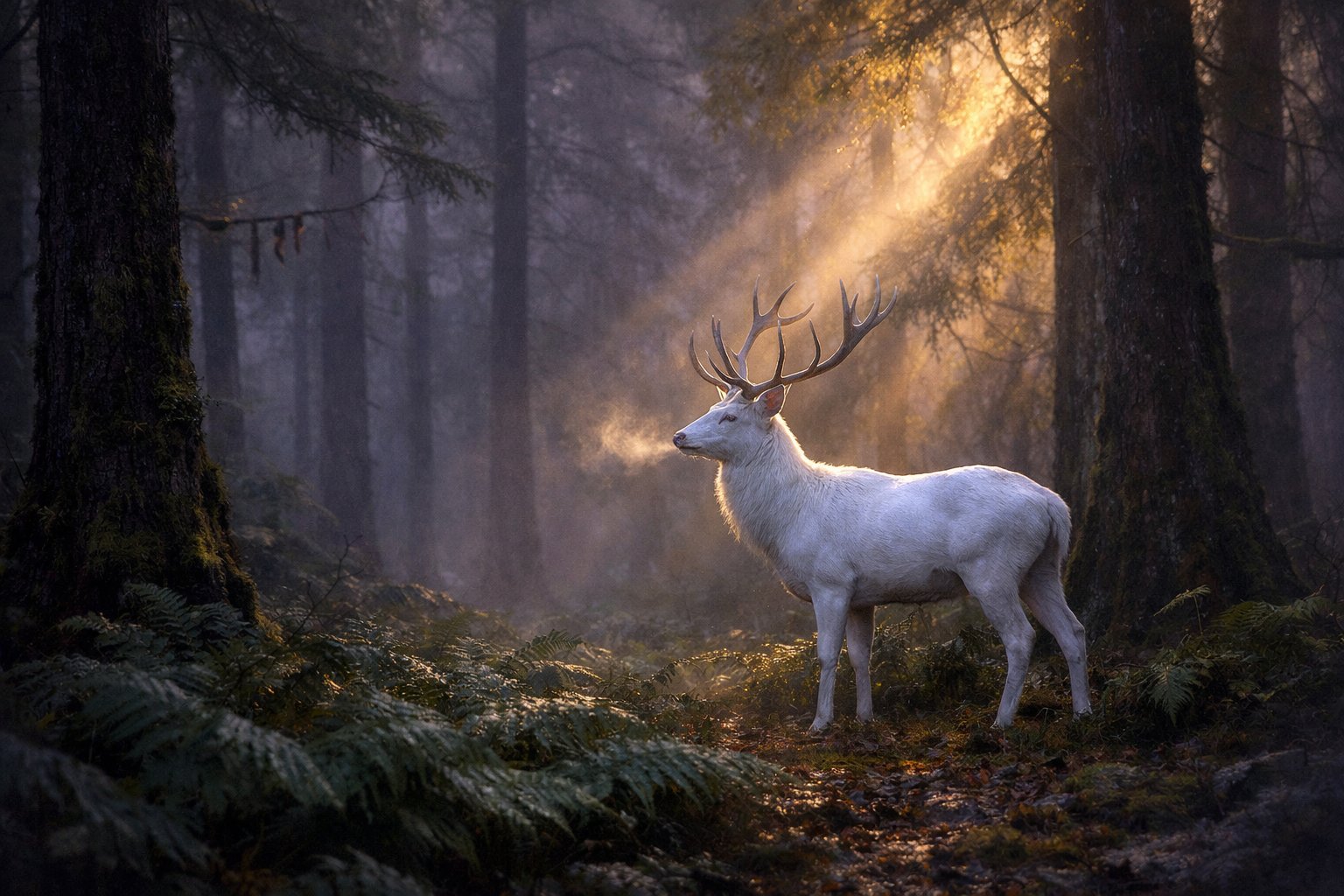
In Celtic and Arthurian material the white stag is a being of the Otherworld whose appearance often signals that a taboo has been crossed. In the Welsh Mabinogion, a white stag draws Pwyll onto the hunting ground of Arawn, a king of the Otherworld, and the encounter sets the whole tale in motion [4]. The Hungarian legend of the wondrous hart sends a white stag ahead of the brothers Hunor and Magor, leading them into Scythia and, in the telling, toward the founding of their peoples. Christian hagiography reused the image, placing a glowing crucifix between the antlers of the stag that converts Saint Hubert.
The messenger appears in fur and scale as well as antler. In Tsimshian and Kitasoo/Xai’xais tradition along the British Columbia coast, Raven turned one in ten black bears white to mark the end of the last ice age, creating the Moksgm’ol, the spirit bear that National Geographic documents as central to those nations’ cosmology [7]. In China, the white snake spirit Bai Suzhen, who cultivated a thousand years on Mount Emei before taking human form, anchors one of the Four Great Folktales [6]; related Japanese belief treats white snakes as messengers of the goddess Benzaiten. The recurring claim is the same: the white animal speaks for something the human cannot otherwise hear.

The Taboo on Killing a White Animal
Many traditions wrap a white animal in a prohibition, treating its killing as a transgression that invites curse, misfortune, or the anger of a spirit power, and this taboo is the point where belief most directly touches the animal’s survival. The rule protects the rare individual long before any conservation statute does.
The taboo is woven into the messenger role. Because the Celtic white stag tends to appear precisely when a hunter has trespassed, the pursuit of it carries the threat of otherworldly reprisal [4]. Plains nations extend a comparable protection to the white bison, whose sacred status under the legend of White Buffalo Calf Woman makes harming one unthinkable [1]. The effect is measurable in the modern record: white-coated langur troops near temples in northern India experience lower hunting pressure, and white deer in protected herds reach ages their pigmented kin rarely see once human reverence removes the gun from the equation.
The conflation worth resolving is between the myth and the mechanism. A taboo does not know genetics, yet it acts on the same animals selection would otherwise cull fastest, because a white coat that is conspicuous to a predator is equally conspicuous to a person deciding what is sacred. The belief and the biology end up pointing at the same individual from opposite directions, one to spare it and one, in the wild, to expose it. Reverence becomes, in effect, a substitute for the camouflage the animal lacks.
Purity, Divinity, and Royalty: The White Elephant
In South and Southeast Asian tradition the white elephant fuses purity, divine favor, and legitimate kingship into a single body, making it the most politically loaded of all the sacred white animals. To own one was to be told by heaven that you ruled justly.
The sanctity begins at the source of the tradition. Buddhist texts record that Queen Maya, mother of the Buddha, dreamed of a white elephant with six tusks entering her side as the sign of her divine conception, an episode the Encyclopaedia Britannica treats as foundational to the Maha Maya narrative [3]. In Hindu cosmology the white elephant Airavata serves as the mount of Indra, king of the gods. In Thailand and Burma, possession of a white elephant signaled that the monarch reigned with justice, which is why the animal once stood at the center of royal regalia.
Reduced to its evidence, the symbol cuts both ways. The English phrase “white elephant,” meaning a ruinous and useless possession, descends from the practice by which the kings of Siam reportedly gifted a sacred elephant to a courtier they wished to bankrupt, since the animal could be neither worked nor given away [3]. The Chinese tradition shows the same logic in a different species: the Bai Hu, the White Tiger of the West and one of the Four Symbols, was said to appear only when a ruler governed with perfect virtue [5]. A white animal could crown a king or, withheld, indict him.
Why the Same Myth Recurs Across Cultures
The cross-cultural recurrence of these myths is not coincidence but a predictable response to anomaly, because an animal that violates the ordinary categories of its kind reliably attracts a charge of the sacred. Rarity, high visibility, and category-breaking combine into something a culture reads as meaning.
What this argument actually rests on is a well-known result in anthropology. In Purity and Danger (1966), Mary Douglas showed that the Lele of central Africa accorded the pangolin a central place in their ritual life precisely because it broke every rule of their animal classification, being scaled like a fish yet a tree-climbing mammal that bore its young singly [9]. A white animal performs the same violation in the register of color: it is unmistakably a deer or a bear or an elephant, yet it is the wrong color for its kind, and that wrongness is what the eye and the mind catch.
From the ethological side the salience is straightforward. A white coat against green or brown cover is detectable at far greater distance than a pigmented one, so the anomalous animal is, literally, the one a watching human notices first and remembers longest. Melville named the same nerve when he traced how whiteness can read as both the holiest and the most dreadful of colors [8]. Put the rarity, the conspicuousness, and the category-violation together, and the sacred reading is close to overdetermined. The myth is the human mind doing what it does with a strong, infrequent signal: assigning it a cause.
When Belief Decides the Animal’s Fate
Cultural belief about albino and white animals is itself an ecological force, raising or lowering an individual’s odds of survival as surely as predation or disease does, which is why a naturalist cannot treat these myths as decoration. The story written around the animal becomes part of its selective environment.
On the protective side the effects are well documented. First Nations stewardship of the spirit bear has driven habitat protection across the Great Bear Rainforest, where the Kermode bear is now British Columbia’s official mammal [7]. The white bison pilgrimages, from Miracle in 1994 to Wakan Gli in 2024, channel reverence into conservation attention for a species that nearly vanished from the Plains [1][2]. Reverence, in these cases, buys the animal a kind of insurance that biology alone would never extend to so conspicuous a coat.
The darker side of pigment superstition is real and deserves naming without sensationalism. Peer-reviewed human-rights research documents how, in parts of Tanzania, beliefs that treat the absence of pigment as supernatural have driven violence against people with albinism, a sobering measure of how far a myth about whiteness can travel from the animal it began with [10]. The lesson for anyone who works with these animals is plain. The myth is not separate from the creature’s life; it is one of the variables. Read the belief accurately, and you can predict, sometimes, whether the next white calf will be guarded or hunted. That is a question worth measuring, herd by herd, with the animal kept in view the whole time.
Frequently Asked Questions
What do albino animals symbolize across cultures?
Albino and white animals most often symbolize one of three things: a good or ill omen, a messenger from the spirit world, or a being under taboo that must not be harmed. Specific meanings vary by tradition. The white bison signals renewal for Plains nations, the white elephant marks divine favor and just kingship in Buddhist and Thai culture, and the white stag serves as an Otherworld messenger in Celtic myth. The shared thread is that whiteness is read as meaningful rather than accidental.
Are albino animals considered good luck or bad luck?
Both, depending on the tradition. Many cultures treat a white animal as a sign of fortune, fertility, rain, or spiritual blessing, which is why white bison births draw pilgrimages. Others read the same pallor as a warning or a harbinger of death. Herman Melville captured this double meaning in Moby-Dick, noting that whiteness can signal both the holiest purity and a nameless dread. The animal is neutral; the luck lives in the cultural frame placed around it.
Why is the white buffalo sacred to Native American tribes?
In Lakota tradition, the white buffalo is sacred because of White Buffalo Calf Woman (Pte San Win), who brought the people the sacred pipe and seven ceremonies and promised to return as a white buffalo calf. A white calf’s birth is read as the renewal of that covenant and a call to care for the Earth. The births of Miracle in 1994 and the Yellowstone calf named Wakan Gli in 2024 were both received as fulfillments of this prophecy.
What does a white elephant symbolize in Buddhism?
A white elephant symbolizes purity, divine conception, and righteous kingship. Buddhist texts record that Queen Maya dreamed of a white elephant with six tusks entering her side before the birth of the Buddha, marking the event as miraculous. In Hindu cosmology the white elephant Airavata is the mount of the god Indra. In Thailand and Burma, owning a white elephant signaled that the monarch ruled with justice and that the kingdom was blessed.
Where does the phrase “white elephant” come from?
The phrase, meaning a costly and useless possession, comes from a reported Southeast Asian royal practice. The kings of Siam, now Thailand, are said to have gifted a sacred white elephant to courtiers they wished to ruin, because the animal was holy and so could not be put to work, sold, or given away, yet was enormously expensive to keep. A blessing impossible to refuse became a burden impossible to escape.
Is the spirit bear an albino bear?
No. The spirit bear, or Kermode bear (Moksgm’ol), is a white-coated subspecies of American black bear, not an albino. Its white fur comes from a recessive mutation in the MC1R gene, and the bears keep normal dark eyes, which an albino would not. On Princess Royal Island in British Columbia, roughly one in ten black bears is white. In Tsimshian tradition, Raven created these bears as a reminder of the last ice age.
What is the difference between albinism and leucism in sacred white animals?
Albinism is the total inherited absence of melanin, producing a white animal with pink, blood-vessel eyes. Leucism is a partial pigment loss that typically leaves the eyes dark. Most animals revered as sacred, including the white bison and the Kermode spirit bear, are leucistic rather than truly albino. The cultural meaning attaches to the white coat regardless of the genetic mechanism, so traditions rarely distinguish the two even though biologists do.
Why do so many cultures treat white animals as supernatural?
Because a white animal is an anomaly, and anomalies attract a charge of the sacred. The anthropologist Mary Douglas argued in Purity and Danger (1966) that creatures violating a culture’s normal categories tend to be treated as either polluting or holy. A white deer is unmistakably a deer yet the wrong color, and that category-breaking, combined with its rarity and high visibility, makes the mind reach for a meaning. Different cultures arrive at similar myths because they face the same striking signal.
Are white stags real or mythological?
Both. White stags exist as living deer whose pale coats result from leucism, and they have been photographed in Britain, Europe, and North America. They also occupy a deep mythological role as Otherworld messengers in Celtic and Arthurian tradition, as the guide of Hunor and Magor in Hungarian legend, and as the stag that converts Saint Hubert in Christian hagiography. The rarity of the real animal is what gave the mythological one its force.
Can cultural beliefs about white animals affect conservation?
Yes, in both directions. Protective beliefs have helped: First Nations reverence for the spirit bear supports habitat protection across the Great Bear Rainforest, and white bison are guarded as sacred. Harmful pigment superstitions also exist, and peer-reviewed research documents real-world violence linked to beliefs about the absence of pigment. For conservation, the practical point is that belief is a measurable variable in whether a rare white animal is protected or persecuted.