
Drafted with AI assistance from the sources listed; images are AI-generated illustrations. How EsoVitae is made
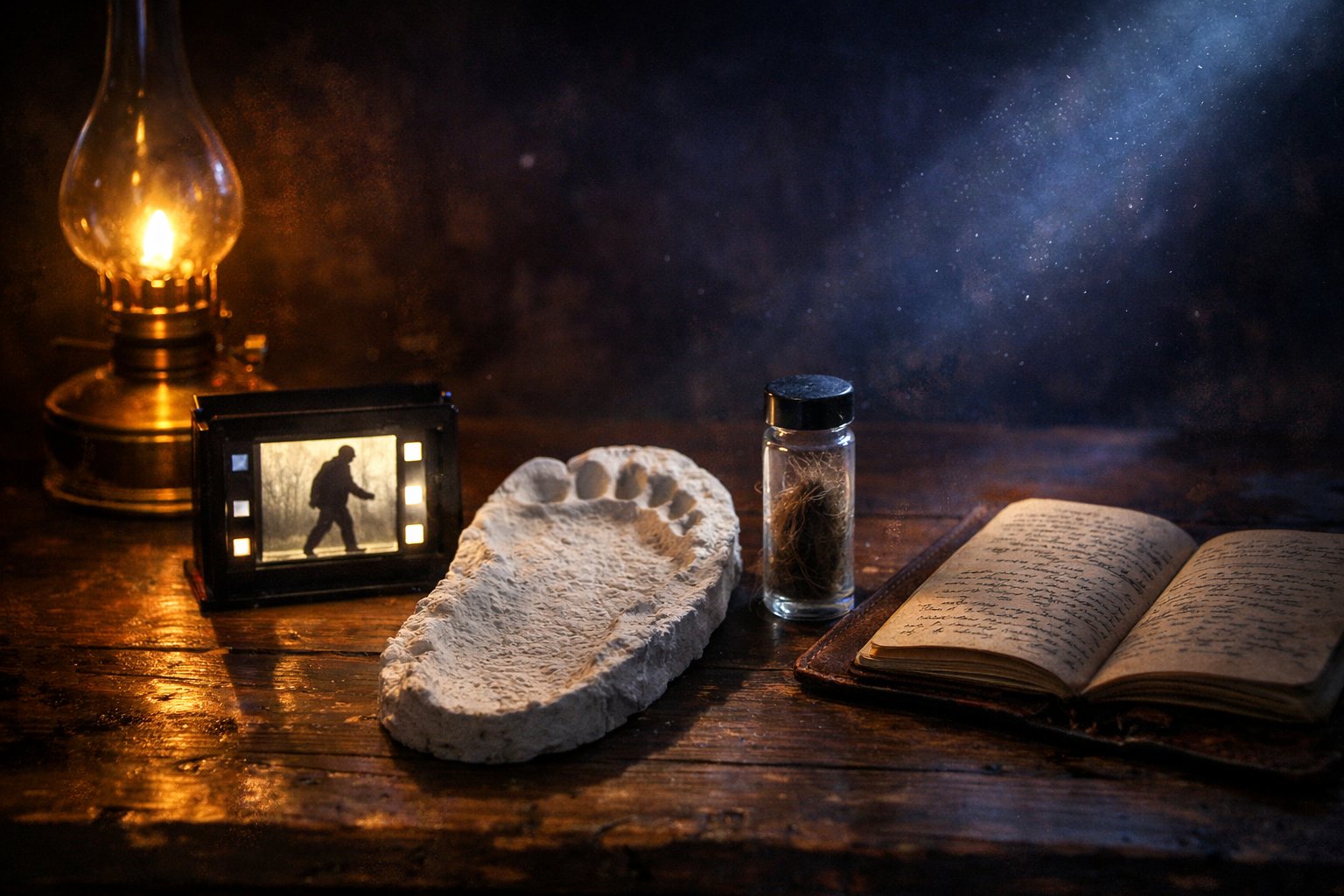
The evidence for Bigfoot, the large hairy hominid reported across North America’s forests, falls into four classes: the 1967 Patterson-Gimlin film, plaster footprint casts, the 2014 Sykes DNA study, and tens of thousands of eyewitness reports. Each class records a real human experience; none has yet produced a body.
What Counts as Bigfoot Evidence, and What Each Class Can Establish
Bigfoot evidence divides into four classes, film, footprints, biological samples, and eyewitness testimony, and each class answers a different question, so weighing the case means asking what every class can and cannot establish on its own. The approach here is to listen first and arbitrate last.
In folklore studies, the figure has a long pedigree. The hairy forest-dweller is a recognized narrative motif, the wild man of the woods, catalogued in the Aarne-Thompson-Uther index alongside the green man and the Norse skogsra. That lineage does not make the physical evidence weaker or stronger. It means the experience was worth naming for centuries before anyone owned a camera. A companion overview of North America’s elusive giant walks the wider terrain. This piece does one thing: it weighs the evidence, class by class.
A note on method. I do not treat the witness as a suspect and I do not treat the skeptic as a spoilsport. The Patterson-Gimlin film testifies to one thing, a footprint cast to another, a hair sample to a third. The honest task is to keep those testimonies separate and let each say only what it can.
The Patterson-Gimlin Film, Frame by Frame
The Patterson-Gimlin film, shot on October 20, 1967, at Bluff Creek in northern California, runs roughly 59.5 seconds on a borrowed 16mm Cine-Kodak K-100 camera and remains the single most analyzed piece of cryptid footage ever recorded [1][3]. Roger Patterson and Bob Gimlin had ridden in on horseback to look for tracks. What they brought back was just under a thousand frames of a tall, dark, upright figure crossing a sandbar.
The image everyone knows is frame 352, the moment the subject, nicknamed Patty, turns to face the lens. Of the film’s roughly 954 frames, motion blur ruins many, yet a few hundred are stable enough to study, especially after M.K. Davis reprocessed the footage to subtract camera shake [3].
The Look-Back Frame and the Costume Question
Two readings have competed since the lab first developed the reel. The costume hypothesis holds that the figure is a person in a tailored ape suit; stuntman Bob Heironimus said he wore it, and effects designer Philip Morris claimed in 2002 to have sold Patterson the costume [1]. The unknown-primate reading runs the other way. Bill Munns argued in his 2014 study When Roger Met Patty that the figure’s shifting muscle mass and the variable sheen of its hair exceed what 1967 foam-and-fabric costuming could produce. The strongest skeptical verdict came early. John Napier, who directed the primate biology program at the Smithsonian, concluded in his 1973 book Bigfoot: The Sasquatch and Yeti in Myth and Reality that the film, taken collectively, points to a hoax of some kind [6]. The film proves a filmed subject. It does not prove a species, and no reconstruction has closed the costume question.

Footprint Casts and the Dermal-Ridge Debate
Footprint casts became Bigfoot’s morphological record in 1969, when a deformed right foot pressed into snow near Bossburg, Washington, produced the Cripplefoot casts that convinced Washington State University anthropologist Grover Krantz the tracks were genuine [1]. Krantz built his case on a detail invisible to most viewers: faint dermal ridges, the foot’s equivalent of fingerprints, that he believed no carver would think to fake.
The dermal-ridge argument later passed to Jimmy Chilcutt, a Texas latent-print examiner who reported that three casts, known as Onion Mountain, Wrinkle Foot, and the Elkins cast, carried friction-ridge patterns unlike any human or known primate [4]. For a while this was the case’s most technical-sounding evidence. Then it met a controlled test. What the 2005 experiments actually establish: Matt Crowley, working from the same hot, dry conditions as the Onion Mountain find, cast ordinary surfaces and reproduced the very ridge patterns Chilcutt had called diagnostic. Michael Dennett reported in the Skeptical Inquirer that the ridges were artifacts of the casting process, appearing across all of Crowley’s tests, and even Jeff Meldrum of Idaho State University, the field’s principal academic advocate, conceded the point [4].
Hoaxing compounds the problem. Ray Wallace’s 1958 Bluff Creek prints, the founding event of the modern phenomenon, were revealed after his 2002 death to have been carved wooden stompers [1]. A cast can record real morphology, a hoaxer’s craft, or a quirk of drying plaster, and telling the three apart is the whole difficulty.
The 2014 Sykes DNA Study
The 2014 Sykes study, published August 22, 2014, in Proceedings of the Royal Society B, sequenced mitochondrial DNA from 30 hair samples attributed to Bigfoot, Yeti, and related figures, and matched every one to a known mammal [2][3]. Bryan Sykes, the Oxford geneticist who pioneered mitochondrial methods in human population studies, ran the samples through the 12S ribosomal RNA gene after rigorous decontamination.
The North American results read like a barnyard census: American black bear, brown bear, cow, horse, dog, sheep, raccoon, deer, porcupine, and human. Two Himalayan hairs first matched a Palaeolithic polar bear, a finding later challenged and reattributed to the Himalayan brown bear, Ursus arctos isabellinus [2]. Across the replication record, this is the single hardest negative result the case has produced. It does not prove no creature walks those forests. It does retire the paranormal-class hypothesis, the idea of a ghostly or interdimensional being that nonetheless sheds ordinary hair, because every hair a believer submitted came from a catalogued animal [2][3].
What the Eyewitness Record Actually Shows
Eyewitness reports are Bigfoot’s largest evidence class, with the Bigfoot Field Researchers Organization indexing several thousand accounts by state and county, led by Washington, California, and the wider Pacific Northwest [5]. One consolidation of the public record counted 3,313 sightings between 1921 and 2013, with Washington alone above two thousand [5].
Here is where the folklorist’s instinct and the analyst’s caution have to share a desk. The popular telling vs the actual record: the maps look like a habitat signal, dense forest, low population, but the same clusters trace interstate highways, popular trailheads, and cell coverage just as closely [5]. A report density that follows roads as faithfully as it follows trees is telling us something about reporters, not only about the reported. John Napier, weighing this record in 1973, still wrote that he was convinced Sasquatch exists, even as he rejected the film [6]. That tension is the honest shape of the eyewitness file.
What testimony establishes is real and not small: a durable, geographically patterned, emotionally vivid human experience, often recounted years later in the present tense, as if the encounter never quite ended. What testimony cannot establish is a species. Both statements are true at once, and a writer who collapses either into the other has stopped listening.

The Folklorist’s Verdict: A File Kept Open
No verified carcass, skeleton, or sequenceable Bigfoot genome exists, so the evidentiary case stays open: strong as a cultural and experiential record, unproven as a zoological one. Laid side by side, the four classes corroborate a phenomenon without confirming an animal.
| Evidence class | Key specimen or dataset | What it can establish | Principal challenge |
|---|---|---|---|
| Patterson-Gimlin film | 16mm footage, Oct 20 1967, ~954 frames | A real filmed subject with a documented gait | Unresolved costume claims; no recovered suit |
| Footprint casts | Bossburg Cripplefoot (1969); Meldrum’s 300-plus collection | Repeatable morphology, occasional ridge detail | Ridges reproducible as casting artifacts; documented hoaxes |
| Biological samples | Sykes 2014, 30 samples, Proc. R. Soc. B | That submitted “Bigfoot” hair comes from known mammals | No sample has yielded an unknown-primate genome |
| Eyewitness reports | BFRO database, 3,300-plus indexed accounts | A durable, patterned human experience | Clusters track roads and population, not only habitat |
The Bigfoot witness deserves careful listening. The wild man of the woods is an old motif and a living report at the same time, and the evidence, weighed honestly, asks us to hold both without forcing a verdict that the casts, the film, the DNA, and the testimony have not yet earned. If you want the cultural afterlife of the figure, see how Bigfoot moved from forest to screen; for the broader terrain, the paranormal and supernatural phenomena collection keeps the same discipline. The file stays open because honesty requires it.
Frequently Asked Questions
What is the strongest evidence for Bigfoot?
The Patterson-Gimlin film of October 20, 1967, is the strongest single piece, because it shows an upright, hair-covered subject with a gait that no one has cleanly reproduced in a 1967-era costume. It proves a filmed subject, not a species, and the costume question remains unresolved on both sides [1][3].
Did the 2014 Sykes DNA study disprove Bigfoot?
Not entirely. Bryan Sykes sequenced 30 hair samples and found every one came from a known mammal, from black bear to human [2]. That rules out a paranormal or unknown-primate origin for the submitted material and retires the supernatural hypothesis, but it cannot prove that no undiscovered animal exists in unsampled forest [2][3].
Are Bigfoot footprint dermal ridges real evidence?
They were once the case’s most technical evidence, after Grover Krantz and Jimmy Chilcutt identified ridge patterns on casts such as Onion Mountain. In 2005 Matt Crowley reproduced those same ridges through ordinary casting, and the Skeptical Inquirer reported them as artifacts of drying plaster, weakening the claim considerably [4].
How many Bigfoot sightings have been reported?
The Bigfoot Field Researchers Organization maintains the largest public database, and one consolidation counted 3,313 reports between 1921 and 2013. Washington leads with more than two thousand, followed by California and the wider Pacific Northwest. The clusters track forest cover, but also roads and population density [5].
What is frame 352?
Frame 352 is the most reproduced still from the Patterson-Gimlin film, the moment the subject turns its upper body toward the camera. Of roughly 954 frames, motion blur spoils many, but several hundred are sharp enough to analyze, especially after stabilization passes removed the hand-held camera shake [3].
Why do folklorists take Bigfoot seriously?
Because the hairy forest-dweller is a documented narrative motif, the wild man of the woods, recorded across cultures long before modern sightings. Folklorists catalogue the experience without arbitrating its physical truth. A patterned, durable account is data about human encounter, whatever its ultimate cause [6].
Has a Bigfoot body ever been found?
No. There is no verified carcass, skeleton, fresh tissue sample, or sequenceable nuclear genome. A breeding population of large hominids would, over time, leave bones, and none have been recovered and authenticated. This absence is the central obstacle to confirming Bigfoot as a biological species [2].
Could Bigfoot sightings be misidentified bears?
In many cases, yes. American black bears occasionally walk upright, and in poor light a bipedal bear can read as a hominid silhouette. The 2014 Sykes study identified several submitted “Sasquatch” hairs as bear [2]. Bear misidentification explains part of the record, though not the film or the morphology debate.