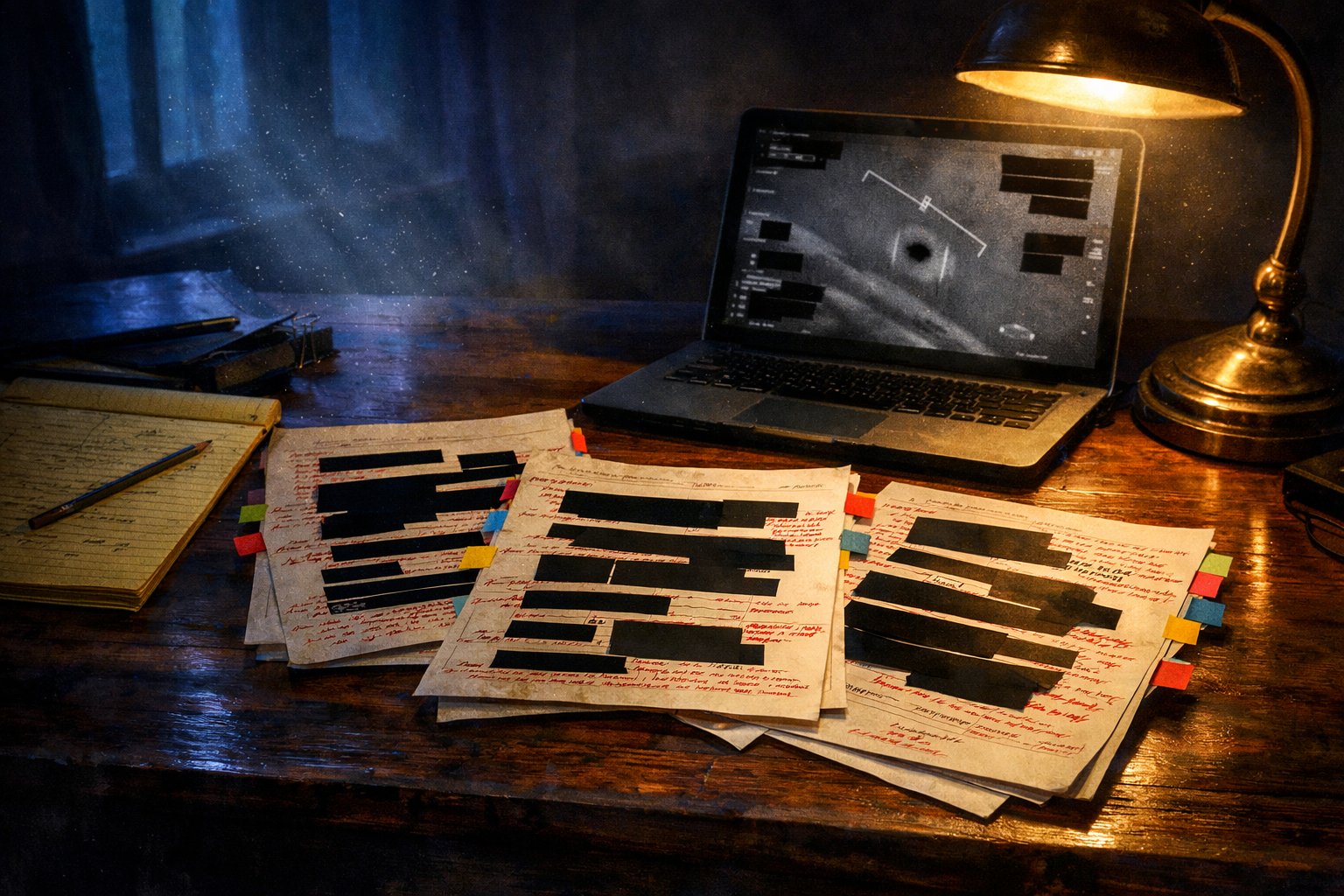
On May 14, 2026, six days after the Department of War posted its first 162 PURSUE records at war.gov/UFO, DefenseScoop published a community-reaction roundup that crystallized a single phrase the UAP research community had begun repeating in podcasts, Substacks, and X threads since the drop: data alone is not disclosure [1]. The line is a critique, not a slogan. It says the Pentagon released a stack of files without supplying the authoritative interpretive context that would turn the files into disclosure on the public’s terms.
This article reads the May 14 community response as its own documentary record. It treats the researchers, journalists, and advocates quoted in the post-release coverage as primary sources on what the Pentagon’s framing left out. It is not an argument that PURSUE failed. It is an audit of the gap researchers say sits between what was released and what disclosure, as a policy goal, was meant to deliver.
Published: May 18, 2026. Last reviewed: May 18, 2026.
The Community’s Headline Critique, in One Sentence
By May 14, 2026, the dominant UAP research community consensus on the May 8 PURSUE drop had condensed into a one-line evidentiary complaint: roughly 160 documents were posted, at least 100 of those carried redactions, and the records arrived without the provenance metadata, raw sensor data, or witness-corroboration scaffolds that would let a disciplined reader convert ink-stained PDFs into resolvable cases [1][2].
The line “data alone is not disclosure” is doing technical work. It pulls the meaning of disclosure away from “files were released” and back toward “questions were answered.” The Pentagon shipped the PDFs, the video stills, and the audio. It did not ship the kinematic ground truth, the unredacted case-officer narratives, or the cross-reference indexes that would let an outside analyst replicate AARO’s adjudications. Researchers quoted by DefenseScoop framed that absence as the load-bearing failure of the rollout, not a procedural oversight [1].
For the documentary case on what is actually inside Release 01, see the companion piece on PURSUE Release 01 and the Pentagon’s first mass UAP declassification. The present article picks up where that one stops: with what the community said about it on the second week.
What “Disclosure” Means When Researchers Use the Word
The community’s use of disclosure is older than PURSUE and more specific than the public-relations register the Department of War used on May 8. Stripped of folklore, disclosure for the major advocacy organizations—the Sol Foundation, the Galileo Project, The Black Vault, Americans for Safe Aerospace—has three minimum requirements that researchers and analysts quoted in the May 14 reporting returned to repeatedly [1][3].
The first is provenance. Every record needs a chain of custody an outside investigator can trace: collecting platform, collection date, intake office, classification path, redaction authority, and analyst attribution. The second is raw alongside summary. Sensor returns, witness statements, and contemporaneous internal memos must travel with the analytic summary that interprets them, so the public can see the working, not just the conclusion. The third is named accountability. A summary memo carries weight when the analyst who signed it is named and the redaction authority is cited; an unsigned executive summary carries far less.
Against that floor, the PURSUE batch was uneven. The FBI legacy material in case file 62-HQ-83894 arrived with strong provenance because it had been on the FBI Vault for years and John Greenewald Jr.’s indexing at The Black Vault had already mapped the sub-serials [4]. The 2023 to 2024 sensor videos arrived without the kinematic fields—velocity, range, acceleration vectors—that Avi Loeb’s May 11 Medium analysis flagged as redacted on initial release [5]. The community read that asymmetry as a tell: the records the public could already get arrived clean; the records the public couldn’t get arrived stripped.
The Redaction Count Researchers Are Citing
As of May 14, 2026, researchers studying the first PURSUE tranche reported the same headline arithmetic across multiple outlets: a little over 160 files in the initial release, with at least 100 of them carrying redactions visible to an outside reader [1]. That ratio—roughly two-thirds of the records partially blacked out—became the most-cited number in the second-week coverage.
The Pentagon’s own framing acknowledged the redactions. Officials stated none of the blackouts applied to “the nature or existence of any reported UAP encounter,” locating the cuts instead in source-protection and methods-protection categories [2]. Researchers found that distinction useful but partial. Source-protection redactions are unavoidable in any declassification regime. The complaint was structural: the redactions were applied to fields—witness affiliation, sensor identifier, geographic coordinates, kinematic measurement—that an outside analyst needs precisely to evaluate whether AARO’s adjudication of “unresolved” is correctly calibrated.
| Field redacted | Researcher complaint | What an analyst needs it for |
|---|---|---|
| Velocity, range, acceleration | “Loeb’s bar to clear” [5] | Certify performance exceeds known platforms |
| Witness affiliation and rank | Limits credibility weighting | Adjudicate observer skill, optical position |
| Geographic coordinates | Blocks geospatial cross-check | Match to civilian radar, weather, traffic logs |
| Sensor make and model | Blocks instrument calibration | Rule out artifacts of a known sensor flaw |
| Collection date precision | Limits timeline reconstruction | Correlate with concurrent military exercises |
The records the community wanted most—the FY2024 Indo-Pacific Command infrared clip’s kinematic appendix, the witness-statement attachments behind the “orbs launching orbs” Western U.S. encounter—were precisely the records with the most aggressive redactions [1][5].
The Voices in the May 14 Roundup
The DefenseScoop May 14 piece and the community-reaction reporting alongside it surfaced a recognizable cast of researchers and analysts whose critiques shaped the second-week narrative [1]. Each carried a slightly different evidentiary expectation, and the differences are instructive.
Avi Loeb, the Harvard astrophysicist who chairs the Galileo Project, posted a May 11 Medium analysis itemizing the 162 records by source agency and concluded that none of the objects in the batch is sufficiently extraordinary to require an exotic origin, while flagging that key kinematic data on the videos remain redacted [5]. Loeb’s critique is the scientific-floor critique. He is asking for the measurements that would let a physicist falsify or confirm an exotic-performance claim. The redactions block that test.
John Greenewald Jr., who has run The Black Vault FOIA clearinghouse for more than two decades, registered a different complaint: that a substantial majority of the FBI material in the drop had been publicly available for years and that re-releasing it under a new portal heading inflates the appearance of novelty without adding evidentiary content [4]. Greenewald’s critique is the FOIA-veteran critique. He is asking whether the visibility uplift is being reported as a content uplift.
Americans for Safe Aerospace, the advocacy organization founded by former Navy pilot Ryan Graves, framed its response around witness corroboration. ASA’s position—reflected in second-week commentary across podcasts and Substacks—was that the released records do not include the kind of corroboration scaffolds (testimony cross-references, multi-platform sensor pairings) that would let the public independently evaluate AARO’s call of “unresolved” on its strongest cases [3].
FOIA-Style Precedents and the Gap Between Released and Answered
FOIA-style mass releases have a well-documented gap between “data released” and “questions answered,” and the UAP research community drew that line explicitly in the May 14 coverage [1][6]. Three precedents anchor the comparison.
JFK Records: Volume Without Consensus
The JFK Assassination Records Collection Act of 1992 required the National Archives to release roughly five million pages of assassination-related records, a process that ran in tranches through 2017 and beyond. The release inarguably enlarged the public record. It did not produce a consensus answer on the central historical questions. Researchers who lived through the JFK rollout—and several of them migrate between the JFK and UAP archival communities—have repeatedly noted that mass release without authoritative interpretive context produces more public confusion, not less [6].
MJ-12: When Provenance Failure Becomes Forgery Bait
The MJ-12 documents are the negative example. Surfaced in 1984 and circulated by UFO researchers as evidence of a high-level government cover-up, the documents were eventually adjudicated as forgeries by FBI and Air Force document analysts after years of public debate. The MJ-12 episode is the cautionary tale researchers cite when they argue that document drops without provenance metadata invite forgery insertion and waste years of analyst time on artifacts that should have been authenticated up front.
AARO Historical Record Report: Synthesis Without Working Papers
The AARO Historical Record Report Volumes I and II, published in March 2024 and the follow-on in late 2024, are the closest precedent inside the UAP file. Both reports synthesized a body of internal records and named no confirmed extraterrestrial program; the community response was sharply divided on whether the synthesis was rigorous or pre-determined [7]. The PURSUE drop reopens that debate by releasing source material adjacent to the synthesis without releasing the analyst working papers that connect the two.
The popular telling vs the actual record: the popular telling on May 8 was that the Pentagon had begun disclosure. The actual record by May 14 was that the Pentagon had begun a release pipeline whose first tranche the research community judged as insufficiently scaffolded to meet the disclosure bar the community itself uses.
What Would Make Round Two Meet the Bar
By May 14, 2026, researchers quoted across DefenseScoop, NBC News, and Aviation Week had begun articulating a concrete checklist for what Release 02 would need to include for the community to register the rollout as substantive disclosure rather than archival visibility [1][2][8]. The list is short, specific, and replicable.
Unredacted Kinematic Fields
First: unredacted kinematic fields on the marquee sensor videos. The football-shaped body in the U.S. Indo-Pacific Command 1:39 infrared track, the Greece 2023 ninety-degree-turn clip, and the Western U.S. orbs-launching-orbs witness logs all carry redactions on the data fields that would let a physicist falsify exotic-performance claims. Avi Loeb has named these fields specifically [5]; the community has converged on them as the minimum unlock for Release 02.
Surviving Provenance Metadata
Second: provenance metadata that survives the export. Each record needs a header bloc with collecting platform, collection date, classification authority, redaction authority, and analyst attribution. The FBI legacy material carries this metadata because it was already on the FBI Vault. The new 2023 to 2024 sensor material largely does not. The community wants Release 02 to ship with the header blocs intact [1].
Witness-Corroboration Scaffolds
Third: witness-corroboration scaffolds for the multi-observer cases. The “orbs launching orbs” encounter is the case AARO itself flagged as among the most compelling in its holdings because six federal officers across three independent two-person teams reported the same event. The community wants the underlying statements, the inter-team distance measurements, the optical-channel separation analysis, and the contemporaneous radio logs released alongside the AARO summary [2]. Without those scaffolds the strongest case in the tranche cannot be independently re-adjudicated.
The 46 Luna-Requested Videos
Fourth: the 46 sensor videos formally requested by Representative Anna Paulina Luna, which were not in the May 8 batch and which Loeb expects to surface in a later tranche [5][8]. Whether and when those clips appear, and what kinematic fields accompany them, will be the practical test of whether the Pentagon’s stated commitment to rolling tranches translates into substantive disclosure.
Strip away the spectacle, and the residue is: the community is not asking for confirmation of non-human intelligence. It is asking for the working papers, the metadata, and the measurements that would let outside analysts reach their own evidentiary conclusions. That is what “data alone is not disclosure” means when researchers say it. The phrase is a request for the scaffolding, not a complaint about the data.
Where This Leaves the Reader
On the documentary record as of May 14, 2026: the Pentagon ran a first tranche, the research community ran a first audit, and the gap between the two is now public, named, and citable. The Department of War committed to rolling tranches every few weeks. The community has filed a public specification for what those tranches need to contain. The next test is whether Release 02 closes the gap or widens it.
The work going forward is the work this beat keeps describing: read what the record says, note what it doesn’t, quote the case by number, wait for the next tranche. For the broader disclosure timeline and how this fits the seventy-nine-year arc of U.S. government engagement with the topic, see the Alien & Extraterrestrial Mysteries pillar. Reporting bio: Marcus Halloway.
Frequently Asked Questions
What does “data alone is not disclosure” actually mean?
It is a community critique that emerged in the days after the May 8, 2026 PURSUE release, articulated across DefenseScoop’s May 14 coverage and adjacent reporting. The phrase argues that releasing files without provenance metadata, unredacted kinematic data, and witness-corroboration scaffolds fails the disclosure-purpose test, even when the file count is large.
How many records were in the May 8 PURSUE tranche, and how many were redacted?
Researchers studying the initial tranche reported a little over 160 files in the release, with at least 100 of those carrying visible redactions. The Pentagon stated none of the redactions applied to the nature or existence of any UAP encounter, locating the cuts instead in source-protection and methods-protection categories.
Who are the main researchers quoted in the May 14 community reaction?
Avi Loeb (Harvard astrophysicist, Galileo Project chair) on the May 11 Medium analysis flagging redacted kinematic data; John Greenewald Jr. of The Black Vault on the recycled-FBI-legacy critique; Americans for Safe Aerospace and other advocacy voices on the absence of witness-corroboration scaffolds. Additional analysts and journalists were quoted in DefenseScoop’s May 14 roundup.
What is Avi Loeb’s specific objection?
Loeb wrote on May 11 that none of the objects in the batch is sufficiently extraordinary to require an exotic origin, while flagging that the velocity, range, and acceleration data on the videos are redacted. Without those fields, no physicist can certify the recorded behavior as exceeding known platform performance, which is the standard scientific bar for the claim.
What is the JFK precedent for this critique?
The JFK Assassination Records Collection Act of 1992 produced roughly five million pages of releases in tranches running through 2017 and beyond. The release enlarged the public record but did not produce historical consensus on the central questions, and researchers who lived through it argue mass release without authoritative interpretive context tends to produce more public confusion, not less.
What were the MJ-12 documents, and why are they relevant here?
MJ-12 refers to a set of documents surfaced in 1984 that purported to show a high-level government cover-up of an extraterrestrial program. FBI and Air Force document analysts eventually adjudicated them as forgeries after years of public debate. The episode is cited as the cautionary precedent for what happens when documents arrive without provenance metadata sufficient to authenticate them up front.
What did the AARO Historical Record Report Volumes I and II conclude?
The AARO Historical Record Report, published in two volumes in 2024, synthesized a body of internal U.S. government records and named no confirmed extraterrestrial program. The community response was sharply divided on whether the synthesis was rigorous or pre-determined, and the PURSUE release reopens that debate by posting source material adjacent to the synthesis without the analyst working papers connecting the two.
What is the “orbs launching orbs” case, and why does the community want more data on it?
It is a 2023 Western U.S. incident in which six federal officers across three independent two-person teams reported large orange orbs releasing smaller red orbs before vanishing. AARO calls it among the most compelling reports in its current holdings. The community wants the underlying witness statements, inter-team distance measurements, optical-channel separation analysis, and contemporaneous radio logs released alongside the AARO summary so the case can be independently re-adjudicated.
What are the 46 sensor videos researchers keep mentioning?
Representative Anna Paulina Luna formally requested 46 sensor videos from the Pentagon that were not included in the May 8 PURSUE batch. Avi Loeb has stated he expects them to surface in a later tranche. Whether they appear in Release 02, and what kinematic fields accompany them, is treated as the practical test of whether the rolling-tranche commitment translates into substantive disclosure.
What checklist has the community filed for Release 02?
Four items: unredacted kinematic fields on the marquee sensor clips; provenance metadata header blocs surviving export on every record; witness-corroboration scaffolds for the multi-observer cases; and the 46 Luna-requested sensor videos. The checklist is short, specific, and was reconstructed from community commentary across DefenseScoop, NBC News, Aviation Week, and the Galileo Project’s Medium output.
Has the Pentagon responded to the “data alone is not disclosure” framing?
As of May 14, 2026, the Department of War had reiterated its commitment to rolling tranches every few weeks and to the existing statutory floor under the FY2026 National Defense Authorization Act, but had not directly addressed the community’s specific scaffold-deficit critique. Release 02’s content, when it lands, will function as the practical answer.