
By EsoVitae Editorial · Published
Drafted with AI assistance from the sources listed; images are AI-generated illustrations. How EsoVitae is made
What Happened on Northwest Orient Flight 305 on November 24, 1971?
A man calling himself Dan Cooper boarded Northwest Orient Flight 305 from Portland to Seattle on the afternoon of Wednesday, November 24, 1971, handed a flight attendant a note announcing a bomb in his briefcase, and demanded $200,000 in twenty-dollar bills and four parachutes. After releasing the passengers in Seattle, he ordered the Boeing 727 toward Mexico City and parachuted from the rear airstair somewhere over southwestern Washington that evening. He has not been positively identified.
The case file the FBI opened that night carries the designation NORJAK, short for Northwest Hijacking, and the file number 164-3856. It is the only unsolved skyjacking in the history of United States commercial aviation. Half a century of agent rotations, pop-cultural retellings, deathbed claims, and one genuinely consequential particle-analysis study have not closed it. The Bureau formally suspended active work on the case in July 2016 after forty-five years; the file remains open in principle, available to claimants who can produce something the previous claimants could not.
What follows is a procedural account, working from the contemporaneous federal record and the recovered physical evidence outward, and turning afterward to the principal suspect candidates and the questions the case has not been able to answer. The aim is to fit the disappearance into the broader landscape of historical and archaeological mysteries in which an absent body, in this case a parachutist who never returned to the world above the trees, drives every interpretation that follows.
The Man Was Not Named D. B. Cooper
The first thing to settle is the name. The man at the ticket counter at Portland International Airport at 2:50 p.m. on November 24, 1971, paid cash for a one-way ticket to Seattle and signed it Dan Cooper. The passenger manifest carried that name. The flight attendants who served him called him that. The hijacker’s identification, such as the cabin crew saw of it, gave the same name. The misnomer that has followed the case ever since came from a wire-service error.
In the hours after the hijacking, the FBI’s Portland field office, working at speed, placed an early identification call to a Portland resident named D. B. Cooper to clear or hold him as a person of investigative interest. The Associated Press picked up the name from a police scanner and transmitted it onto the wire under deadline. By the time the bureau corrected the record, the wire copy had been set into the next morning’s papers. The hijacker has been called D. B. Cooper in popular usage ever since. The Portland D. B. Cooper, whose involvement was eliminated within hours, never bore any further relationship to the case. The aerial fugitive remains, in the federal record, Dan Cooper. The press locked the wrong name in.
The Hijacking, Hour by Hour
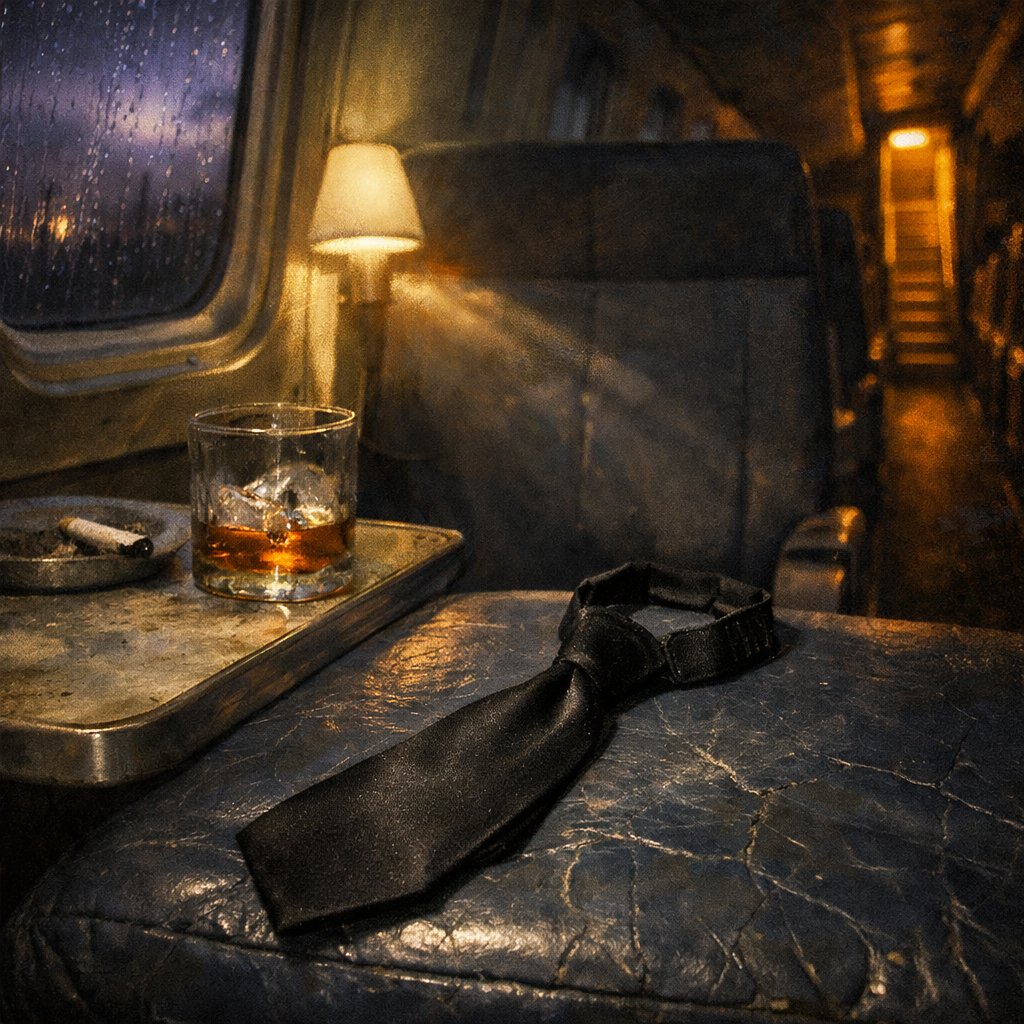
Flight 305 was a Boeing 727-100 leased to Northwest Orient. The aircraft sat thirty-seven passengers on the Portland-Seattle leg that Wednesday afternoon, including the hijacker. Dan Cooper sat in seat 18C, smoked Raleigh filter-tip cigarettes, ordered a bourbon and soda for two dollars, and tipped the flight attendant. He wore a dark business suit, a black clip-on tie, a white shirt, and brown loafers. He carried a black attaché case.
At 3:00 p.m., shortly after takeoff, he passed flight attendant Florence Schaffner a note he asked her to read. She put it into her purse, assuming it was a phone number. He leaned across the aisle and told her, quietly, that she should look at the note because he had a bomb. The case in his lap, briefly opened to her, contained what appeared to be eight red cylinders wired to a battery. Schaffner relayed the demands to the cockpit. Captain William Scott radioed Northwest Orient operations, who relayed the message to the FBI and to local police.
By the time the aircraft circled Seattle for the next two hours, the bureau had assembled the demand: $200,000 in twenty-dollar bills, two primary parachutes, two reserve parachutes, and a fueled aircraft ready for an onward flight. Northwest Orient’s president, Donald Nyrop, instructed the company to comply. The currency, drawn from a Seattle First National Bank vault, consisted of 10,000 unmarked twenty-dollar bills, all dated 1969 or earlier, all photographed for serial-number capture before delivery. The serial numbers were retained as the central forensic identifier of the case.
At 5:24 p.m., Flight 305 landed at Seattle-Tacoma International Airport. Cooper released all thirty-six passengers and two of the four cabin crew in exchange for the ransom and the parachutes. The aircraft refueled. At 7:40 p.m., with the captain, first officer, flight engineer, and flight attendant Tina Mucklow remaining onboard, the aircraft took off again under Cooper’s instructions: heading southeast, at minimum airspeed, no higher than 10,000 feet, with the rear airstair lowered.
The Jump, and Where the Search Ran Out of Daylight
Mucklow last saw Cooper at the rear of the cabin at 8:00 p.m., tying the canvas bank bag containing the ransom around his waist. He instructed her to enter the cockpit and close the door. At approximately 8:13 p.m., the cockpit instruments registered the slight pressure shift consistent with the airstair being deployed in flight. The crew did not see him jump. They saw the aft door light come on and felt the airframe yaw briefly. By the time the aircraft landed in Reno at 11:02 p.m., Cooper, the money, and two of the four parachutes were gone.
The flight path that evening crossed the Lewis River basin near Ariel in southwestern Washington in heavy weather. The night was overcast, with rain turning to sleet at altitude and a temperature of seven below freezing in the slipstream. Cooper jumped wearing the suit he had boarded in, with a single primary parachute strapped over it; he had cut up one of the reserve chutes, apparently for harness cord. The drop zone, calculated from the aircraft’s track and the prevailing winds, lies in a corridor running roughly between Ariel and Battle Ground in Cowlitz and Clark counties. The terrain is steep, forested, and wet, with the Lewis River at its lower edge.
The bureau, working with the Federal Aviation Administration and the United States Air Force, conducted ground searches in 1971 and 1972 across that corridor without recovering a body, a parachute, or any of the currency. A 727 reflight in early 1972, intended to refine the calculated drop zone with the same flap settings and weights, produced a more constrained corridor but no recoveries on the ground beneath it.
The Tena Bar Currency Find of February 1980
On Sunday, February 10, 1980, an eight-year-old boy named Brian Ingram was building a campfire pit with his family on a beach known as Tena Bar on the Columbia River, about nine miles downstream of Vancouver, Washington. While clearing sand for the fire, he uncovered three bundles of disintegrating twenty-dollar bills, banded with rotted rubber bands. The total recovered came to $5,800. The serial numbers, where still legible, matched the NORJAK ransom list.
The find produced one of the few certainties in the case. The currency at Tena Bar was Cooper’s. The location, however, opened a different problem. Tena Bar lies west and south of the calculated drop zone, on the wrong side of the Lewis River, and on a tributary of the Columbia rather than directly beneath the corridor. Hydrologists and FBI specialists who examined the deposit pattern concluded that the bills had not arrived by simple downstream wash. The rubber bands, dated by the United States Bureau of Engraving and Printing, would have failed within months of immersion in cold river water; the bands recovered with Ingram’s bundle had not failed, suggesting the bundles had been buried in dry ground and uncovered by the river relatively recently. According to the FBI case summary, the bureau did not arrive at a settled hypothesis for how the money got to Tena Bar from any candidate jump zone. Brian Ingram was eventually awarded a portion of the recovered currency in 1986 after litigation; one of his bills sold at auction in 2008 for $37,000.
Tom Kaye’s 2013 Particle Analysis on the Tie
Cooper left the black clip-on JCPenney tie on his seat before he jumped. The tie sat in the federal evidence locker for forty years. In 2009, the FBI invited a citizen-science group called Citizen Sleuths, led by paleontologist Tom Kaye, paleo-imaging specialist Alan Stone, and forensic researcher Carol Abraczinskas, to examine the tie under scanning electron microscopy. Their results, presented publicly in 2011 and refined by 2013, identified more than a hundred thousand microscopic particles adhering to the tie fibers, dominated by titanium and a class of rare-earth aluminum-bearing alloys.
The combination is industrially specific. Pure titanium and the particular rare-earth aluminum filings detected on the tie were used in the early 1970s in only a small number of advanced industries: aerospace skin and fastener fabrication, certain chemical-process plant builds, and a handful of metallurgical research facilities. Boeing’s Renton and Auburn manufacturing facilities outside Seattle were among the leading users of those alloys at the time. Kaye’s working hypothesis, advanced cautiously, was that the tie had been worn by a man who routinely walked through Boeing manufacturing floors during the period the alloys were in production. The hypothesis is not a proof. It does not name a person. It does, on the most conservative reading of the particle data, narrow the field of plausible occupations to a handful that included Boeing engineering and production work.
The Suspect Candidates Who Have Not Closed the Case
The candidate list is long. Larry Carr, the bureau’s lead NORJAK case agent from 2008 until the suspension, told reporters that the field office had received more than a thousand suspect tips over the life of the case. Geoffrey Gray, in his 2011 book Skyjack: The Hunt for D. B. Cooper, surveyed the most stubborn candidates and found none of them rising above circumstantial alignment. Drew Beeson’s 2011 crowdsourced project The 35 Who Could Be Cooper assembled the documentary record on each candidate side by side. Four names recur in the serious literature.
Robert Rackstraw
Robert Rackstraw (1943-2019), a former Vietnam-era helicopter pilot and convicted forger, was the subject of a multi-year investigation by retired television documentary producer Thomas Colbert and a privately assembled cold-case team. Colbert sued for FBI files under the Freedom of Information Act in 2016 and produced a 2018 History Channel series advancing Rackstraw as Cooper. Rackstraw denied the identification through his attorneys and died in 2019. The bureau has not endorsed the identification at any stage. Several of Colbert’s central decoded-letter claims rely on cryptanalysis the federal record does not corroborate.
Richard McCoy Jr.
Richard Floyd McCoy Jr. (1942-1974) hijacked a United Airlines Boeing 727 over Utah on April 7, 1972, demanded a ransom and parachutes in a manner closely modelled on NORJAK, and parachuted into Utah. He was arrested two days later. The crew of Flight 305, shown his photograph in the spring of 1972, did not identify him as Cooper. McCoy escaped a federal prison in 1974 and was killed by FBI agents in a shootout in Virginia later that year. Bernie Rhodes, the agent who arrested him, advanced the McCoy identification in his 1991 book D. B. Cooper: The Real McCoy. The bureau has consistently declined to endorse the identification.
Ted Mayfield and Sheridan Peterson
Ted Mayfield (1932-2015), an Oregon-based parachuting instructor with a documented criminal record, was investigated several times over the years on the strength of his parachuting expertise and rough physical resemblance to the composite sketches. Sheridan Peterson (1926-2021), a former Boeing technical writer who had served in Vietnam-era parachute work and lived a nomadic later life, was actively investigated late in the case and never cleared or charged. Both men denied the identification. Both died without the case being closed against them.
Why the Case Remains Open
A historian writing this case has to perform the same discipline the federal investigators perform. She has to hold open what the evidence cannot close. The contemporaneous physical record on Cooper himself is unusually thin: a tie, a hair sample lifted from the headrest of seat 18C, a partial fingerprint set, and the eight bundles of currency Ingram pulled from Tena Bar nine years later. The Bureau ran DNA analysis on the tie’s collar in 2001 and obtained a partial mitochondrial profile that has not, in the years since, matched any candidate to the bureau’s standard. According to the bureau’s 2016 statement on the suspension, NORJAK was reassigned from active to inactive after a thorough internal review concluded that no further investigative action was likely to resolve the file in the near term.
There are three reasons the case has not closed. The first is the absence of a body. Whether Cooper survived the jump or not, no remains have ever been recovered, and remains alone would localize the rest of the evidence. The second is the survival of the candidate field as a candidate field: every plausible suspect has died without producing a confession that satisfies the federal record’s evidentiary thresholds. The third is the testimony problem. The crew who saw Cooper for those six hours of November 24, 1971, are themselves now mostly gone; Tina Mucklow has spoken to historians sparingly and is the last principal eyewitness alive. The case remains open because its central artifact, the man himself, did not return.
What can be said with confidence is what was true on the evening of November 24, 1971. A man boarded Flight 305 in Portland and left it in the dark over southwestern Washington with $200,000 strapped to his waist. He left a tie on his seat. He left no body, no parachute, no campsite. The Tena Bar currency surfaced in 1980 and refused to fit any clean drift hypothesis. The particle analysis on the tie pointed cautiously at Boeing manufacturing work without naming any individual. NORJAK is the only unsolved skyjacking in the history of United States commercial aviation, and its absence is itself the artifact a careful reader has to read.
Frequently Asked Questions
What was Northwest Orient Flight 305?
Flight 305 was a scheduled Northwest Orient Airlines flight from Portland International Airport to Seattle-Tacoma International Airport on the afternoon of Wednesday, November 24, 1971. The aircraft was a Boeing 727-100. The flight carried thirty-seven passengers and a cabin crew of four. The hijacker, calling himself Dan Cooper, boarded under that name in Portland.
Why is the hijacker called D. B. Cooper if his name was Dan Cooper?
The Associated Press picked up the name D. B. Cooper from a Portland police scanner during the early FBI inquiry, when the bureau was clearing a Portland-area resident of that name as a person of investigative interest. The wire copy went out under deadline and was set into print before the bureau corrected the record. The misnomer has followed the case in popular usage ever since. The name on the boarding pass and the federal file is Dan Cooper.
What did Cooper demand?
The hijacker demanded $200,000 in twenty-dollar bills, two primary parachutes, two reserve parachutes, and a fueled aircraft ready for onward flight. Northwest Orient complied with all four demands. The 10,000 twenty-dollar bills were drawn from a Seattle First National Bank vault and photographed for serial-number capture before delivery, a forensic detail that became central to the case nine years later.
Where did Cooper jump from the plane?
Cooper jumped from the rear airstair of the Boeing 727 at approximately 8:13 p.m. on November 24, 1971, somewhere over southwestern Washington. The most carefully reconstructed flight path crosses the Lewis River basin near Ariel, in a corridor running roughly between Ariel and Battle Ground in Cowlitz and Clark counties. The drop zone has been refined many times and never confirmed by ground recovery.
What happened at Tena Bar in 1980?
On Sunday, February 10, 1980, an eight-year-old boy named Brian Ingram uncovered three bundles of disintegrating twenty-dollar bills while clearing sand for a campfire on Tena Bar, a beach on the Columbia River about nine miles downstream of Vancouver, Washington. The recovered total was $5,800. The serial numbers matched the NORJAK ransom list. The bureau later determined the bundles had been buried in dry ground rather than washed downstream.
What did Tom Kaye’s 2013 particle analysis find?
Tom Kaye and the Citizen Sleuths team used scanning electron microscopy on Cooper’s clip-on tie and identified more than a hundred thousand microscopic particles, dominated by titanium and a class of rare-earth aluminum-bearing alloys. The combination is industrially specific. The metals were used in the early 1970s primarily in aerospace skin and fastener fabrication, narrowing Cooper’s plausible occupational background toward Boeing manufacturing or a similar advanced metallurgical environment.
Why did the FBI suspend the NORJAK investigation in 2016?
After forty-five years of active investigation, in July 2016 the bureau formally reassigned NORJAK from active to inactive. The decision followed an internal review that concluded no further investigative action was likely to resolve the file in the near term. The case is not closed; it is suspended. New material evidence can still cause it to be reopened. The bureau retains the recovered physical evidence in long-term storage.
Who was Larry Carr?
Larry Carr was the FBI agent who served as lead investigator on NORJAK from 2008 until the case was suspended in 2016. He took the assignment on its thirty-seventh anniversary, opened the bureau’s evidence holdings to citizen-science review for the first time, and brought Tom Kaye’s Citizen Sleuths team into the case. He retired before the formal suspension was announced.
Was Robert Rackstraw D. B. Cooper?
Robert Rackstraw was a former Vietnam-era helicopter pilot and convicted forger advanced as Cooper by Thomas Colbert’s privately funded cold-case team in a 2018 History Channel series. Rackstraw denied the identification through his attorneys and died in 2019. The bureau has not endorsed the identification, and several of Colbert’s central decoded-letter claims rely on cryptanalysis the federal record does not corroborate.
Was Richard McCoy Jr. D. B. Cooper?
Richard Floyd McCoy Jr. carried out a closely similar 727 hijacking over Utah on April 7, 1972, was arrested two days later, and was killed in a shootout with FBI agents after a prison escape in 1974. The Flight 305 cabin crew, shown McCoy’s photograph in 1972, did not identify him as Cooper. The bureau has consistently declined to endorse the McCoy identification, although Bernie Rhodes, the agent who arrested McCoy, argued for it in print in 1991.
How much money was actually recovered?
Of the $200,000 ransom paid to Cooper on the evening of November 24, 1971, $5,800 was recovered at Tena Bar in February 1980 by Brian Ingram. None of the remaining $194,200 has ever been identified entering circulation through banks, casinos, or commercial transactions. The bureau monitored serial-number returns through the Federal Reserve clearing system for years, with no matching deposits.
Did Cooper survive the jump?
Survival is unknown. The contemporary FAA and bureau view, based on the weather and the equipment, was that Cooper’s chances were poor: he jumped at night, in a heavy storm, into rugged forested terrain, wearing a business suit and loafers, with a non-steerable primary parachute. The absence of a body and the ground-level disposition of the Tena Bar currency leave the question genuinely open. He may have died on impact; he may have walked out.
Where can I read the primary sources?
The bureau’s case summary at fbi.gov is the canonical short reference. For a longer documentary survey, Geoffrey Gray’s Skyjack: The Hunt for D. B. Cooper (Crown, 2011) is the most carefully sourced single volume. The Citizen Sleuths website, maintained by Tom Kaye, hosts the technical write-ups of the 2009 to 2013 particle and tie-fiber work. Drew Beeson’s 2011 crowdsourced project The 35 Who Could Be Cooper remains the most useful suspect-by-suspect documentary collation.
For deeper context across the historical and archaeological mysteries archive, consider The Tower of Babel: Historical Evidence and Indus Valley: Trade and Communication.