
By EsoVitae Editorial · Published
Drafted with AI assistance from the sources listed; images are AI-generated illustrations. How EsoVitae is made
The Wolfsegg Iron, sometimes called the Salzburg Cube, has spent more of its life in fringe literature than in the museum case it originally entered. A workman struck it out of a block of brown coal in the autumn of 1885, and within a few years a respectable mining engineer was lecturing on it as a meteorite. By the early twentieth century it had been recruited into Charles Fort’s catalogue of “damned” data. By the late twentieth century, two unglamorous metallurgical reports had drained most of the strangeness back out of it. The afterlife of the case is more revealing than the case itself.
Direct Answer
The Wolfsegg Iron is a 785-gram cuboidal iron mass found in 1885 inside a block of Tertiary brown coal at the Braun foundry in Schöndorf, Austria, and reported by Adolf Gurlt in 1885. Metallurgical work by Hubert Mattle (1966) and Gero Kurat (1973) at Vienna’s Naturhistorisches Museum identified it as ordinary cast iron, almost certainly a piece of nineteenth-century mining ballast that fell into the seam during extraction.
What Reidl Found in the Schöndorf Foundry
In the autumn of 1885, a workman named Reidl was breaking apart blocks of brown coal at the Gussstahl- und Feilenfabrik, the cast-steel and file works owned by the sons of Isidor Braun in Schöndorf, near Vöcklabruck in Upper Austria. The foundry routinely processed lignite shipments from the seams at Wolfsegg am Hausruck, eight kilometres to the east, where the local Hausruck coal had been mined since the early nineteenth century. Reidl’s hammer struck something harder than coal. When the lignite shell broke open, a small iron cuboid lay inside it, dark with adherent coal dust and a thin film of rust.
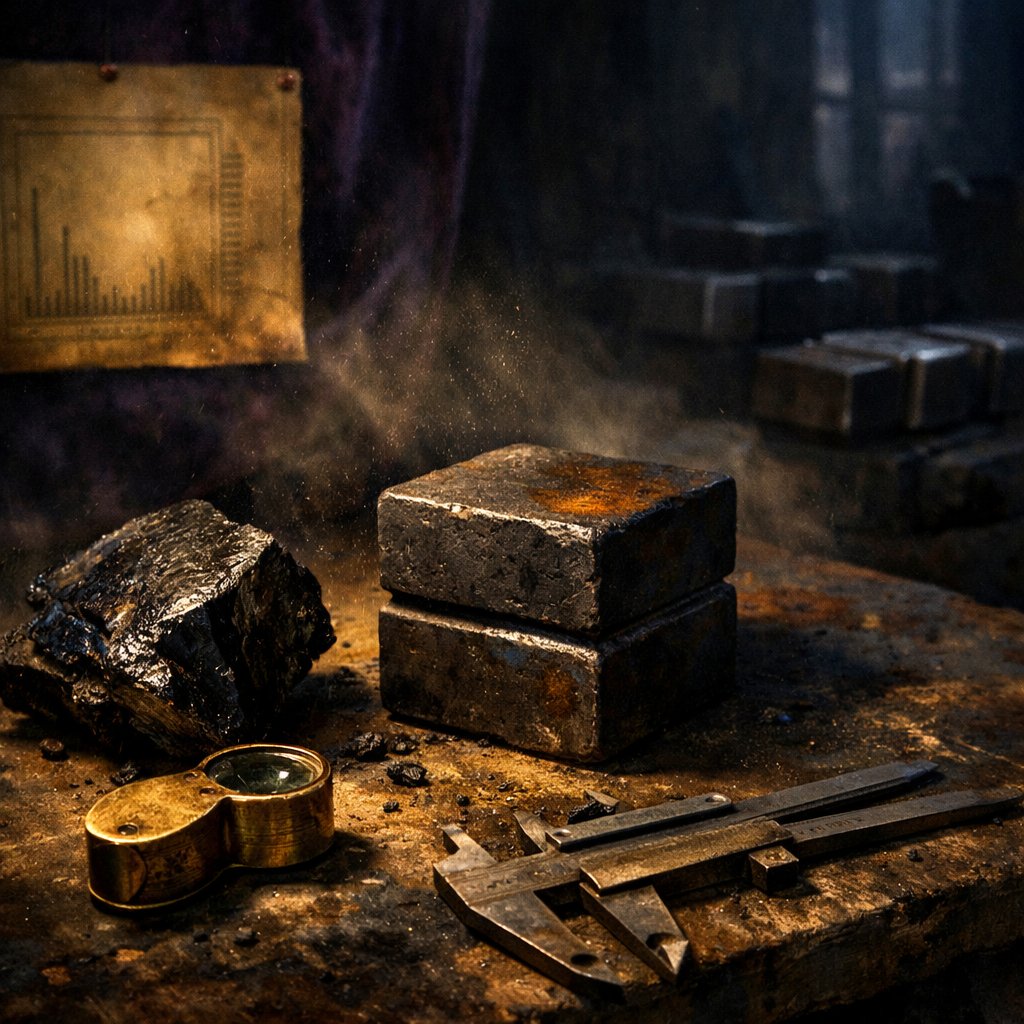
The dimensions were modest. The cuboid measured roughly 67 by 67 by 47 millimetres, weighed 785 grams, and presented four roughly flat faces with two opposing convex faces. A continuous shallow groove ran around its midline, deep enough to feel under the thumb and even enough to suggest a deliberate cut. The four flatter faces invited the immediate impression of machined work. The convex faces and the rusted, irregular edges argued against it. The Braun family submitted the object to the Heimathaus Museum of Vöcklabruck and to specialists at the local mining district, and word travelled to academic circles in Bonn within a year.
Adolf Gurlt’s 1885 Publication and the Meteorite Hypothesis
Adolf Gurlt (1829-1902), Professor of Geology at the University of Bonn and a respected mining engineer, presented the find to a learned audience late in 1885 and published a short technical note in the Verhandlungen of the Naturhistorischer Verein of the Prussian Rhineland the following year. Gurlt described the cuboid’s specific gravity at 7.75, noted its iron composition with a thin oxide skin, and proposed that the object was meteoritic. The reasoning was reasonable for the available data. Iron meteorites occasionally weathered into rough cuboidal forms during atmospheric ablation. The lignite seam offered an undisturbed matrix that, if genuinely contemporary with the iron, would push the meteorite’s fall well into the Cenozoic.
Gurlt did not claim the object was an artifact, and he did not claim it was ancient in any sense relevant to human history. The artifact reading came later. What Gurlt offered was a sober note in a regional natural-history journal, accompanied by drawings of the groove and the convex faces. The German-language paper sat quietly in its bound volume for two decades before an English-language popular author found it.
How Charles Fort Made It a Mystery
Charles Hoy Fort (1874-1932) collected anomalies the way a magpie collects shiny objects, with a delight that did not always pause to verify. His Book of the Damned, published in 1919, gathered cases of “damned” data, observations rejected by mainstream science. Fort included the Wolfsegg Iron in passing, drawing on a brief secondary summary of Gurlt’s note rather than the original German text. In Fort’s hands the object lost its specific gravity and gained an air of menace. His readers met it as a sealed iron cube cut from coal that had to be older than human civilisation, and the framing stuck.
Fortean periodicals carried the case forward through the 1930s and 1940s. By the time the original cuboid disappeared from the Linz Oberösterreichisches Landesmuseum during the upheaval of the Second World War, the popular literature already treated it as proof of impossible technology. The wartime loss of the original physical object, and the survival of only a plaster cast and the foundry’s record copy at the Heimathaus Museum of Vöcklabruck, deepened the mystery for readers who confused absence of evidence with evidence of suppression.
The Mattle and Kurat Reports, 1966 to 1978
A serious metallurgical re-examination became possible only when the surviving fragments and the cast became available for non-destructive analysis. In 1966, Hubert Mattle, working under the auspices of the Austrian Geological Survey, published a paper in Materialprüfung (the German materials-testing journal) on iron-ore aggregation in lignite seams. Mattle did not test the Wolfsegg cuboid directly in his published 1966 paper, but his analysis of pyrite and marcasite pseudomorphs forming in Tertiary brown coal supplied the natural-formation hypothesis that subsequent researchers would test against the Wolfsegg find.
In 1973, Gero Kurat (1938-2009), then curator of the meteorite collection at the Vienna Naturhistorisches Museum, ran electron-beam microanalysis on the surviving sample with Rudolf Grill of the Federal Geological Office. Their results were unambiguous. The metal contained no measurable nickel, chromium, or cobalt; iron meteorites carry several percent nickel by mass. The composition closed the meteorite door. The metal also contained no significant sulphur, which closed the pyrite-pseudomorph door. What the analysis did show was a low-magnesium, high-carbon profile consistent with cast iron of the kind produced in nineteenth-century European foundries.
Mattle returned to the question in a follow-up examination running into 1978, working from the cast and the surviving documentation. He concluded that the cuboid had been cast using the cire perdue (lost wax) technique, a method routine for nineteenth-century mining hardware. The shallow midline groove, which had so impressed early observers, was a casting parting line of the sort produced when the wax model was assembled in two halves before investment.
Two Naturalistic Readings That Both Work
Two reconstructions now sit on the table, and the metallurgy permits either one. The first reads the cuboid as a piece of nineteenth-century cast iron used as ballast or counterweight in mining machinery, a perfectly ordinary fitting that fell off a wagon or a shaft hoist into the working face of the seam during extraction at Wolfsegg or its sister pits. The piece would then have been carried with the coal shipment to the Schöndorf foundry and broken out of its lignite carrier when Reidl’s hammer landed. This is the dominant explanation in the modern literature and is consistent with the cast-iron metallurgical profile, the lost-wax casting marks, and the active mining context.
The second reading, less popular but not yet ruled out, treats the object as a natural concretion or pyrite-marcasite pseudomorph that lost most of its sulphur during its long residence in the alkaline coal matrix and the later acidic groundwater bath, leaving an iron-oxide-and-carbon residue that crystallised into a roughly cuboidal mass. Mattle’s 1966 paper sketches the geochemical pathway. Kurat’s electron-beam data complicates this reading because the residual iron looks too pure and too cast-like for a natural pseudomorph, but the question remains alive in the German-language geological literature.
What the Coal Seam Actually Is
Popular accounts often quote a 60-million-year age for the lignite that held the cuboid. The figure is too high. The Hausruck and Kobernausserwald formations, the local Wolfsegg coal-bearing units, are Late Miocene to Pliocene in age, roughly 12 to 5 million years old, with some sources placing them slightly earlier in the Tortonian. The 60-million-year claim circulating online appears to be a transcription error from “Tertiary,” a now-deprecated geological term that covers a broad span from 66 to 2.6 million years ago. The genuine age of the coal is striking enough; an iron object actually contemporary with a Late Miocene seam would still be impossible by every chronology of European metallurgy. The tighter date does not rescue the artifact reading. It simply removes one inflationary number from the popular telling.
Why This Case Is Functionally Resolved
The Wolfsegg Iron is one of a small set of OOPArt cases that mainstream metallurgy has functionally resolved. Resolution does not require certainty between the two naturalistic readings; it requires that the extraordinary reading, the artifact-of-impossible-antiquity claim, no longer be needed to fit any of the surviving evidence. After Kurat’s 1973 microanalysis and Mattle’s lost-wax conclusion, the artifact reading lost its load-bearing data points one by one. The metallurgy is ordinary. The casting marks are ordinary. The mining context is ordinary. The disappearance of the original cuboid in the 1940s is regrettable for completeness, but the surviving cast and the published analyses carry the case.
The interesting question is not whether the cuboid was machined by a vanished civilisation but how a single sober note by a Bonn geology professor migrated through Fort’s anthology, through Cold War-era anomalist paperbacks, and into twenty-first-century cable documentaries. The migration says more about the appetite for unsolved things than about the object itself. For readers tracking the broader pattern of resolved-yet-recirculating cases, see the pillar guide to Historical and Archaeological Mysteries.
Frequently Asked Questions
What is the Wolfsegg Iron?
The Wolfsegg Iron is a small cuboidal mass of iron, roughly 67 by 67 by 47 millimetres and weighing 785 grams, discovered in 1885 inside a block of brown coal at the Braun foundry in Schöndorf, Austria. It was first proposed as a meteorite by Adolf Gurlt and later identified as ordinary cast iron by twentieth-century metallurgical analysis.
Why is it also called the Salzburg Cube?
The “Salzburg Cube” is a popular nickname that crept into English-language Fortean writing. The object was never found near Salzburg. It was found in Schöndorf in Upper Austria, more than a hundred kilometres from the city. The nickname stuck because Salzburg is a recognisable Austrian place name; the locality near Vöcklabruck and Wolfsegg am Hausruck is not.
How old is the coal seam in which it was found?
The Hausruck lignite is Late Miocene to Pliocene, dated to roughly 12 to 5 million years before present. Older popular accounts cite 60 million years; the figure is too high and probably reflects a confusion with the wider Tertiary period. Either way, no plausible iron-working culture predates the seam.
Did Adolf Gurlt say it was an artifact?
No. Gurlt’s 1885 publication proposed a meteoritic origin and treated the find as a problem in geology, not archaeology. The framing of the cuboid as a manufactured object came later, primarily through Charles Fort’s Book of the Damned in 1919 and subsequent Fortean magazines.
What did Hubert Mattle and Gero Kurat actually conclude?
Kurat’s 1973 electron-beam microanalysis showed no nickel, no chromium, no cobalt, and no significant sulphur, ruling out both meteoritic origin and pyrite pseudomorph. The composition matched cast iron. Mattle’s later 1978 work identified casting marks consistent with the cire perdue (lost wax) technique, a routine method in nineteenth-century mining-hardware production.
What happened to the original cuboid?
The original cuboid was exhibited at the Oberösterreichisches Landesmuseum in Linz from 1950 to 1958. Documentation indicates it was lost during the wartime and post-war reorganisation of the museum’s holdings, with surviving fragments later returning to the Heimathaus Museum of Vöcklabruck, where the cast also resides.
Could it still be a natural pyrite or marcasite pseudomorph?
The pyrite-pseudomorph reading is weakened by the absence of sulphur in Kurat’s analysis, since pyrite is iron sulphide. Mattle’s 1966 paper showed that iron-ore aggregation in lignite is geochemically possible, but the cast-iron composition and the lost-wax casting marks make the natural-pseudomorph reading less parsimonious than the mining-ballast reading.
Why is the case considered functionally resolved?
“Functionally resolved” means that the extraordinary reading, the impossible-antiquity artifact, no longer fits any of the surviving evidence. The metallurgy is ordinary cast iron. The casting marks are nineteenth-century. The discovery context is an active foundry processing freshly mined coal. Two naturalistic readings remain in play, but neither requires the artifact framing.
How did Charles Fort hear about the find?
Fort drew on English-language popular summaries of Gurlt’s German paper, probably through American natural-history journals of the 1890s and 1900s. He cited the case briefly in The Book of the Damned (1919), without the technical details, framing it as a “damned” datum to embarrass mainstream science. The framing endured.
Is the Wolfsegg Iron unique among OOPArts in being resolved?
It is one of a small set, alongside the Coso Artifact, the Dorchester Pot, and several other coal-and-stone curiosities, in which a careful re-examination by trained specialists has dissolved the original anomaly. Most OOPArts that recirculate in popular literature have not received that kind of focused attention; the Wolfsegg case has, and the result has held since the 1970s.
Where can a curious reader see the cast today?
The plaster cast is held by the Heimathaus Museum of Vöcklabruck in Upper Austria, alongside documentation of the 1885 find. Photographs of the cast circulate widely; the original published drawings from Gurlt’s paper appear in the Verhandlungen of the Bonn Naturhistorischer Verein for the year 1886.
Why does the case still appear in popular media?
Resolved cases re-circulate because the resolution is duller than the mystery. A cable-television segment on a piece of nineteenth-century mining ballast does not draw the same audience as a segment on a sixty-million-year-old machined cube. The popular framing depends on the artifact reading, and the artifact reading does not depend on the metallurgy.