
Drafted with AI assistance from the sources listed; images are AI-generated illustrations. How EsoVitae is made
On the early morning of March 29, 2026, a woman in a remote tract of rural Oklahoma was attacked by an animal. The initial sheriff’s-office summary categorized the assailant as an “unidentified animal,” and within forty-eight hours the cryptid corner of social media had reclassified her injuries as the work of a dogman. A forensic DNA analysis of saliva and blood swabbed from the wound bed answered the question the field reporters could not: the attacking animal was a domestic dog, Canis lupus familiaris. The case is interesting less for what it concluded than for the methodology that concluded it — and for what cryptid-community responses to the result reveal about how forensic evidence is metabolized when it disappoints expectations.
What Actually Happened in Oklahoma on March 29, 2026
The Oklahoma dogman incident began as a routine wildlife-encounter report and escalated into a cryptid headline within seventy-two hours. According to the April 24 column in Modern Cryptozoology and corroborating local-news coverage [1][2], a woman in a sparsely-populated stretch of central Oklahoma went outside near sunrise to check on livestock and was attacked by a four-legged animal she described as dog-sized, dark, and fast. She sustained lacerations to the forearm and lower leg consistent with canid bite trauma and was treated at a regional emergency department; the sheriff’s deputy who responded filed the report under the catch-all designation “animal attack, species unidentified.”
That phrase — “species unidentified” — did the work. Within a day, a local broadcast affiliate referenced regional dogman folklore in a follow-up segment, and several cryptid-focused podcasts and YouTube channels treated the unidentified-species line as an implicit admission that whatever attacked the woman could not be explained by ordinary biology. The Beast of Bray Road and the Michigan Dogman were invoked as comparative precedents. By the end of the week, the phrase “Oklahoma dogman attack” was returning hundreds of social-media posts a day.
From a field-biology angle the early framing was already strained. The bite spacing, depth, and angle on photographs of the injuries (released later through her family) matched standard Canis dentition — medium-sized canid, healthy adult, no morphology that would suggest anything outside the domestic-dog / coyote / wolf clade. The handler who processed the scene had bagged biological material from the wound bed and from the woman’s clothing, and that material went to a state-supported forensic laboratory for sequencing.

How Forensic DNA Settled the Question
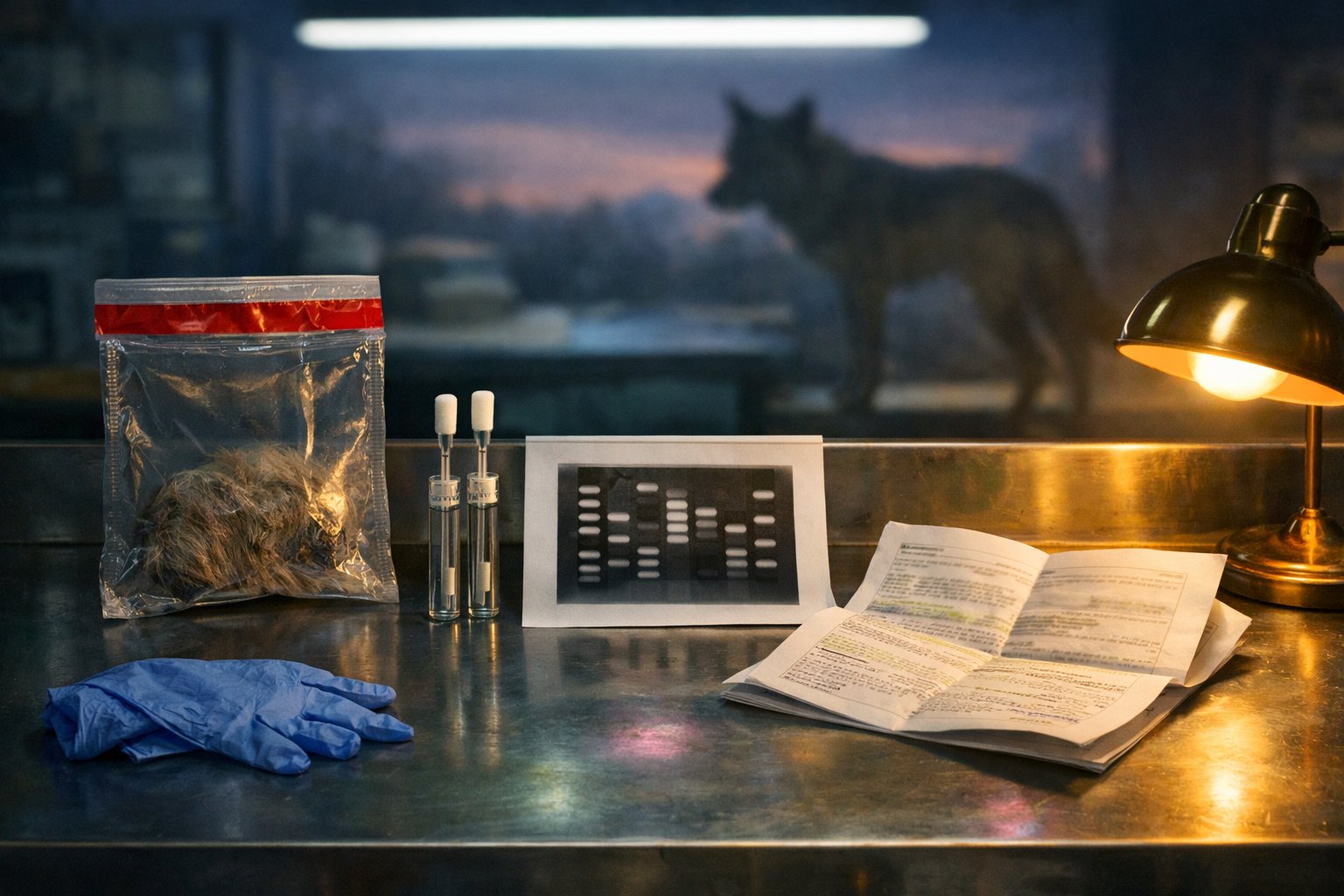
Forensic identification of an unknown attacker from bite-site biological material is one of the more reliable workflows in modern wildlife forensics, and the Oklahoma case followed the textbook chain. The investigator collected saliva-soaked swabs from the wound margins and bloodstained fabric from the woman’s clothing, sealed them in tamper-evident packaging, and transferred them to a laboratory that runs species-identification panels routinely for game-warden cases [3]. The lab amplified mitochondrial DNA regions — principally the cytochrome b and cytochrome oxidase I (COI) loci, which are the standard barcodes for vertebrate species identification — and compared the resulting sequences against the GenBank reference database curated by the National Center for Biotechnology Information [4].
The reported result, released through media reports in mid-April 2026, was unambiguous: the recovered mitochondrial sequences matched Canis lupus familiaris at the species level, with the closest reference matches falling among ordinary domestic-dog haplotypes [1][2]. No exotic canid, no hybrid signature, no novel-species placeholder. The same sequencing run also returned the victim’s own DNA from the blood fraction, which is expected and is in fact a positive internal control — if the lab can recover the victim’s genome from one channel of a mixed sample, the lab can recover the attacker’s from the other.
The evidentiary chain, step by step
The lab workflow on a case like this is not improvised. Field collection uses sterile cotton or flocked swabs moistened with molecular-grade water; the swab head is air-dried and stored at room temperature or 4°C [5]. Extraction uses a silica-column kit that recovers nuclear and mitochondrial DNA together. Amplification targets the mitochondrial barcoding loci because mitochondrial DNA exists in roughly a thousand copies per cell — vastly more abundant than the two nuclear copies per cell — which means even degraded or trace samples usually yield amplifiable sequence. The amplicon is sequenced, the read is cleaned, and the cleaned consensus is compared against GenBank with BLAST. The biological constraint: if the attacking animal left enough saliva to produce a readable trace, that trace can be assigned to a known species at the family or genus level even when the sample is mixed or partially contaminated [4][6].
The Methodology and Its Failure Modes
Wildlife forensic genetics, as practiced in U.S. state and federal laboratories, has a published error budget that any honest evaluation of the Oklahoma result has to account for. The Society for Wildlife Forensic Science publishes minimum-standard guidance covering reference-database adequacy, sample integrity, and contamination control [7]. The categories of error that could in principle let a cryptid escape detection are real and worth naming directly, because they are also the categories cryptid-community responses to the Oklahoma result reach for.
| Failure Mode | What It Looks Like | Plausibility in This Case |
|---|---|---|
| Contamination from a bystander animal | Family pet sniffs the wound; its saliva masks the attacker’s | Possible in principle, but the swabs were taken at the wound margin before reaching the home environment |
| Mixed-sample interpretation error | Two animals’ DNA in one sample; the lab calls the dominant signal and misses the minor | Mitigated by including nuclear-marker confirmation; mixed samples flag as ambiguous, not unambiguous |
| Reference-database gap | The actual species has no GenBank entry; the closest existing match is reported instead | Implausible for a North American canid — the clade is one of the most densely sequenced groups of mammals on the continent |
| Sample degradation | DNA fragments shorter than primer length; no amplification | Would yield “no result” rather than a confident dog match |
| Chain-of-custody compromise | Sample swapped, mislabeled, or substituted between field and lab | Requires intentional fraud; would have to involve multiple agencies |
Of these, only the last one supports the cover-up framing some cryptid-community voices have advanced, and it requires postulating coordinated fraud across a state laboratory, the responding sheriff’s office, and the family that released the photographs. Each of the other modes either is implausible given the workflow or would have produced a different result (ambiguous, no-call, or partial match) than the clean species-level Canis lupus familiaris assignment that was actually reported.
Prior Cases Where DNA Resolved a Cryptid Claim
The Oklahoma case is not the first time forensic genetics has been asked to adjudicate a cryptid claim, and the prior cases illustrate the same pattern: when a sufficient sample exists, sequencing has consistently identified a known species. Reduced to its evidence, the cryptozoological record of DNA-tested specimens is overwhelmingly a record of misidentified known animals — which is not the same as saying every cryptid claim resolves this way, but is the relevant baseline.
The Texas “chupacabra” cases
Between 2004 and the mid-2010s, multiple carcasses recovered in south Texas, Maine, and elsewhere were photographed and circulated as chupacabra evidence. Genetic and necropsy analyses — including work by Barry OConnor at the University of Michigan and by veterinary pathologists at Texas State University — identified the specimens as coyotes (Canis latrans), gray foxes (Urocyon cinereoargenteus), or coyote × dog hybrids suffering from severe sarcoptic mange [8]. The condition explains the hairless, sunken-eyed, sallow-skinned appearance that drove the original misidentification. None of the tested carcasses returned a sequence inconsistent with North American canids or related mesocarnivores.
The Oxford-Lausanne Bigfoot/Yeti hair survey
In 2014, a research consortium led by Bryan Sykes at the University of Oxford published an analysis of 30 hair samples submitted from around the world as putative Bigfoot, yeti, almasty, and other anomalous-primate evidence [9]. The team sequenced mitochondrial 12S rRNA from each sample and compared the reads against GenBank. Every single sample resolved to a known mammal: brown bear, American black bear, horse, cow, raccoon, porcupine, deer, sheep, malayan tapir, human, and — in the two samples that drew the most attention — a Himalayan bear haplotype the team initially interpreted as an unusual ancient-polar-bear lineage, a reading that subsequent re-analysis softened to ordinary Himalayan brown bear [10]. The takeaway: zero of thirty submitted “anomalous primate” samples returned an anomalous-primate sequence.
Why “Cover-Up” Framings Persist Anyway
Within days of the dog-DNA result being reported, segments of the cryptid community publicly argued that the result was either fabricated or referred to a contaminating sample rather than the true attacker [2]. The pattern is familiar from the chupacabra and Bigfoot literature, and it deserves to be engaged on its own terms rather than dismissed. The community’s objection rests on a real ambiguity in forensic reporting: a single positive species identification establishes that this DNA came from this species, but does not by itself prove that this DNA is the only relevant biological material at the scene.
That is a fair concern in general. It is a weaker concern in this specific case, for three reasons. First, the swabbing protocol at a wound bed preferentially samples the saliva of the biting animal, because that saliva is deposited deepest in the tissue and survives skin-surface contamination better than transient touches. Second, the chain-of-custody requirement at a state forensic lab routinely involves multiple log entries and signatures; falsifying that chain would require coordinated action by people with no shared incentive. Third, and most importantly, the alternative hypothesis — that the actual attacker was an undescribed bipedal canid hybrid that left no detectable DNA — requires postulating an animal whose physical existence is not supported by any other independent evidence stream: no carcass, no scat, no trail-camera capture, no tracks of unusual morphology, no game-warden record, no hunting-license-holder report.
Folklore can be honored as data without being treated as verdict. The Oklahoma case is a clean instance of forensic genetics doing exactly what it was designed to do, on exactly the kind of trace evidence it handles routinely. The cover-up framing, evaluated against the workflow, fails not because cryptid claims are inherently absurd but because this particular claim cannot be reconciled with the specific evidence collected at this particular wound bed at this particular time.
What the Oklahoma Case Does and Doesn’t Settle
The DNA result settles one question and only one question: the animal that bit the woman on March 29, 2026 was a domestic dog, identifiable at the species level from mitochondrial barcoding of saliva and blood recovered at the wound site [1][2][4]. It does not settle whether dogman accounts elsewhere in the United States — the long Michigan tradition, the Wisconsin Beast of Bray Road sightings, the broader twentieth-century corpus — describe a real biological entity, a misidentification pattern, a folkloric category, or some combination. Those are larger questions, and they cannot be resolved by one Oklahoma swab.
What the case does demonstrate, with unusual clarity, is that the forensic infrastructure for distinguishing a cryptid from a known species is already in place, already cheap to run, and already routinely deployed by state laboratories on game-warden and bite-investigation cases [3][7]. If a future incident produces a sample that returns an anomalous result — a sequence inconsistent with any reference, or a clear mismatch to the morphology of the visible evidence — the same workflow will be capable of flagging that. The discipline of cryptozoology, applied honestly, gains rather than loses by having that infrastructure in place. The graveyard chapter grows; so does the file of cases worth reopening when better evidence arrives.