
Drafted with AI assistance from the sources listed; images are AI-generated illustrations. How EsoVitae is made
The Dancing Plague of 1518 was an outbreak of compulsive dancing in Strasbourg, Alsace, that began on July 14, 1518, when Frau Troffea danced alone in the street. Within a month, roughly 400 people had joined. Historians now read it as mass psychogenic illness, not a poisoning.
What Was the Dancing Plague of 1518?
The Dancing Plague of 1518 was a two-month outbreak of involuntary dancing in Strasbourg, then a free city of the Holy Roman Empire, recorded by physicians, clergy, and the city council between July and September of that year.
The victims did not dance for joy. Contemporary witnesses describe people moving for hours and days, sweat-soaked, hollow-eyed, until they dropped. Some accounts say the exertion killed them. The Dancing Plague of 1518 is unusual among such episodes because so much paper survived: chronicle entries, sermon notes, and minutes from the magistrates who tried to manage it, according to the Encyclopaedia Britannica [1].
It was not the first event of its kind. Medieval Europe logged earlier outbreaks of “dancing mania,” a phenomenon scholars label choreomania, including one at Kölbigk around 1021 and a larger Rhineland wave that struck Aachen and Erfurt in 1374. Strasbourg simply left the clearest case file, which is why a cold-case reading starts here [2].
| Outbreak | Year | Place | Recorded scale |
|---|---|---|---|
| Kölbigk dance | c. 1021 | Saxony | A churchyard group, per legend |
| Aachen–Erfurt mania | 1374 | Rhineland | Spread city to city along the Rhine |
| Strasbourg dancing plague | 1518 | Strasbourg, Alsace | Up to 400 dancers over two months |
Building the Timeline: July to September 1518
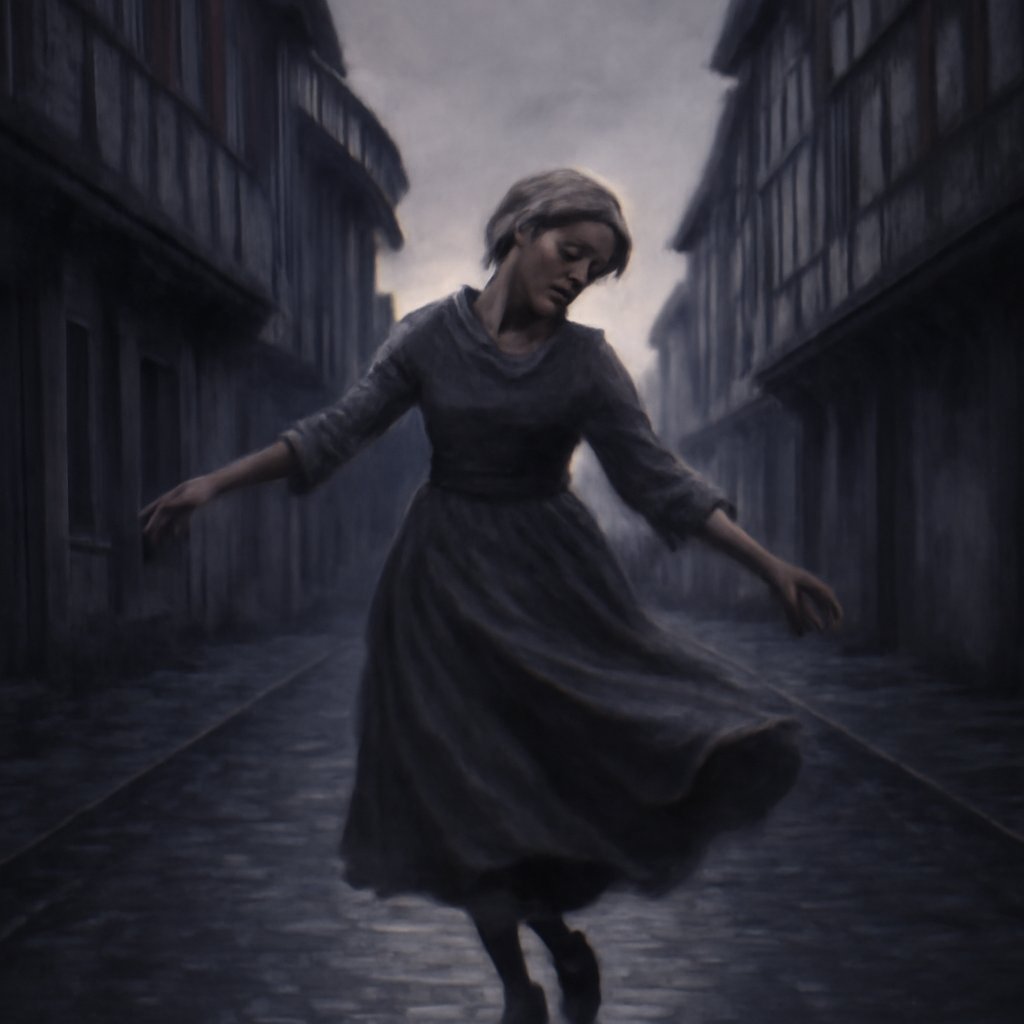
The outbreak began on July 14, 1518, when Frau Troffea stepped into a Strasbourg street and danced without music for days, collapsing from exhaustion and resuming until more than thirty neighbors joined her within a week.
The First Dancer: Frau Troffea
Build the timeline first. The earliest entry belongs to Frau Troffea, a woman who began to dance outside her half-timbered home and could not stop. The Imlin family chronicle opens its account on July 14 and reports that she danced for roughly six days before others were drawn in, according to historian John Waller’s reconstruction in The Public Domain Review [3]. No music, no festival, no stated cause. She is the last-seen entry that opens the file.
The Outbreak Spreads
Within four days the count reached roughly thirty-four dancers, and by August the crowd had grown to as many as 400, a figure repeated by both Britannica and National Geographic [1][2]. A separate set of annals attributed to the Strasbourg humanist Sebastian Brant begins on July 22, 1518. The dancers were not hidden away. They moved through the grain market, the horse market, and the open squares, visible to the whole city, which is part of why the affliction kept recruiting. The dancing held through the summer heat and tapered off by early September, giving the episode a duration of about two months [1].
The City’s Response: A Prescription to Dance More
Strasbourg’s physicians diagnosed the dancing as a case of overheated blood, and the magistrates acted on that Galenic theory by clearing guildhalls, hiring musicians, and building a wooden stage so the afflicted could dance the fever out.
The logic followed period medicine. Under the humoral framework inherited from Galen, an excess of “hot blood” had to be burned off through exertion, so the Strasbourg city council prescribed more of the symptom as the cure. It hired pipers and drummers and recruited strong men to keep the dancers upright, Britannica records [1].
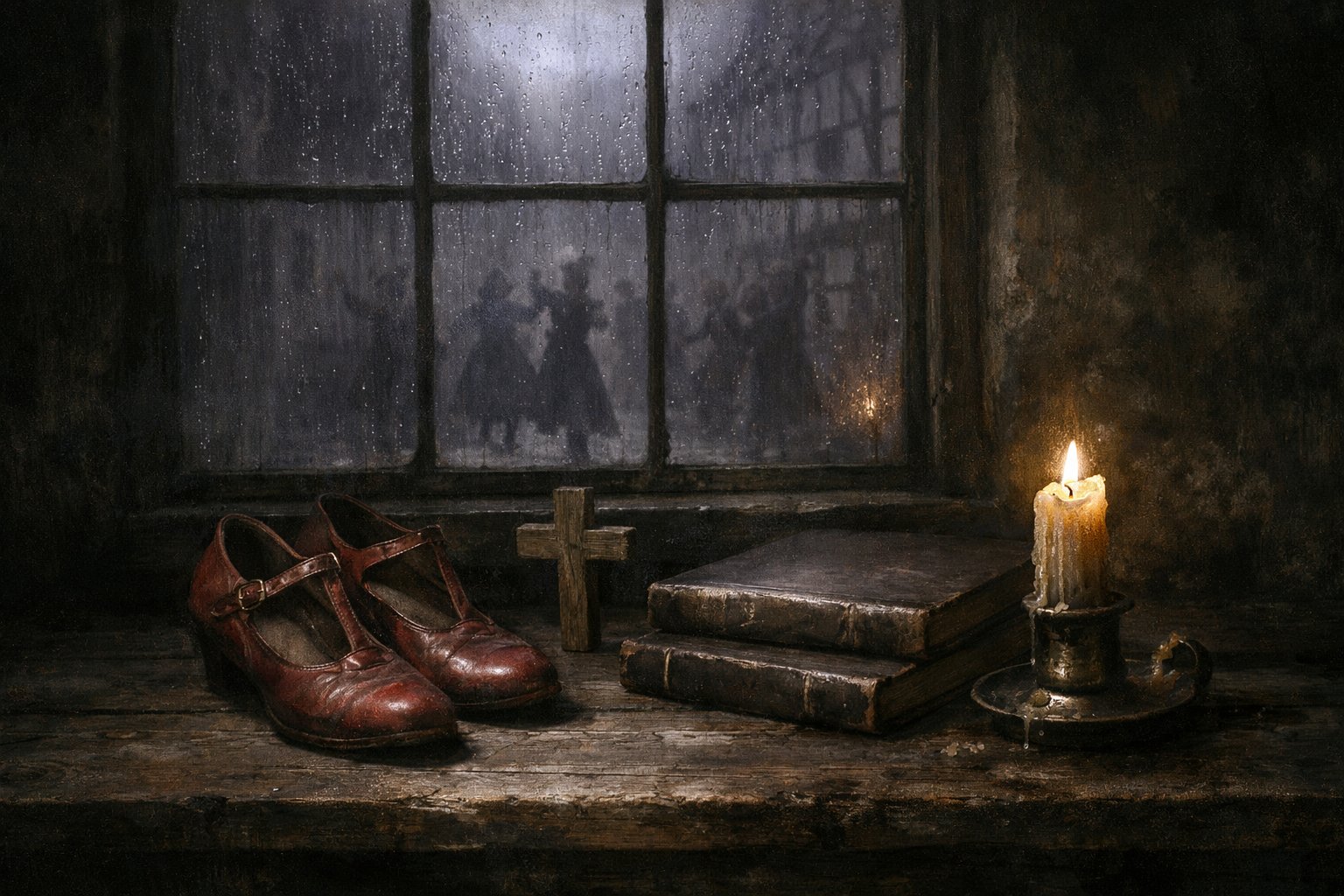
What the timeline reveals: the cure fed the contagion. As musicians played, more residents joined, and the council reversed course. It banned public dancing and music, then organized a pilgrimage that sent the afflicted to a shrine of Saint Vitus in a grotto above Saverne, west of the city, where they received small crosses and red shoes in hope of a divine cure [2][5]. The reversal matters to the investigation. The same authorities who first staged the dancing later treated it as a curse to be lifted, which shows how fast the city’s own theory of the case shifted within a single summer. By September the dancing had stopped.
What the Surviving Records Actually Say
Three near-contemporary sources carry the case: the Imlin family chronicle, the annals attributed to the humanist Sebastian Brant, and the later chronicle of the architect Daniel Specklin, supported by city-council minutes and physicians’ notes.
These documents agree on the core fact. People danced, in public, in numbers, over weeks. Daniel Specklin’s chronicle adds the marketplaces, the hired musicians, and the wooden platform; the council notes confirm the official interventions [3][4]. On that point the record is firm.
Per the case file: the contemporary documents confirm the dancing but not the death toll. The often-quoted figure of fifteen deaths per day comes from later retellings, not from the 1518 municipal registers, a distinction John Waller is careful to flag [3][1]. The bodies, if there were many, left no surviving count. That gap belongs in the notes column, not the report.
Provenance is the discipline here. A claim is only as strong as the document that carries it and the distance between that document and the event. The 1518 council notes sit closest to the dancing and say the least that is dramatic. The vivid mortality figures sit decades downstream, copied and amplified by later chroniclers. A cold-case reader trusts the nearest paper first and treats every later embellishment as a lead to verify, not a fact to bank.
The Theories on the Table
Modern explanations cluster into three competing hypotheses: ergot poisoning from moldy rye, a neurological movement disorder, and mass psychogenic illness driven by famine, disease, and acute religious dread in the summer of 1518.
The Ergotism Hypothesis
Ergotism is poisoning by Claviceps purpurea, a fungus that grows on damp rye and produces psychoactive alkaloids chemically related to LSD. The theory is tidy: bad bread, bad harvest, hallucinations. It fails on the physical evidence. Ergotism constricts blood flow and can cause gangrene and seizures; it does not let a person dance, coordinated and upright, for days. Waller and others treat sustained group dancing as the symptom ergot cannot produce [3][1]. There is a second objection on the evidence: a single tainted grain supply would have struck households unevenly, yet the dancing recruited across the city in public, person to person, which fits a behavior that spreads by sight rather than a poison that spreads by bread.
Mass Psychogenic Illness
The leading reconstruction, argued by medical historian John Waller, reads the episode as mass psychogenic illness, a stress-driven disorder that spreads through a shared belief. Three bad harvests, soaring grain prices, smallpox, syphilis, and the recurring plague had left Strasbourg desperate by 1518 [2][3]. Into that distress came a specific local fear: that Saint Vitus could afflict sinners with an uncontrollable dance. Waller argues the belief supplied the script, and that residents in a trance-like state enacted it. Sociologist Robert Bartholomew and historian H.C. Erik Midelfort have weighed similar cultural readings [4].
Why the Case Stays Open

No single explanation closes the Dancing Plague of 1518, because the surviving records confirm the dancing without preserving the autopsies, confessions, or counts that a modern investigator would need to rule a cause.
A later witness complicates it further. The physician Paracelsus passed through Strasbourg in 1526 and wrote his own account, dismissing Saint Vitus and coining the term “chorea lasciva,” which he blamed on imagination and willful behavior rather than any saint or poison [3]. His reading is one more interpretation layered onto a thin evidentiary base; the further from 1518 a source sits, the more it tells us about the teller.
The pattern outlives the city. Southern Italy logged its own dancing affliction, tarantism, blamed on a spider’s bite and cured by the tarantella, while the Rhineland mania of 1374 had run the same course a century earlier. Set those cases side by side and the common thread is not a toxin but a shared belief about how a body in crisis should move.
The strongest available reconstruction names two ingredients: extreme collective distress and a belief that gave it a shape. That is an inference the record will bear, not a proof it can deliver. What would reopen the file is plain enough: a contemporary parish death register, a physician’s case notes naming the dead, or a council ledger counting them. Until such a document surfaces, the cause stays provisional, and the dance keeps its silence within the wider field of unsolved mysteries and historical enigmas. Readers can follow more of this work on unexplained historical events or review the methods behind it on the our related coverage.
Frequently Asked Questions
When and where did the Dancing Plague of 1518 happen?
It began on July 14, 1518, in Strasbourg, a free city in the Alsace region of the Holy Roman Empire, now part of France. The outbreak lasted roughly two months and tapered off in early September 1518.
Who was Frau Troffea?
Frau Troffea was the woman recorded as the first dancer. She stepped into a Strasbourg street and danced for several days without apparent cause. Within a week, more than thirty other people had joined her.
How many people died in the Dancing Plague of 1518?
The true number is unknown. A widely repeated claim of fifteen deaths per day comes from later accounts, not from contemporary Strasbourg records. The 1518 documents confirm the dancing but do not preserve a verified death count.
How did the city of Strasbourg respond?
Physicians blamed overheated blood, so the city council first encouraged more dancing, providing guildhalls, musicians, and a wooden stage. When that worsened the outbreak, the council banned music and sent the afflicted on pilgrimage to a shrine of Saint Vitus near Saverne.
Was the Dancing Plague caused by ergot poisoning?
Probably not. Ergotism, caused by a fungus on rye, restricts blood flow and causes convulsions and gangrene. It cannot sustain coordinated dancing for days. Most historians, including John Waller, reject ergot as the primary cause.
What is mass psychogenic illness?
Mass psychogenic illness is a condition in which physical symptoms spread through a group under extreme stress, shaped by shared fears and beliefs rather than by a toxin or pathogen. It is the leading modern explanation for the 1518 outbreak.
What does Saint Vitus have to do with the dancing?
Saint Vitus was associated in popular belief with a curse that forced sinners to dance. That fear gave the outbreak its cultural script, and the city council ultimately sought a cure at a shrine dedicated to the saint.
Is the Dancing Plague of 1518 considered solved?
No. Mass psychogenic illness is the strongest reconstruction, but it remains an inference drawn from limited records. Without a contemporary death register or detailed medical notes, the cause stays provisional and the case remains open.