By Iris Kowalczyk · Published June 10, 2026 · Updated June 10, 2026
The Kryptos sculpture is an encrypted copper screen that artist Jim Sanborn installed at CIA headquarters in 1990. Its 869 characters hold four messages. Cryptanalysts solved the first three by 1999. The fourth, K4, has never been cracked. In 2025 its plaintext surfaced from an archive, but the cipher itself remains unbroken.
Published: June 5, 2026. Last reviewed: June 5, 2026.
What the Kryptos sculpture is
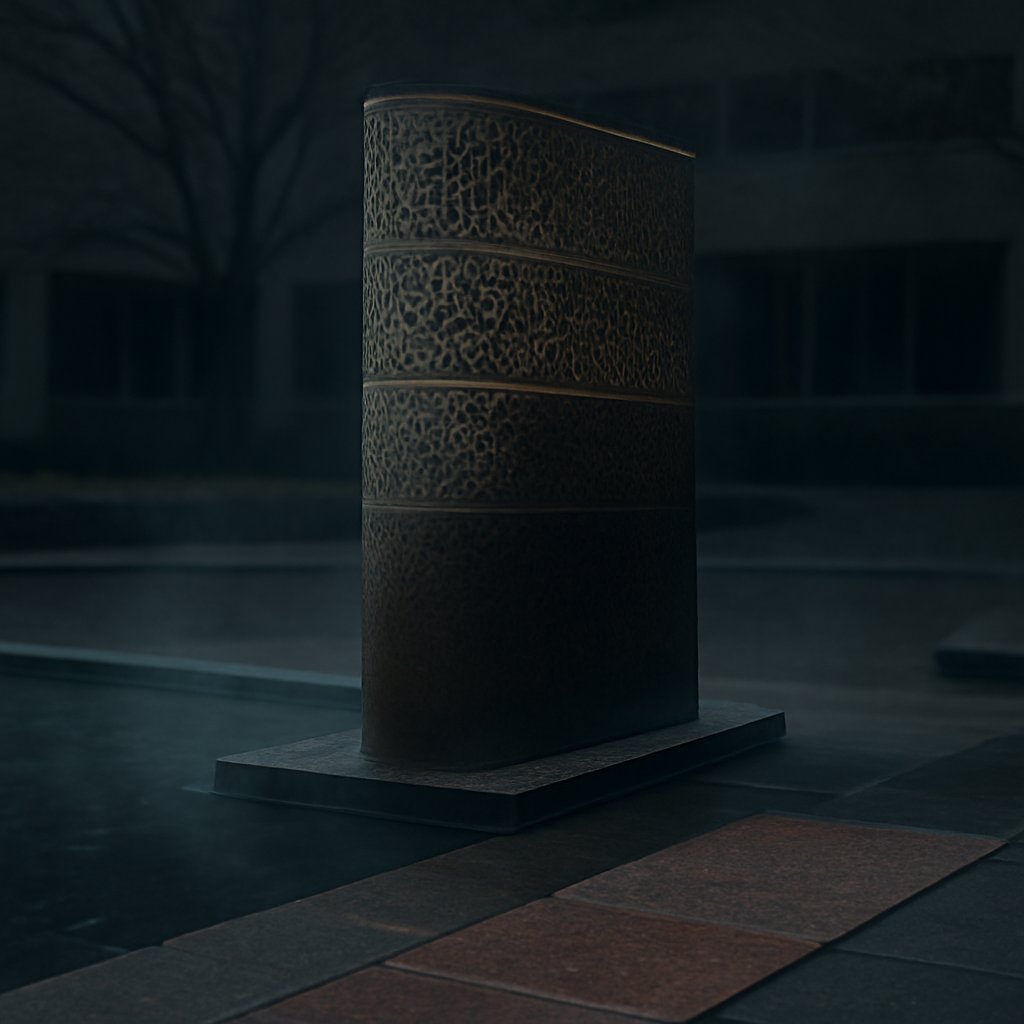
Kryptos is a ten-foot S-shaped copper screen that sculptor Jim Sanborn dedicated at CIA headquarters in Langley, Virginia, on November 3, 1990, carrying 869 carved characters across four encrypted sections [1][4]. The name is Greek for “hidden.” The agency lists its theme as intelligence gathering [4].
The screen is only part of the installation. Sanborn set the copper among a pool of moving water, slabs of red and green granite, white quartz, and a piece of petrified wood, in a courtyard between the old headquarters and the newer building [1]. Most of the public will never stand in front of it. The people who pass it daily are intelligence officers walking to lunch.
The carved text holds 865 letters and four question marks, 869 characters in all, split into four passages labeled K1 through K4 [1][4]. Three of those passages now read in plain English. One does not. That split is the whole case, and it has held for more than three decades.
For more than thirty years Kryptos has been described as the most famous unsolved code in the United States, worked over by professional cryptanalysts and weekend hobbyists alike [2][3]. The pull is not the carving. It is the silence at the end of it. Three passages answer a careful reader. The fourth has answered no one who started from the copper.
The two men who built the cipher
Jim Sanborn designed Kryptos with Ed Scheidt, a retiring chairman of the CIA’s cryptographic center, who shaped the cipher systems in 1988, two years before the copper was cut [1][5]. Scheidt taught the methods; Sanborn carved the result. The full set of charts left the building only inside two men’s heads.
That collaboration is the chain of custody for this puzzle. The encryption keys, the coding tables, and the step-by-step path from plain text to cipher are held by Sanborn and Scheidt alone [5]. No third party watched the work. When a maker is also the only witness, every claim about method traces back to him.
Sanborn also built in traps. The text carries deliberate misspellings, including the words IQLUSION, UNDERGRUUND, and DESPARATLY, planted on purpose rather than slipped in by error [1]. The design goal, by his account, was a slow reveal: solvable, but not quickly [1][8]. That intent is the likely reason K4 behaves differently from the passages above it. The same two hands built all four sections, yet the last one appears to carry an extra step the others do not [2][7]. He expected the wait to run in years. The wait ran in decades.
Three passages closed, one left open
Three of Kryptos’s four messages were broken between 1992 and 1999, first by a National Security Agency team, then by CIA analyst David Stein, and publicly by computer scientist Jim Gillogly [1][6]. The NSA work stayed classified for years. Stein cracked K1 through K3 with pencil and paper in 1998. Gillogly reached the same plaintext by computer and announced it in June 1999 [1][6].
The first two passages used a Vigenere cipher. K1 ran on the keyword PALIMPSEST and decoded to a line about the nuance of “iqlusion” [1]. K2 used the keyword ABSCISSA. It described information gathered and transmitted underground to an unknown location, named only “WW,” and listed coordinates that sit close to the Langley campus itself [1][6]. Researchers read WW as William Webster, the CIA director who accepted the sculpture. The evidence ledger shows one wrinkle even here: in 2006 Sanborn told the Kryptos Group that the accepted ending of K2 was wrong, and a corrected reading followed [6].
K3 switched methods. Sanborn used a transposition cipher, scrambling 337 letters like a long anagram [2]. Decoded, it paraphrases Howard Carter’s account of opening Tutankhamun’s tomb on November 26, 1922, down to the trembling hands and the question “can you see anything?” [1].
| Section | Characters | Cipher method | Status |
|---|---|---|---|
| K1 | About 63 | Vigenere, keyword PALIMPSEST | Solved by 1999 |
| K2 | About 372 | Vigenere, keyword ABSCISSA | Solved by 1999 |
| K3 | 337 | Columnar transposition | Solved by 1999 |
| K4 | 97 | Unknown | Plaintext found 2025; cipher unbroken |
K4: ninety-seven letters that beat the machines
K4 is the fourth and final passage, ninety-seven letters beginning with the cluster OBKR, and it resisted every cryptanalytic attack for thirty-five years after the sculpture’s 1990 dedication [1][2]. Supercomputers failed it. The NSA failed it. Thousands of amateurs failed it.
Sanborn began releasing cribs once the silence ran long. He told The New York Times in 2010 that characters 64 through 69 decode to BERLIN, and in 2014 he added that positions 70 through 74 read CLOCK [7]. In 2020 he released two more: EAST at positions 22 through 25, and NORTHEAST at 26 through 34 [1][7]. The pairing BERLINCLOCK points readers toward the Mengenlehreuhr, the set-theory clock in Berlin that tells time in stacked rows of lit fields.
The released words read like directions. EAST and NORTHEAST suggest a bearing, while BERLIN paired with CLOCK points at a specific object, not a city [7]. Whether the fragments name a place, a method, or both is the question the cipher will not settle from outside.
Part of the difficulty is simple arithmetic. Ninety-seven letters is a short sample, too short for the frequency analysis that breaks longer ciphers, and Sanborn has hinted that K4 carries an extra masking step on top of the base method [2][7]. A community formed around the open file anyway. Elonka Dunin co-founded the Kryptos Group in 2003 to coordinate amateur and professional attempts, and her running archive of the Kryptos research remains the standing reference for the case [6]. What the timeline reveals is steady erosion without a break: four confirmed cribs across a decade, each narrowing the search, none exposing the method.
The 2025 discovery that did not break the code
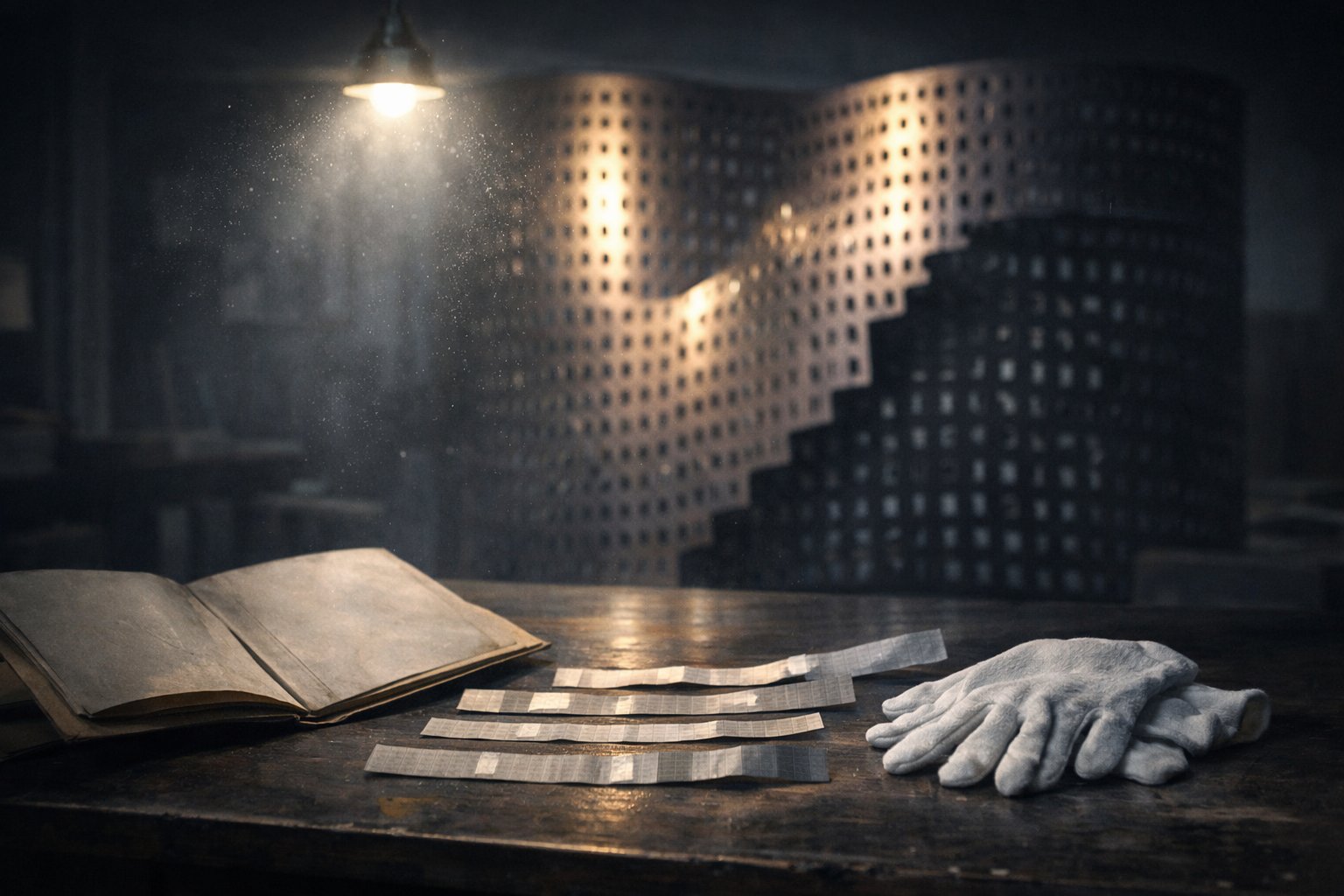
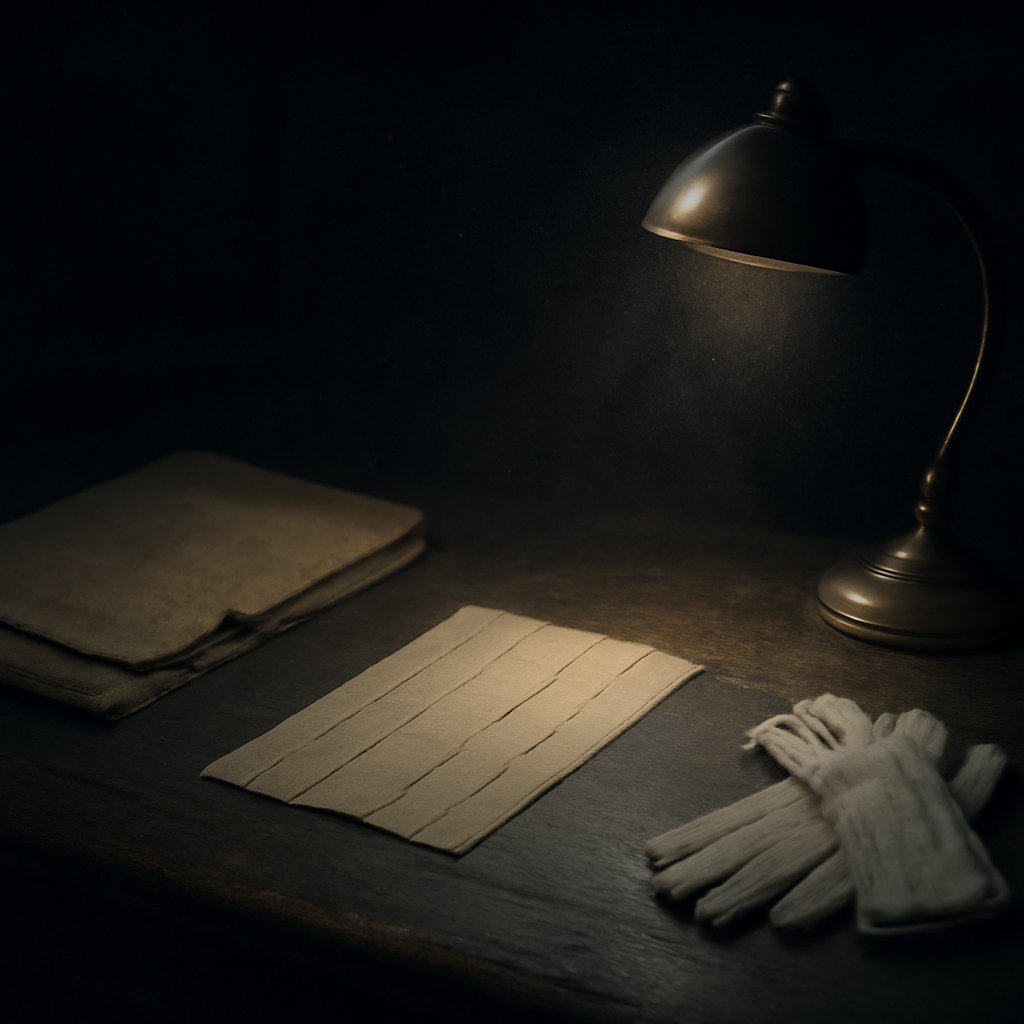
In September 2025, journalists Jarett Kobek and Richard Byrne found five pages of scrambled K4 text inside Jim Sanborn’s papers at the Smithsonian Archives of American Art [2][5]. The pages were 1990 CIA documents that Sanborn had cut into strips and taped out of order, years earlier, to prove the sculpture’s hidden content was not offensive. He donated his archive in 2023 and, by his own account, never noticed the strips went with it [5].
The researchers requested the file, reassembled the strips, and emailed Sanborn the result on September 3, 2025 [2]. He confirmed the text was accurate, then drew a hard line. “What they found was scrambled text, and not by solving the cryptogram,” Sanborn said [5]. Kobek agreed in plain terms: “There’s no way on earth that this is a cryptographic solve, and we have not claimed that” [5].
Two things get conflated here: having the words and having the method. Elonka Dunin drew the same line, calling it the difference between holding the plaintext and holding the technique that produced it [5]. In cold-case terms, a confession turned up in an old evidence box. It tells you what happened. It does not tell you how the cipher was built. The archive that held the strips is now sealed for fifty years, and Sanborn asked the journalists for a nondisclosure agreement, which they declined while agreeing to keep the plaintext quiet [1][5].
The auction, the new keeper, and a fifth code
RR Auction sold the Kryptos K4 solution and Sanborn’s related archive for $962,500 on November 20, 2025, transferring custody of the secret to a single buyer [2][3]. The sale ran from October 16 under the title “Decoding History: Kryptos, Enigma and the Rosetta Stone” [8].
Sanborn’s reasons were practical. In his late seventies and slowed by health scares, he had spent years fielding thousands of proposed solutions by email, each one needing a check against the real answer [8]. He framed the winner as a new keeper rather than a collector, someone to verify future claims and carry on the exchange with followers. The lot was more than a sealed answer: the buyer receives prototype material, encryption tables, and a private session in which Sanborn explains how K4 connects to an unpublished fifth section [3][5].
The keeper role is unusual for an art sale. The winning bidder inherits not just an object but an obligation, becoming the person who confirms or rejects the next claimed solve [3][5]. Sanborn has effectively named a successor to a thirty-five-year correspondence.
That section, K5, is the part most people never hear about. Sanborn confirmed in an open letter in August 2025 that a fifth coded message is built to reveal itself only after the first four are solved [1][3]. So the case changed hands without closing. A provisional read: the auction settled ownership of the secret, not the question of how the secret was made.
What the record will bear
The Kryptos record now holds a strange asymmetry. Its final answer is known to a handful of people, while its method remains unreconstructed by anyone outside Sanborn and Ed Scheidt [5]. That is not a solved case. A solved case shows the chain from ciphertext to plaintext and lets a stranger walk it again. K4 still has a missing page in that chain.
The distinction is worth keeping straight. Finding the words is recovery; breaking the cipher is proof. The plaintext recovered in 2025 tells us what K4 says, but no published method turns the ninety-seven carved letters into that text, and until one does, the passage stays open and K5 stays sealed behind it [3][5].
None of this diminishes the recovery. Knowing what K4 says is real progress, and it narrows what any future method has to produce. The cold-case standard is just unforgiving on one point: a result you cannot reproduce is a lead, not a closure [5]. The lead is strong. The case is still open.
For readers tracking the broader file of unsolved mysteries and enigmas, Kryptos is a useful test of what “solved” should mean. The cold-case approach in these case files treats the matter the way the cipher does: nothing closes until the method is shown. More on the wider field of enigmatic codes and ciphers belongs in the same column.