By Emilia Wellesley · Published May 4, 2026 · Updated May 13, 2026
Last reviewed: May 4, 2026.
What Is Göbekli Tepe, and Why Does It Matter?
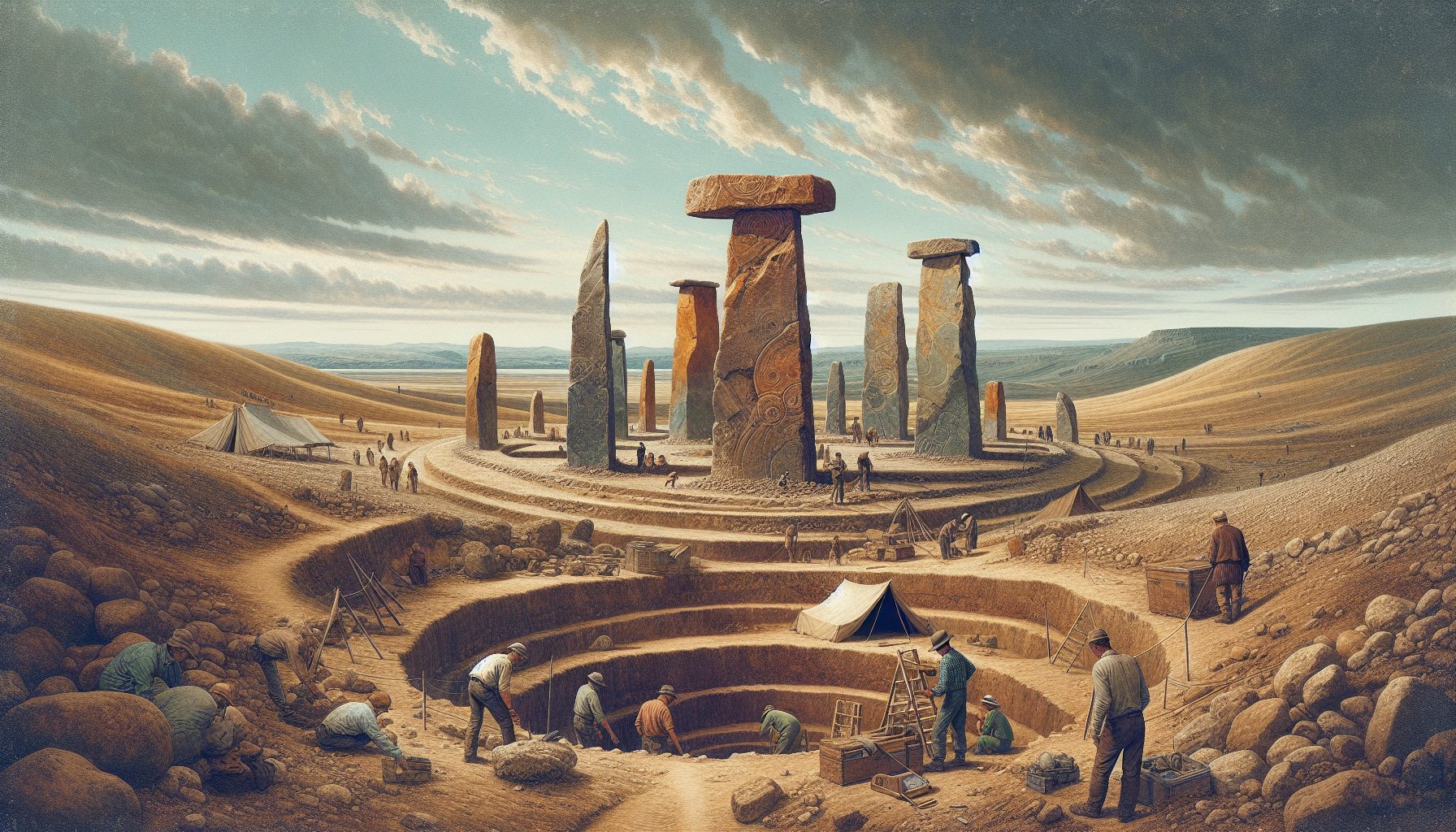
Göbekli Tepe is a Pre-Pottery Neolithic hilltop site in southeastern Turkey, near the modern city of Şanlıurfa, where excavators since 1995 have uncovered massive T-shaped limestone pillars set in circular and rectangular enclosures. Radiocarbon evidence places its monumental phase between roughly 9500 and 8000 BCE, predating Stonehenge by some six thousand years and forcing a reappraisal of when complex ritual architecture began.
For most of the twentieth century, archaeologists assumed that monumental construction required settled agriculture, and settled agriculture required a long, slow accumulation of surplus. Göbekli Tepe inverts that order. The pillars went up while the people who carved them were still hunting gazelle and gathering wild cereals. The site sits on the threshold between two worlds, and standing inside one of its enclosures, even now, with most of the limestone reburied for protection, the conventional narrative of the Neolithic feels thinner than it once did.
This guide traces the site’s discovery and dating, the principal interpretations of its purpose, the sharp scholarly debate now reshaping the original “first temple” hypothesis, and the place Göbekli Tepe holds within the broader landscape of historical and archaeological mysteries. The aim is to keep the questions open where the evidence keeps them open.
Discovery, Excavation, and the Shape of the Site
A 1963 joint survey by Istanbul University and the University of Chicago first noted the mound, then logged it as a medieval cemetery and moved on. Three decades later, in 1994, the German archaeologist Klaus Schmidt (1953-2014) revisited the survey notes, recognized the unusual scatter of worked limestone on the surface, and opened the first formal excavation in 1995 under the joint auspices of the German Archaeological Institute (DAI) and the Şanlıurfa Museum.
The Mound and Its Layers
The tell rises about fifteen meters above the surrounding plateau and covers roughly nine hectares. Excavators have identified two principal occupation layers. Layer III, the older, contains the iconic monumental enclosures with the largest pillars, dated to the Pre-Pottery Neolithic A (roughly 9500-8700 BCE). Layer II, sitting above it, holds smaller rectangular rooms with shorter pillars from the Pre-Pottery Neolithic B (roughly 8700-8000 BCE). Geomagnetic survey suggests that fewer than ten percent of the original structures have been opened, according to the ongoing field reports issued by the German Archaeological Institute’s Istanbul Department.
The T-Shaped Pillars
More than two hundred T-shaped limestone pillars have been documented so far. The largest stand five and a half meters tall and weigh up to ten tonnes. Each was quarried from local Eocene limestone outcrops within a few hundred meters of the site. Many bear bas-relief carvings of foxes, vultures, scorpions, snakes, wild boar, aurochs, and a striking number of dangerous predators rather than the prey species the builders presumably hunted. Some pillars carry stylized arms and belts, suggesting they represent abstracted human or supernatural figures.
Who Built It, and How?
The builders were Pre-Pottery Neolithic foragers transitioning toward the earliest experiments in cultivation. Faunal remains from the site are overwhelmingly wild: gazelle, aurochs, onager, fox, and a striking quantity of wild birds. No domesticated animals have been securely identified in Layer III. The plant assemblage shows wild einkorn and barley alongside other gathered species, with no firm evidence of cultivated grain in the earliest phase.
Labor and Coordination
The scale of the work is the puzzle. Quarrying a ten-tonne pillar, dressing it, transporting it without wheeled vehicles or draft animals, and raising it into a stone socket required coordinated labor on a scale not previously associated with mobile foraging communities. Estimates published in Antiquity suggest a single Layer III enclosure may have demanded the seasonal cooperation of several hundred people drawn from a wide catchment, possibly assembling at the site for weeks at a time.
The Brewing Hypothesis
Large limestone vessels capable of holding up to 160 liters have been recovered from Layer III. Residue analyses by Oliver Dietrich and colleagues, published in 2012, identified oxalates consistent with the fermentation of cereals, raising the possibility that communal feasts, possibly involving an early form of beer, helped knit together the labor force. The link between feasting, fermentation, and the appearance of monumental architecture is now a serious thread in the literature on Neolithic ritual gathering.
Schmidt’s “First Cathedral” Hypothesis
Klaus Schmidt published the first sustained interpretive synthesis in his 2010 article in Documenta Praehistorica, where he proposed that Göbekli Tepe was a purely ritual center, a “cathedral on a hill” built before the village, before agriculture, and before pottery [1]. In his reading, the site had no permanent residents. Hunter-gatherers from across the surrounding region travelled to it for ceremonies, and the burden of returning to the site repeatedly may itself have driven the local domestication of einkorn at nearby Karaca Dağ, identified by Britannica as the genetic source for one of the founder cereals of Old World agriculture.
Cult of the Dead
Schmidt argued that the predominance of vultures, scavengers, and dangerous predators on the pillars points to a death cult. He pointed to nearby Pre-Pottery Neolithic sites such as Çayönü and Nevalı Çori, which produced human skull caches and decorated crania. His later excavations at Göbekli Tepe recovered fragmented human bone with cut marks, published posthumously in 2017 by Julia Gresky and colleagues, suggesting deliberate skull modification consistent with a regional skull cult.
Religion Before Agriculture
The provocation in Schmidt’s reading is the inversion of cause and effect. The standard narrative had agriculture producing surplus, surplus producing leisure, and leisure producing temples. Schmidt suggested the temples came first, and the need to feed the workforce drove the experiment in cultivation. The argument was contested almost immediately, but it succeeded in moving the site from regional curiosity to a central case in the global story of how complex society begins, as surveyed in Smithsonian Magazine’s long-form profile of the site.
Lee Clare’s Revision and the Domestic Question
Schmidt died unexpectedly in 2014. His successor as project director, Lee Clare, has spent the past decade revising the original interpretation in light of new excavation data. The revision is not a rejection so much as a complication, and it has reshaped how the site is now understood within professional archaeology.
Evidence for Domestic Activity
In a 2020 field report on the project’s Tepe Telegrams research blog, Clare and his team documented stone tools, hearth features, and grinding installations within and around the so-called ritual enclosures [2]. The implication is that the boundary between sacred and domestic, central to Schmidt’s reading, may have been porous or absent. People probably lived at the site, at least seasonally, in addition to gathering there for ceremonies. The pillars may have stood inside, or alongside, occupied buildings rather than purely sanctified ones.
From “Cathedral” to “Special Buildings”
Clare’s preferred terminology has shifted from “temple” toward “special buildings” or “communal architecture.” The change is deliberate. It widens the interpretive frame to include feasting halls, council houses, communal storage, and ritual function as overlapping rather than separate purposes. Comparable structures at nearby Karahan Tepe, Sayburç, and the broader Taş Tepeler (“Stone Hills”) network now point to Göbekli Tepe as one node in a regional Pre-Pottery Neolithic phenomenon rather than a singular cathedral.
What the Carvings Might Mean
The iconography is the part of the site that most resists confident reading. The carvings are precise, specific, and almost entirely silent. Without writing, without a contemporary mythological text, every interpretation is a reconstruction from absence.
Pillar 43, the “Vulture Stone”
Pillar 43 in Enclosure D shows a vulture lifting a disc-shaped object above a headless human figure, accompanied by scorpions, snakes, and other creatures. Schmidt read it as funerary iconography, the vulture carrying the soul. A 2017 paper by Martin Sweatman proposed an astronomical reading, identifying the carvings as constellations recording a comet impact. The astronomical hypothesis has been firmly criticized in subsequent scholarship for cherry-picking imagery and ignoring stratigraphic context, and most field archaeologists treat it as speculative.
The Animal Repertoire
Across the pillars, dangerous animals dominate: foxes baring teeth, snakes coiled in dense rows, scorpions, leopards, vultures with extended wings. Prey species, the gazelle and aurochs that supplied most of the calories, are rare. A common reading is that the carvings depict spirit animals or totemic figures rather than a hunting tally. Whatever the precise function, the carvings demonstrate that Pre-Pottery Neolithic foragers held a complex symbolic vocabulary, organized in deliberately repeated motifs across multiple enclosures.
Dating, Reburial, and the Site’s Future
Radiocarbon samples from charcoal and bone collagen embedded in the wall fills consistently place Layer III in the late tenth and early ninth millennia BCE. Pedogenic carbonate dates published by Dietrich in 2011 corroborate the broader chronology, and recent uranium-thorium analyses have refined the construction sequence within Enclosure D. Scholarship on these dates is archived in the alchemy- and antiquity-focused holdings of academic repositories such as the JSTOR-archived Documenta Praehistorica issue carrying Schmidt’s 2010 synthesis [3].
Deliberate Backfilling
One of the most striking features of the site is that the enclosures were deliberately buried in antiquity, packed with limestone rubble, animal bone, and flint debris. Whether this represents ritual decommissioning, structural protection, or seasonal cycling between use and burial remains debated. The backfill is what preserved the site so well, and it is also why Göbekli Tepe still has so much left to give.
Conservation and UNESCO Status
Göbekli Tepe was inscribed on the UNESCO World Heritage List in 2018. A protective shelter now covers the main excavation area, and the Turkish Ministry of Culture has paused several enclosures’ opening to allow the development of long-term conservation strategies. The site is open to visitors via a managed walkway. Less than a tenth of the buried structure has been excavated, which means that the interpretive picture is still being assembled and that the field’s strongest claim about the site is, properly, that the strongest claim has not yet been made.
Why Göbekli Tepe Reshapes the Neolithic Story
Whatever its precise function, Göbekli Tepe demonstrates three things that older models of the Neolithic struggled to accommodate. Pre-agricultural societies could organize labor at monumental scale. Symbolic life was already complex before settled farming. And the threshold between mobile foraging and sedentary village life was longer, more variable, and more regionally specific than the mid-twentieth-century synthesis allowed. The site does not overturn the Neolithic Revolution. It widens its prologue.
Frequently Asked Questions
How old is Göbekli Tepe?
The monumental enclosures of Layer III date to roughly 9500-8700 BCE, with the upper Layer II structures continuing in use until around 8000 BCE. This places the site in the Pre-Pottery Neolithic A and B periods, several thousand years before Stonehenge or the earliest Egyptian pyramids.
Where is Göbekli Tepe located?
The site sits about fifteen kilometers northeast of the city of Şanlıurfa, in southeastern Turkey, on a limestone ridge overlooking the Harran Plain. It is part of a broader Pre-Pottery Neolithic landscape now called Taş Tepeler, the “Stone Hills” of Upper Mesopotamia.
Who discovered Göbekli Tepe?
A 1963 joint Istanbul-Chicago survey first logged the mound. Sustained excavation began in 1995 under Klaus Schmidt of the German Archaeological Institute, working with the Şanlıurfa Museum. After Schmidt’s death in 2014, Lee Clare took over as project director.
Was Göbekli Tepe really the world’s first temple?
It was the title Klaus Schmidt gave it, but current excavation directors prefer the more cautious “special buildings” or “communal architecture.” Recent evidence suggests domestic activity at the site, and similar enclosures at neighboring sites like Karahan Tepe complicate any claim of singularity.
What animals are carved on the pillars?
The repertoire favors dangerous and scavenging species: foxes, vultures, scorpions, snakes, leopards, wild boar, and aurochs. Prey animals like gazelle, which supplied most of the diet, are rare on the pillars, suggesting symbolic rather than hunting-record purposes.
Did the builders practice agriculture?
No domesticated animals or cultivated grains have been securely identified in the earliest Layer III. The builders were Pre-Pottery Neolithic foragers gathering wild cereals and hunting wild gazelle, fox, and onager. Klaus Schmidt argued that the site itself may have helped drive local domestication.
Why was the site buried?
The enclosures were deliberately backfilled in antiquity with rubble, bone, and flint debris. Whether the burial was ritual decommissioning, structural protection, or part of a periodic cycle of use and reburial remains an open question. The backfill preserved the site exceptionally well.
Can visitors see Göbekli Tepe today?
Yes. Göbekli Tepe was inscribed on the UNESCO World Heritage List in 2018 and is open to the public via a managed walkway under a protective shelter. Less than ten percent of the buried structure has been excavated, and most of the site remains underground.