By Emilia Wellesley · Published May 5, 2026 · Updated September 10, 2026
Last reviewed: September 10, 2026.
What Are the Tartaria Tablets?
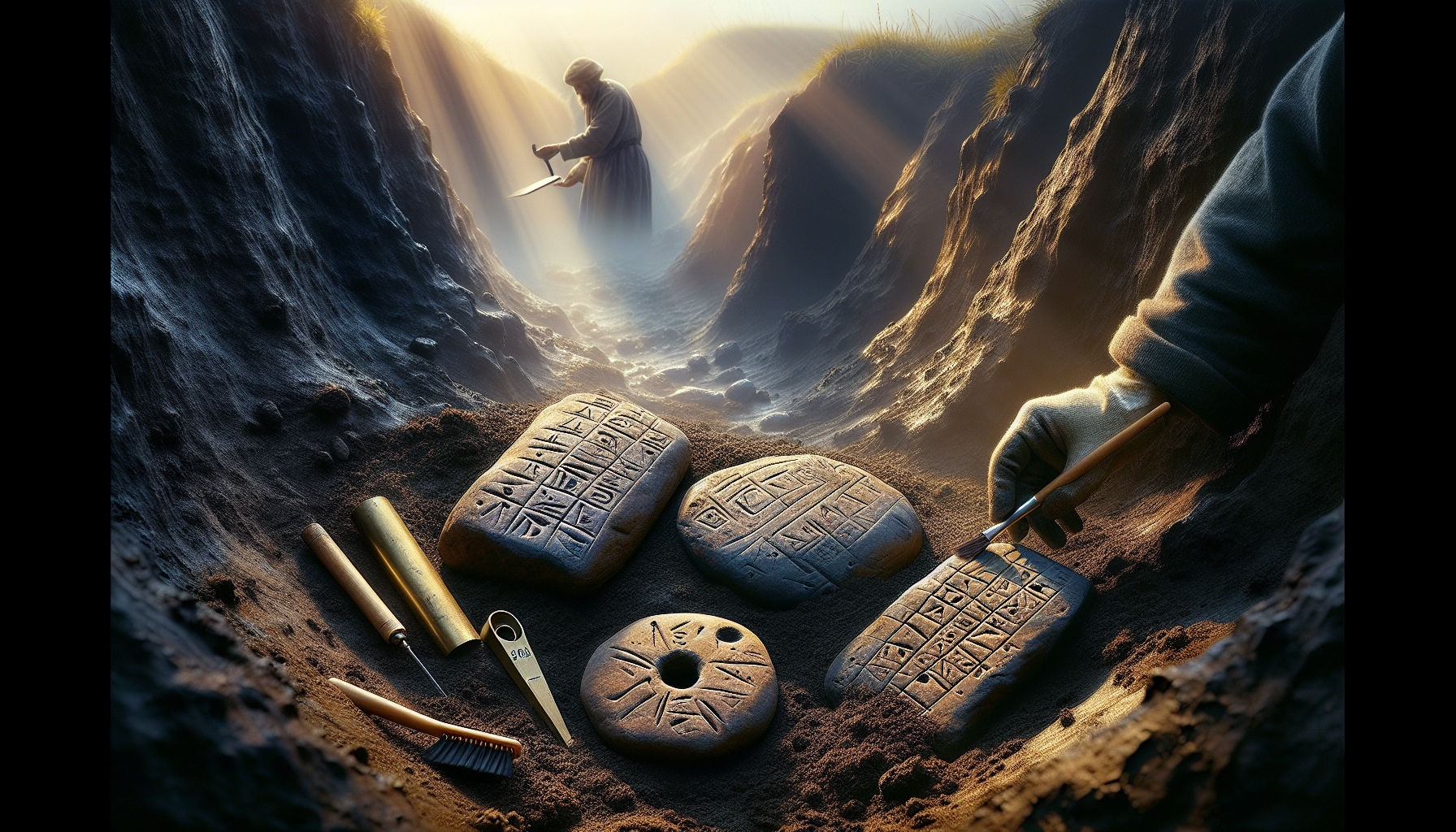
The Tartaria tablets are three small clay objects pulled from a Neolithic ritual pit in western Romania in 1961. Two are pierced rectangles, one is a perforated disc, and all three carry incised pictographs that resemble early writing. Whether they are writing or symbolic decoration remains contested.
The tablets are not impressive at first glance. The largest is about six centimeters across. The clay is unfired or only lightly baked. The signs were pressed into the surface with a sharp tool, in irregular rows, by a hand that was either very practiced or completely untrained, depending on whom one reads. They were found alongside the disarticulated bones of an adult human and a cluster of broken figurines, and that pit, more than the marks themselves, has shaped sixty years of argument about what the tablets actually are.
If the radiocarbon chronology now favored by Romanian archaeologists holds, the Tartaria signs predate the earliest cuneiform tablets at Uruk by close to a millennium. That single comparison is why the objects keep returning to debate, and why the interpretation of three thumb-sized clay pieces sits inside a wider question about historical and archaeological mysteries still unresolved across the Neolithic record of southeast Europe.
The 1961 Discovery at Tartaria
The site sits on a low terrace above the Mureș River in Alba County, Transylvania. In the summer of 1961, the Romanian archaeologist Nicolae Vlassa (1934-1985), then with the Cluj Museum of History, was excavating a Vinča-culture settlement layer when he uncovered a small ritual pit. He published his initial report in the journal Dacia in 1963, and the find passed almost immediately from local notice into international controversy [1].
The Pit and Its Contents
The pit, labeled by Vlassa as a sacrificial deposit, contained the three tablets together with twenty-six clay and stone figurines, two anchor-shaped objects, a Spondylus-shell bracelet, and the burned, dismembered bones of an adult woman. The grouping mattered. Burials within ritual pits, accompanied by figurines and shell ornaments imported from the Aegean, are characteristic of the late Vinča horizon. The tablets, in other words, did not arrive alone. They came embedded in a ceremonial assemblage.
The Three Objects
The first tablet is rectangular and unpierced, about 6.2 centimeters long, incised with stylized animals and a tree-like figure. The second is also rectangular but has a small hole in one corner, suggesting it was meant to be hung or strung. It carries a single line of densely packed signs that form the most writing-like sequence in the group. The third is round, with a perforation in the middle, and is divided into four quadrants by incised lines, each quadrant containing different symbols. The Cluj-Napoca museum, formally the National Museum of Transylvanian History, has held all three since they were registered in its inventory in the early 1960s [2].
How Old Are the Tartaria Tablets?
The dating question is where the controversy intensifies. Vlassa’s original report assigned the tablets to the Vinča-Turdaș cultural horizon, which he placed around 2700 BCE on the calibration curves available in the early 1960s. That number was already provisional. As radiocarbon dating matured, the Vinča chronology kept moving deeper into prehistory. By the 1970s, the relevant layer was being pushed past 4000 BCE. By the 2010s, fresh accelerator mass spectrometry samples from comparable Vinča sites in Serbia and Romania had relocated the horizon to between roughly 5400 and 5000 BCE [3].
Pre-Sumerian or Not?
If the tablets sit in a layer dated around 5300 BCE, as the original stratigraphy suggests under modern calibration, they predate the earliest known proto-cuneiform tablets from Uruk by some 1,800 years. That comparison is what made the find globally famous. It also licensed a generation of speculative claims, ranging from the responsible (an independent Balkan proto-writing tradition) to the unsupported (Sumerian colonists in Transylvania, a single primordial script). The Romanian archaeologist Gheorghe Lazarovici, in a series of papers from 2008 onward, has argued that the chronology is now stable enough to take the dating seriously while keeping the writing question open [4].
The Stratigraphy Problem
A lingering complication is that the tablets were not found in primary deposition on a sealed floor. They came from a pit that may have been dug down from a later occupation surface into earlier strata. The American archaeologist Shan Winn, in a careful 1981 reassessment, argued that the pit’s stratigraphic position was ambiguous enough that the tablets could not be securely tied to the date Vlassa proposed [5]. Most subsequent work has either accepted Winn’s caution or proposed corroborating dates from comparable Vinča deposits, but the original pit cannot be re-excavated and the question is not fully closed.
Writing System or Symbolic Decoration?
Granting that the tablets are old, what are the marks? The literature has clustered around three positions. Some scholars read the signs as a fully formed proto-writing system. Others see organized symbolic notation that is meaningful but not linguistic. Still others classify the marks as decorative or ritual, indistinguishable in function from the geometric incisions on Vinča pottery elsewhere in the same horizon. Each position has its own evidentiary ladder, and the Britannica entry on the Vinča culture notes that the question remains formally undecided in the discipline as of recent revisions to the encyclopedia [6].
The Old European Script Hypothesis
The most ambitious reading came from the Lithuanian-American archaeologist Marija Gimbutas (1921-1994). In The Goddesses and Gods of Old Europe (1974) and her later work, she argued that the Vinča-horizon signs constitute a script she called Old European, used across southeast Europe between roughly 5300 and 4000 BCE for ritual and possibly accounting purposes. She catalogued more than two hundred recurring signs across pots, spindle whorls, and figurines from over a hundred sites, and treated the Tartaria tablets as a particularly dense example [7]. Gimbutas’s broader Old European framework has drawn vigorous criticism on other grounds, but the catalog of signs she compiled remains a reference point.
The Symbolic-Incision Counter-Argument
The skeptical position notes that the Tartaria signs do not repeat across the three tablets in a way that would suggest words or syllables encoded in a stable inventory. They lack the redundancy and combinatorial regularity that characterize even early proto-writing systems such as Mesopotamian numerical tablets or the Indus signs. Shan Winn argued that the marks fit better into a tradition of symbolic incision, where signs operate as ownership marks, ritual identifiers, or religious shorthand without encoding speech [5]. On this reading, the tablets are not less interesting; they are just a different category of artifact than tablets of writing.
What Would Settle the Question
A definitive answer would require either a much larger corpus from related sites (which would let analysts test for combinatorial structure) or a bilingual artifact pairing Vinča signs with a known script (which would not be expected in this horizon and has never been found). Without one of those breakthroughs, the question stays formally open. The honest scholarly position is that the tablets show organized symbolic behavior of considerable sophistication, that this behavior may shade into proto-writing, and that the line between the two is harder to draw than nineteenth-century definitions of writing assumed.
The Vinča Culture and Its World
The tablets cannot be read apart from the culture that made them. The Vinča complex, named after the type-site of Vinča-Belo Brdo near Belgrade, flourished in the central Balkans between roughly 5400 and 4500 BCE. Its settlements were larger and more densely planned than anything in contemporary western Europe. Its pottery was technically advanced, its copper metallurgy among the earliest in the world, and its symbolic life elaborate enough to have produced the very corpus of incised signs that the tablets sit inside.
Settlements, Trade, and Ritual
Vinča sites cluster along the Danube, Sava, Morava, and Mureș river systems. Houses were rectangular, often two-storied, organized in regular rows. The settlements traded long-distance, importing Spondylus shells from the Aegean, obsidian from the Carpathians, and salt from inland deposits. The ritual repertoire included anthropomorphic figurines, often female, and the deposition of artifacts in pits like the one at Tartaria. The tablets fit a society with the social complexity to produce specialized notation, even if no one yet had reason to call it writing.
What the Tartaria Tablets Tell Us, and What They Do Not
Sixty years on, the most defensible reading of the Tartaria tablets is the one that holds the question open with discipline. The artifacts are securely Neolithic. They belong to a culture with the demographic and economic substance to support symbolic specialization. The signs they carry overlap measurably with a wider Vinča corpus that recurs across hundreds of sites. They predate cuneiform on the current chronology. None of that is the same as saying they are writing in the sense that a Sumerian scribe in Uruk would have understood the term.
What the tablets do show, with unusual clarity, is that the standard story of writing as a one-time invention in late-fourth-millennium Mesopotamia is too clean. Symbolic notation in southeast Europe two millennia earlier was already organized, repeated, and ritually charged. Whether the next step from notation to writing was taken at Tartaria or only approached, the pit at Tartaria preserved the trace of a community thinking in signs. That trace, more than any single decipherment claim, is what the three small tablets carried out of the Mureș valley and into the catalog of Europe’s deepest unresolved questions about its own beginnings.
Frequently Asked Questions
What are the Tartaria tablets made of?
The three tablets are made of local Transylvanian clay. Two are unfired or only lightly baked, and one shows traces of a more thorough firing. The clay is not visually distinctive, which is part of why the tablets sat unrecognized among the figurines for several years before Vlassa returned to them.
Where can the Tartaria tablets be seen today?
All three tablets are held by the National Museum of Transylvanian History in Cluj-Napoca, Romania, where they are part of the Neolithic collection. They are displayed periodically and have been the subject of dedicated exhibitions tied to the anniversaries of the 1961 discovery.
Who found the Tartaria tablets?
The tablets were found in 1961 by Nicolae Vlassa, a Romanian archaeologist working out of the Cluj Museum of History. Vlassa published the original excavation report in the journal Dacia in 1963, and that report remains the primary source on the find context.
How old are the Tartaria tablets really?
Vlassa originally placed them at around 2700 BCE on early-1960s calibration curves. Modern accelerator mass spectrometry dates for the relevant Vinča horizon push the layer to between roughly 5400 and 5000 BCE, with around 5300 BCE the most cited estimate when the tablets are tied to the original stratigraphy.
Are the Tartaria tablets older than Sumerian writing?
If the modern Vinča chronology is accepted and the tablets are securely tied to that horizon, they predate the earliest proto-cuneiform tablets from Uruk by close to two thousand years. Whether that makes them writing in the same sense remains the central interpretive dispute, not a settled fact.
Has anyone deciphered the Tartaria signs?
No widely accepted decipherment exists. Several proposals have linked the signs to Sumerian, Linear A, or Cretan hieroglyphic systems, but none survive close scrutiny. The corpus is too small and the comparative anchors too weak to support a translation. Most working scholars treat the marks as undeciphered and possibly undecipherable.
What is the Vinča culture?
The Vinča culture is a Neolithic and early Chalcolithic complex of the central Balkans, dated roughly 5400 to 4500 BCE. It is named for the type-site of Vinča-Belo Brdo near Belgrade and is known for its dense settlements, advanced pottery, early copper metallurgy, and a rich corpus of incised signs that includes the Tartaria tablets.
What was Marija Gimbutas’s role in the controversy?
Marija Gimbutas treated the Tartaria signs as part of what she called the Old European script, a symbolic system she argued was used across southeast Europe between roughly 5300 and 4000 BCE. Her broader interpretive framework has been criticized, but her catalog of recurring Vinča signs remains influential.
Why is the stratigraphy of the find disputed?
The tablets came from a ritual pit that may have been dug from a later occupation surface into earlier layers. Shan Winn argued in 1981 that this made the secure assignment of the tablets to a single Vinča phase difficult. Subsequent work has narrowed but not closed the question.
Are there other artifacts with similar signs?
Yes. Hundreds of Vinča-horizon objects from sites across Serbia, Romania, Bulgaria, and northern Greece carry incised signs that overlap measurably with the Tartaria corpus. Spindle whorls, pottery sherds, and figurines have all yielded comparable marks, which is why the tablets are read as a particularly dense example of a wider symbolic tradition rather than as an isolated find.