
By EsoVitae Editorial · Published
Drafted with AI assistance from the sources listed; images are AI-generated illustrations. How EsoVitae is made
What Are the South American Quipus?
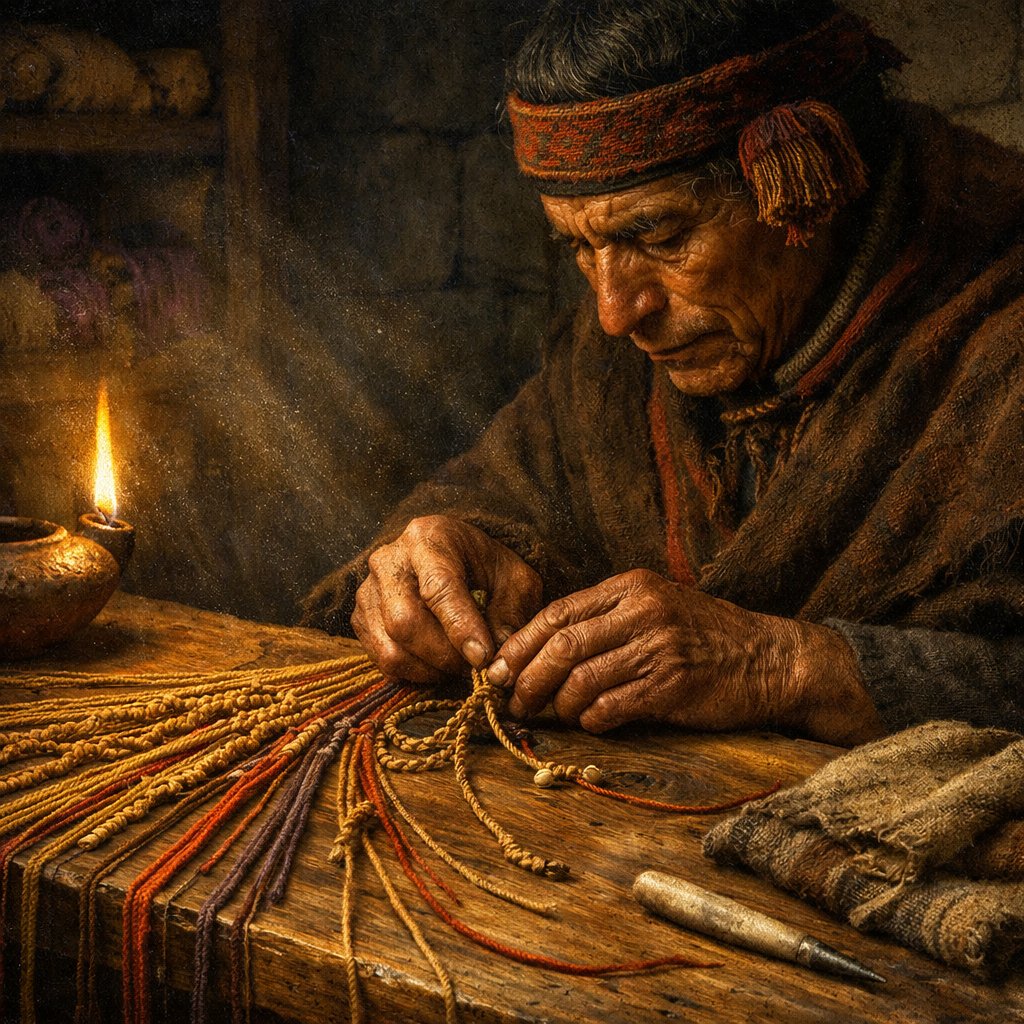
The South American quipus, sometimes spelled khipus from the Quechua word for knot, are knotted-cord recording devices developed in the Andes from at least the third millennium BCE and brought to administrative perfection by the Inka empire of the fourteenth through sixteenth centuries CE. A quipu is a primary cord from which dozens or hundreds of pendant cords descend, each pendant carrying knots whose type, position, color, ply direction, and material encoded numerical and, increasingly the evidence suggests, narrative information.
A reader who first encounters a photograph of an Inka quipu sees what looks like a tassel of dyed wool. The unprepossessing appearance is part of why the colonial archive misread the object so badly for so long. The quipu is a textile and a writing-substrate at once, a medium peculiar to the Andean world, and one whose decoding has moved, in the past two decades, from a confident dismissal to a working scholarly programme. To call a quipu primitive record-keeping is to mistake the surviving evidence as completely as one would mistake a folded medieval pen-trial for the Book of Kells.
What follows is a working historian’s account of where the tradition begins, how the numeric system was decoded, what the latest narrative-cord research suggests about a logo-syllabic layer, and how this Andean information technology fits into the broader landscape of historical and archaeological mysteries.
The Pre-Inka Roots: Caral and the Three-Thousand-Year Substrate
The Inka systematization of the quipu rests on a substrate of knotted-cord recording at least three thousand years older. At Caral, the Late Archaic urban site in the Supe Valley north of Lima excavated by Ruth Shady Solis from 1996 onward, a small fragment of knotted cotton was recovered from a public structure dated by radiocarbon to roughly 2500 BCE. The fragment is too small for full reconstruction, but its arrangement of plied cords and intervening knots is morphologically continuous with the later Inka examples, and the carbon dates place quipu-like recording roughly contemporary with the earliest Sumerian cuneiform tablets at Uruk [1]. Caral itself, a six-pyramid ceremonial complex without surviving fortifications or weaponry, predates the Olmec by more than a millennium and overturns earlier diffusionist models of New World civilization.
Between Caral and the Inka emergence in the fifteenth century, knotted-cord devices appear in Wari and Tiwanaku contexts of the first millennium CE. The Wari quipus, in particular, use a more pictorial cord arrangement than the standardized Inka decimal corpus, and Gary Urton’s analysis of the Wari corpus has argued that the system’s typological richness, before Inka administrative standardization, may preserve clues to a non-numeric layer that the Inka inherited and rationalized [2]. The point worth holding open is that the Inka quipu is not the beginning of the tradition. It is a late and centralized form of a much older Andean practice.
How the Numeric Quipu Was Decoded
The decoding of the numeric layer of the Inka quipu is the part of the story that has been settled for almost a century, and the credit belongs to L. Leland Locke (1875-1943), an American mathematician at Brooklyn Polytechnic Institute, whose The Ancient Quipu: A Peruvian Knot Record (American Museum of Natural History, 1923) cracked the system. Locke noticed that the knots on each pendant cord cluster in distinct vertical zones, and that the zones correspond to the powers of ten in a positional decimal notation: a knot in the lowest position represents units, the next zone represents tens, the next hundreds, and so on upward to the cord’s attachment to the primary [3].
The Three Knot Types
Locke also identified three distinct knot types whose deployment carries arithmetic information. The single overhand knot, called by quipu specialists the simple knot, marks digits in the higher-order positions where each knot stands for one of that power. The long knot, an extended overhand of two to nine turns, encodes the digits two through nine in the units position only, with the number of turns reading off the digit directly. The figure-eight knot represents the digit one in the units position, distinguishing it cleanly from a tens-zone simple knot. The result is an unambiguous decimal-positional notation, with zero represented by the absence of any knot in a given zone, an idea formally analogous to the placeholder zero of the South Asian numeral system that reached Europe through Arabic transmission. The Inka knot system is independent of and roughly contemporary with the Indian innovation, a parallel invention by an unconnected civilization.
The Ascher Mathematical Project
Marcia Ascher (1935-2013) and Robert Ascher (1931-2008), an American mathematician and an American anthropologist married to each other and based at Cornell, extended Locke’s work in the 1970s and consolidated their findings in Code of the Quipu: A Study in Media, Mathematics, and Culture (University of Michigan Press, 1981, expanded edition Dover 1997). The Aschers documented hierarchical relationships among the cords: subsidiary cords attached at the knots of pendant cords often carry summations or breakdowns, and the structure of the cord array encodes the mathematical relationships among the recorded categories. A storehouse quipu, for instance, might list the goods received from a province on its primary pendants while the subsidiaries break each pendant into the contributing communities, and a top cord at the array’s apex might carry the grand total. The Aschers showed that the quipu was not merely a counting device but a structured numerical document, with the cord topology itself doing the work that a column-and-row table does on a paper ledger [4].
The Khipu Camayocs and the Inka Bureaucracy
A quipu is useless without a reader. The Inka empire trained a class of specialist record-keepers called khipu camayocs, the Quechua term meaning roughly “the ones in charge of the knot.” The camayocs were a hereditary professional caste, attached to provincial administrative centers and to the imperial capital at Cuzco, and their training was conducted in special schools called yachaywasi. A camayoc’s knowledge included the conventions of cord material, twist direction, and color coding peculiar to his service, and the camayoc was responsible not only for reading existing quipus but for composing new ones to record the year’s tribute, census, military levy, or storehouse contents.
The Spanish chronicler Pedro Cieza de León (c. 1520-1554), writing in the 1550s, described the camayocs as appearing before regional inspectors with their knotted records and reading off populations, harvests, and herds with the same fluency a European clerk would read a parchment ledger. Cieza’s account is independently confirmed by the indigenous chronicler Felipe Guaman Poma de Ayala (c. 1535-c. 1616), whose Nueva Coronica y Buen Gobierno (c. 1615) contains illustrations of camayocs holding quipus and includes Quechua and Spanish glosses that allow modern researchers to anchor the office in the late-pre-conquest Inka bureaucracy. The fluency the chroniclers describe is not consistent with a system that records numerical data alone. A camayoc reading off a “history” or a “song” from a quipu, as several chroniclers say they did, must have had access to a non-numeric layer the surviving early-twentieth-century decoding programme could not reach.
The Narrative Quipus and the Hyland-Medrano Decipherment Programme
For most of the twentieth century the question of whether the quipu encoded language was treated as unanswerable on the surviving evidence. That position has shifted decisively in the past decade, and two parallel research lines deserve naming. Sabine Hyland, a Scottish-American anthropologist at the University of St Andrews, conducted ethnographic and archival fieldwork in the Andean village of San Juan de Collata, central Peru, where two large eighteenth-century khipus had been preserved by the local community as ancestral letters. Hyland’s 2017 paper in Current Anthropology argues that the Collata khipus encode a logo-syllabic system, with each pendant cord standing for a syllable selected from an inventory of about ninety-five distinct cord types defined by fiber, color, and ply direction [5]. The two khipus, on Hyland’s reading, are letters between local kuracas during a 1780s anti-colonial rebellion. The decipherment is not yet complete; what the Collata study establishes is the existence of a non-numeric, language-encoding khipu tradition that survived into the late colonial period.
In parallel, Manny Medrano, then a Harvard undergraduate, working with Gary Urton, published a 2018 paper in Ethnohistory matching six numeric khipus from the Santa River valley to a 1670 Spanish colonial census of the same valley. Medrano demonstrated that the cord-by-cord knot counts on the khipus correspond to the household-by-household tribute payments listed in the census, with cord color encoding the moiety affiliation of each tributary, and that ply direction (S-twist or Z-twist) encodes a second social category that the Spanish census paraphrases as ayllu membership [6]. The Medrano-Urton match is the first published case of a quipu being read against a parallel alphabetic record, and it confirms that a single quipu can carry at least three independent layers of social meaning beyond the bare numeric tally.
The Khipu Database Project at Harvard
The Medrano work is the visible surface of a larger institutional effort. Gary Urton (b. 1946) founded the Khipu Database Project (KDB) at Harvard’s Department of Anthropology in 2002, with the aim of digitizing every accessible quipu in museum and private collections worldwide. The KDB at present contains records of more than 950 khipus, with photographs, fiber-by-fiber descriptive metadata, and standardized typological codes that allow researchers to query the corpus for structural patterns invisible to inspection of any single specimen. According to Britannica’s overview of the quipu, roughly a thousand surviving Inka and pre-Inka khipus are known worldwide, and the KDB has now catalogued the great majority [7]. The corpus has yielded statistical regularities, including a recurring six-cord arrangement that Urton has tentatively associated with the Inka decimal administrative units of chunkas (groups of ten households).
The Living Quipu Tradition: Salomon at Tupicocha
A second, equally consequential research line is ethnographic rather than archival. Frank Salomon (b. 1946), professor of anthropology at the University of Wisconsin-Madison, conducted fieldwork in the Andean village of Tupicocha, in the Huarochiri province east of Lima, where the local ayllus still maintain a set of nine ancestral khipus that they refer to as caytus. The Tupicocha khipus are paraded annually on the day the new ayllu officers are installed, and the outgoing officer reads off the quipu the year’s record of community work, the names of those who served, and any disputes adjudicated. Salomon’s The Cord Keepers: Khipus and Cultural Life in a Peruvian Village (Duke University Press, 2004) documents the practice in detail and demonstrates that knotted-cord recording in the Andes is not a dead tradition recovered only from museums [8]. According to the Smithsonian’s profile of the living khipu tradition, perhaps two hundred similar village quipus are still extant in pockets of the central and southern Peruvian highlands.
The Colonial Loss and the Spanish Suppression
The reason the surviving Inka khipu corpus is roughly a thousand objects rather than tens of thousands is colonial. After the conquest of 1532, Spanish administrators initially relied on the camayocs, since the colonial bureaucracy needed to reach into the same provincial economy the Inka had taxed. Quipus served as Inka-side documentation in colonial litigation through the second half of the sixteenth century. The shift came after the 1572 execution of Tupac Amaru I, the last neo-Inka ruler at Vilcabamba, and the consolidation of Toledo’s reforms. The Third Council of Lima in 1583 declared the quipus to be idolatrous, on the grounds that the camayocs were treating the cords as ritual objects, and ordered their destruction wherever the missionary clergy could reach them. The Council’s decree is preserved in the council acts and was cited explicitly by parish priests as authority for confiscation and burning. The destruction was uneven, and survival correlates strongly with concealment: the Tupicocha caytus, the Collata letters, and the museum specimens recovered from highland tombs all owe their persistence to having been removed from the reach of the suppression. The colonial archive contains repeated complaints by surviving camayocs that their professional knowledge had no successor, and the Quechua-language testimony of Diego de Castro Titu Cusi Yupanqui in 1570 already speaks of khipu literacy as a precarious inheritance.
What the Tradition Adds Up To
A historian writing on the quipu has to refuse two equal temptations. The first is the romantic reading, in which the knotted cords become an undeciphered Andean alphabet equivalent to Linear A, withholding their secrets until the right philologist arrives. That reading flatters the past at the cost of getting it wrong: the numeric layer is decoded, has been since 1923, and the recent narrative-cord research is a working programme rather than a long-deferred breakthrough. The second temptation is the dismissive reading, in which the quipu becomes a primitive tally-stick less sophisticated than a Sumerian bulla, of interest only as a curiosity. That reading is also wrong. The quipu is a fully positional decimal notation independently invented; it is a structured document with topological encoding of categorical relationships; it is, on the Hyland and Medrano evidence, almost certainly a candidate writing system in its non-numeric layer; and it is, in the Tupicocha case, a living medium of community recording. The honest reading holds the record open. The Andean civilizations developed an information technology peculiar to their material and social world, and the surviving evidence is enough to require us to take it on its own terms rather than measuring it against the wedge-on-clay tradition the Mediterranean happened to inherit.
Frequently Asked Questions
What does the word quipu mean?
Quipu (also spelled khipu) is the hispanicized form of the Quechua word khipu, meaning simply “knot.” The term applies both to the individual knot tied in a cord and, by extension, to the entire knotted-cord recording device. Quechua speakers in the modern Andes still use the word in both senses. The plural in English follows the regular pattern (quipus or khipus); in Quechua, the plural is unmarked, and a single object and many objects share the form.
How old is the quipu tradition?
The earliest physical evidence is a small knotted-cotton fragment recovered from the Late Archaic site of Caral in the Supe Valley north of Lima, radiocarbon-dated to roughly 2500 BCE. The fragment is morphologically continuous with later Inka examples, suggesting that knotted-cord recording in the Andes predates the Inka systematization by approximately three thousand years. Wari and Tiwanaku-context khipus from the first millennium CE document an intermediate stage between the Caral substrate and the Inka administrative corpus.
Who was L. Leland Locke and what did he decode?
L. Leland Locke (1875-1943) was an American mathematician at the Brooklyn Polytechnic Institute whose 1923 monograph The Ancient Quipu: A Peruvian Knot Record, published by the American Museum of Natural History, demonstrated that the Inka knotted cord system encodes a positional decimal numeric notation. Locke identified three distinct knot types (the simple knot, the long knot of two to nine turns, and the figure-eight knot) and showed that their position along each pendant cord corresponds to powers of ten, with absence of a knot encoding zero.
What is a khipu camayoc?
A khipu camayoc was a specialist record-keeper in the Inka empire, trained in a hereditary professional caste to read existing quipus and compose new ones. The Quechua term means roughly “the one in charge of the knot.” Camayocs were attached to provincial administrative centers and to the imperial capital at Cuzco, and their training was conducted in schools called yachaywasi. The Spanish chroniclers Pedro Cieza de Leon and Felipe Guaman Poma de Ayala both describe camayocs reading off complex numeric and historical records with fluency suggesting access to layers beyond the numeric.
Did quipus encode language, or only numbers?
The numeric layer is fully decoded and has been since Locke’s 1923 work. The question of a language-encoding layer was treated as unanswerable for most of the twentieth century. Recent work has shifted the position. Sabine Hyland’s 2017 paper on the San Juan de Collata khipus argues for a logo-syllabic encoding, with cord features (fiber, color, ply direction) standing for syllables drawn from an inventory of about ninety-five distinct cord types. Manny Medrano and Gary Urton’s 2018 match of six Santa River khipus to a 1670 Spanish census confirms that cord features encode social-categorical information beyond bare numeric value.
What was the Khipu Database Project?
The Khipu Database Project (KDB) is a digital catalogue of the world’s surviving khipus, founded by Gary Urton at Harvard’s Department of Anthropology in 2002 and now containing records of more than 950 specimens with photographs, fiber-by-fiber descriptive metadata, and standardized typological codes. The corpus allows researchers to query for structural patterns invisible in any single specimen. The KDB has yielded statistical regularities, including a recurring six-cord arrangement that may correspond to the Inka decimal administrative unit of chunkas (groups of ten households).
Are there still working quipus in the Andes today?
Yes. Frank Salomon’s ethnographic fieldwork at Tupicocha, in the Huarochiri province east of Lima, documented a living tradition in which the local ayllus maintain nine ancestral khipus, called caytus, that are paraded annually at the installation of new community officers and used to record the year’s communal work. Salomon’s The Cord Keepers: Khipus and Cultural Life in a Peruvian Village (Duke University Press, 2004) is the standard reference. Roughly two hundred similar village khipus are estimated to survive in pockets of the central and southern Peruvian highlands.
Why are so few Inka quipus surviving?
The Spanish colonial administration tolerated the camayocs through the second half of the sixteenth century because the colonial bureaucracy needed Inka-side documentation. After the 1572 execution of Tupac Amaru I and the consolidation of Toledo’s reforms, the Third Council of Lima in 1583 declared the quipus idolatrous and ordered their destruction. Survival correlates strongly with concealment: museum specimens recovered from highland tombs, the Collata letters preserved as community heirlooms, and the Tupicocha caytus all owe their persistence to having been removed from the reach of the missionary clergy.
What did Marcia and Robert Ascher contribute?
Marcia Ascher (1935-2013) and Robert Ascher (1931-2008), a Cornell-based mathematician-anthropologist couple, extended Locke’s numerical decoding in the 1970s and consolidated their findings in Code of the Quipu: A Study in Media, Mathematics, and Culture (University of Michigan Press, 1981; expanded Dover edition 1997). The Aschers documented hierarchical relationships among cords (subsidiaries attached at pendant knots often carry summations or breakdowns) and demonstrated that the cord topology itself does the work that a column-and-row table does on a paper ledger.
How does the Inka decimal system compare to other ancient numeric systems?
The Inka knot notation is fully positional and uses zero by absence, in close formal analogy to the South Asian numeral system that reached Europe through Arabic transmission. The two systems are independent inventions by unconnected civilizations: the Inka system on the Andean continent, the Indian system on the South Asian subcontinent, both developed without contact between them. The contemporaneous Mediterranean systems (Roman numerals, Greek alphabetic numerals) are not positional in the same sense, making the Inka invention the more elegant of the two ancient American place-value notations (the other being Maya base-twenty).
What is the San Juan de Collata khipu archive?
The San Juan de Collata archive consists of two large eighteenth-century khipus preserved by the local community in the central Peruvian highlands as ancestral correspondence. Sabine Hyland, working with the community’s permission and under contemporary indigenous-archaeology protocols, photographed and analyzed the khipus and concluded in her 2017 Current Anthropology paper that they encode a logo-syllabic letter sequence, with each pendant cord standing for a syllable selected from an inventory of about ninety-five distinct cord types defined by fiber, color, and ply direction. On Hyland’s reading the khipus are letters exchanged between local kuracas during the 1780s anti-colonial rebellion of Tupac Amaru II.
Where can I read the primary scholarly literature?
L. Leland Locke’s The Ancient Quipu: A Peruvian Knot Record (American Museum of Natural History, 1923) remains the foundational decoding. Marcia and Robert Ascher’s Code of the Quipu (University of Michigan Press, 1981; Dover 1997) is the standard mathematical analysis. Gary Urton’s Signs of the Inka Khipu (University of Texas Press, 2003) and Inka History in Knots (University of Texas Press, 2017) consolidate the structural and historical research. Frank Salomon’s The Cord Keepers (Duke University Press, 2004) is the standard ethnography of a living tradition. The Harvard Khipu Database Project (https://khipukamayuq.fas.harvard.edu/) is the indispensable open digital reference.