By Emilia Wellesley · Published May 4, 2026 · Updated May 13, 2026
Last reviewed: May 4, 2026.
Explore the complex narrative surrounding the Dropa Stones, delving into the conflicting theories and evidence regarding their origin and the implications for our understanding of human history and extraterrestrial engagement.
Historical Context
In 1938, a curious discovery was made by Chi Pu Tei, a professor who led an archaeological expedition into the remote reaches of the Bayan Kara Ula mountains located on the Tibetan Plateau in China. Amidst the sprawling wilderness, the team stumbled upon an intricate network of caves, which housed a fascinating and somewhat mystifying cache of artifacts.
The caves, found at an imposing altitude, revealed not just any ordinary prehistoric remnants but a series of disc-shaped stones that would later stir global controversy and intrigue. Known today as the Dropa Stones, these items bore features that suggested an origin steeping with mystery and conjecture.
Delving Deeper into the Data
The initial analysis was as complex as it was compelling. The stones aged roughly 12,000 years, were etched with hieroglyphics that no one, at the time of discovery, could decode. This unearthed language didn't fit within any known script, suggesting a potential source disconnected from any recognized ancient civilizations inhabiting the nearby regions or even the broader geographic confines of ancient human history.
The cultural layers of this region, known for its rich tapestry of ethnic groups and ancient tribes, hinted at a backstory vastly differing from the usual historical narratives. The stories emerging from local folklore not only peppered the academic discourse with intriguing but unsubstantiated claims, they also brought forward the challenging domain of separating myth from plausible historical fact.
Chi Pu Tei's Influence and Consequence
Professor Chi Pu Tei, originally skeptical of the fantastical explanations at his disposal, documented the findings meticulously, understanding the broad implications they could hold. His records catalyzed a broader scholarly examination, although the academic community was polarized from the onset. On one hand, his findings threatened to rewrite the understanding of prehistoric human interaction and technological capability. On the other, they posed a sensational story ripe for dismissal as mere pseudoscience.
The implications of this discovery were profound, sparking a debate stretching far beyond the confines of traditional archaeology into realms involving UFOs, ancient astronauts, and other attributes aligned with extraterrestrial contact theories. These claims, prominently featured in the later works of authors and enthusiasts like Hartwig Hausdorf, injected the Dropa Stones into popular culture, gaining traction in a period where mankind's fascination with space and the unknown reached new heights.
Bridging Links with Tibetan and Chinese Archaeology
The region’s rich archaeological significances, combined with the interplay of Sino-Tibetan relations, provided a broader canvas to evaluate the veracity and relevance of Chi Pu Tei's findings. Yet, despite numerous theories that ventured into speculative archaeology, mainstream science demanded a rigor that the existing evidence could not fulfill.
Moreover, the backdrop against which these stones were studied—a period fraught with its own geopolitical and cultural upheavals—added layers of complexity to their interpretation and acceptance within the global scientific community. This contentious juncture in archaeological history not only shaped ongoing debates about human origins and ancient technological advancements but also underscored the interspersed relations between validated historical data and the expansive orbit of cultural mythology.
Physical Description of the Stones
Characteristics
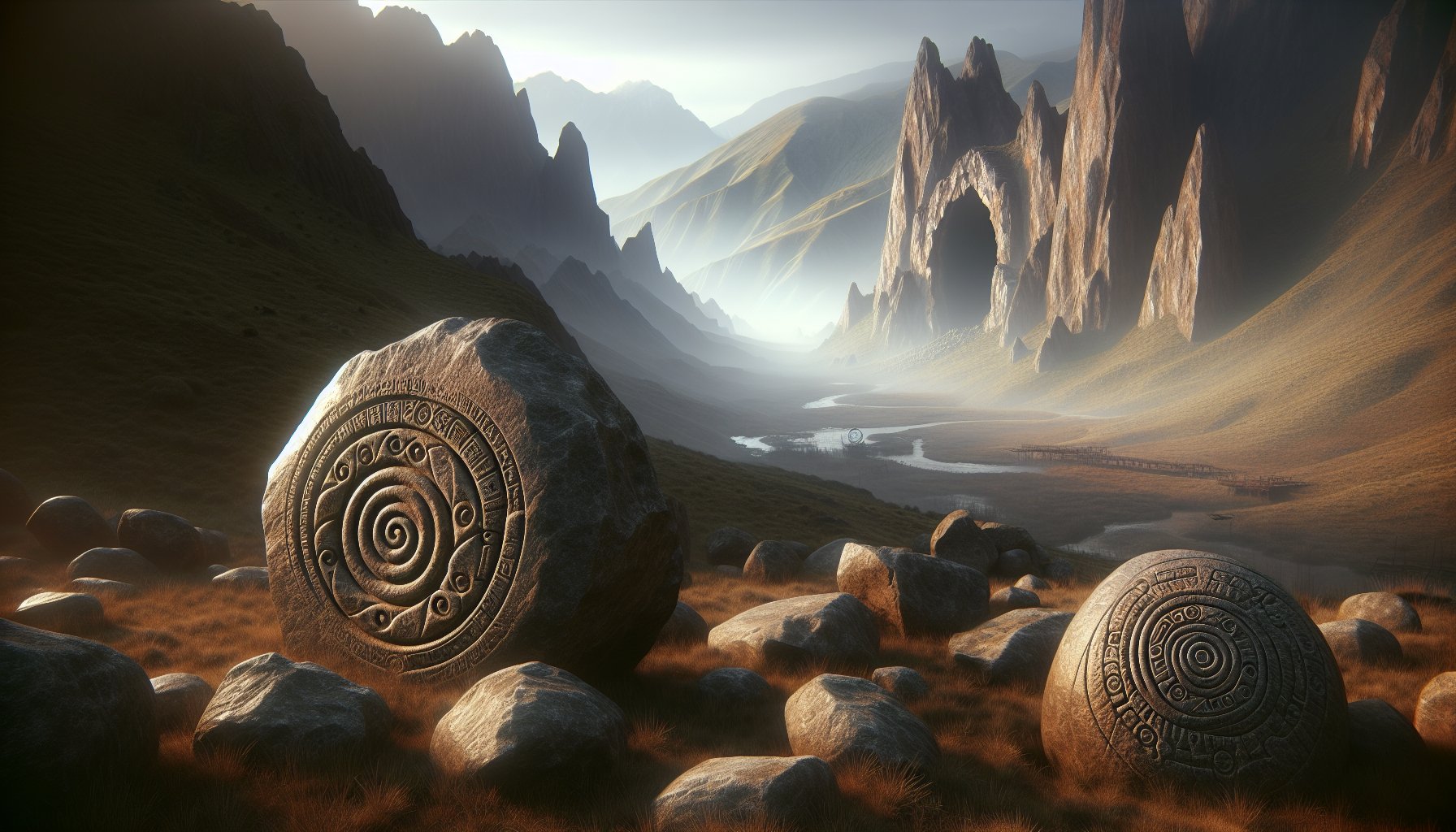
The physical attributes of the Dropa Stones, often described as small, circular discs, remain as enigmatic as their origins. Each stone measures approximately one foot in diameter and is etched with a double spiral of fine grooves, running from the perimeter to the center, which purportedly contain minuscule hieroglyphs. Reports suggest these stones are crafted from a hard stone not native to the Baian-Kara-Ula region, adding another layer of mystery to their story.
Crafted with precision, the stones spark debates about the technology available during their alleged creation period. The fact that they were found lodged in the floors and walls of the cave systems leads some to speculate about their role or purpose, which remains an unresolved puzzle to this day.
Hieroglyphic Analysis
Delving into the heart of the mystery, the hieroglyphs inscribed on the stones are nothing short of baffling. They purportedly narrate an extraordinary tale of hardship and alien encounter, according to Tsum Um Nui's controversial translation. These glyphs, which resemble no known scripts, have fueled a multitude of theories about their origin and meaning.
Despite various attempts, no definitive interpretations have been made since the script does not align with any known languages recorded in linguistic history. This gap has led to a schism between those who believe in their extraterrestrial origins and those who argue that the stones could simply be an elaborate hoax or a misinterpretation of a native, albeit unusual, form of art or storytelling.
The granular analysis of these symbols has often been impeded by the lack of accessibility to the stones for thorough examination, as well as the reported poor condition of some of the glyphs, complicating efforts to photograph or replicate them for deeper study. Consequently, whether these symbols hold messages from ancient astronauts, depict cultural myths, or are products of natural processes continues to elude definitive scientific scrutiny, keeping the Dropa Stones firmly on the fringe of archaeological research and a centerpiece of ancient astronaut theories and pseudoscience debates.
Theories and Interpretations
Extraterrestrial Hypotheses
Venturing into the depths of the theories surrounding the Dropa Stones, one cannot help but encounter the alien origin narrative, often championed by researchers like Tsum Um Nui. According to him, these circular discs don't just carry random incisions but tell the harrowing tale of a spacecraft from another world that crash-landed in the remote Bayan Kara Ula mountains thousands of years ago. The deciphered hieroglyphs, albeit not universally recognized as authentic, are said to narrate the struggles of the Dropa people, purportedly the extraterrestrial travelers, as they attempted to survive on Earth after their spacecraft had been irreparably damaged.
This theory takes a bold leap from archaeological exploration into the realms of interstellar communications, proposing that the Dropa Stones could be remnants of ancient contact with extraterrestrial beings. It's a storyline that tickles the fancy of UFO enthusiasts and fans of ancient astronaut theories, positioning the stones not only as cultural artifacts but as potential evidence of ancient alien encounters.
Skeptical Perspectives
On the flip side of the coin lies a bedrock of skepticism. Mainstream scientists and archaeologists typically wave off the extraterrestrial theories as part of a larger pseudoscience debate. Critics argue that the evidential foundation for the stones’ alien connection is shakier than a fiddler on a roof. First and foremost, there is a significant void in verifiable evidence—no reputable institution houses these stones, and no peer-reviewed archaeological paperwork supports their existence with concrete scientific backing.
Moreover, the tale of their discovery and subsequent interpretations by Tsum Um Nui muddles into the murky waters of myth rather than historical fact. Many scholars believe that if the stones exist at all, they could be mere fabrications or misinterpretations of natural objects. The fact that many details trace back to dubious sources and a single narrative thread spun in the mid-20th century adds to the contention. As it stands, these stones represent a case study in how archaeology can intersect with folklore and pseudoscience, igniting debates that ripple through both the academic community and the public domain.
This section of the narrative doesn't just dissect the stones themselves but underscores the broader dialogue between established science and the tantalizing allure of otherworldly explanations. It reflects a quintessential human yearning to find connections to the cosmos, yet it also showcases our obligation, as custodians of science and history, to distinguish between the fanciful and the factual. The Dropa Stones, whether myth or reality, serve as a pivotal learning point in our ongoing quest to understand human history’s complexities and the vast, unexplored frontiers of our universe.
Scientific Investigation and Analysis
Archaeological Assessment
Within the realms of serious archaeological inquiry, the acceptance of the Dropa Stones as genuine ancient artifacts remains overshadowed by a profound degree of skepticism. Initial reports suggest that the stones were unearthed during the 1938 expedition led by Chi Pu Tei in the Baian-Kara-Ula Mountains, yet, corroborative evidence from other archaeological ventures during or following this period remains conspicuously absent.
Key Points Highlighting Skepticism:
- Lack of Corroborative Artifacts: The absence of additional artifacts, similar hieroglyphic samples, or fragments of tools or domestic remains casts a significant shadow on the narrative.
- Documentation Gaps: Critically noted is the absence of any formal archaeological report or journal entry from the 1938 expedition. This gap in documentation is problematic, undermining the credibility of the discovery claims.
For any artifact to be accepted within scholarly circles, it must be supported by clear, verifiable evidence of its provenance and context. Without this foundational evidence, the Dropa Stones remain in limbo, challenging to establish any concrete historical significance.
Technological Examination
The intrigue surrounding the Dropa Stones has occasionally led to calls for their examination using modern scientific techniques. These include:
- Radiometric Dating: To determine the age of the stones.
- Microscopic Analysis: To understand the composition of the materials.
- Scanning Electron Microscopy (SEM): To inspect the techniques used to carve the hieroglyphs.
Issues and Implications:
- Current Whereabouts: A major impediment to scientific studies is the current location of the stones. Since their supposed discovery, the stones have vanished from public and academic scrutiny, possibly hidden in private collections or lost, hampering scientific scrutiny and adding to the myths surrounding their origin.
- Potential Outcomes:
- If found to contain elements or isotopes suggesting an extraterrestrial origin, such discovery would be monumental, possibly validating theories of prehistoric human contact with extraterrestrial entities.
- Conversely, evidence of a terrestrial origin or recent fabrication could effectively resolve one of the tantalizing archaeological mysteries.
Conclusion:
Within the framework of legitimate science, these unresolved issues highlight the challenges and complexities involved when folklore intersects with potential fact. Until substantial evidence is brought forward, and thorough scientific examinations conducted, the Dropa Stones will continue to be viewed with a mixture of fascination and skepticism, lodged firmly between the realms of archaeological controversy and mythical narrative.
Cultural Impact and Legacy
Influence on Pop Culture
The Dropa Stones have burrowed deeply into the substratum of popular culture, often surfacing in a whirlpool of media narratives, fringe theories, and speculative fiction. Their allure stems not only from their mysterious origin but from the profound implications such discoveries suggest about human history and extraterrestrial contact. Books like Hartwig Hausdorf's "The White Pyramid" have catapulted the stones from the silent obscurity of the Baian-Kara-Ula mountains into the limelight of global conversation. Furthermore, television series such as the History Channel’s “Ancient Aliens” have explored these artifacts as pivotal episodes, weaving intricate tales of ancient astronaut theories that captivate the imagination of millions worldwide.
Academic and Scientific Implications
In academic spheres, the tale of the Dropa Stones serves as a contentious case study at the intersection of legitimate archaeological inquiry and the seductive allure of pseudoscience. While mainstream science dismisses the stones as artifacts of factual history, citing a stark absence of verifiable evidence and the potential for the narrative to be a fabrication, their story remains a focal point in discussions concerning the protocols and boundaries of scientific skepticism and credibility.
The discourse surrounding the stones highlights a broader impact on how unexplained artifacts are treated within the scientific community and popular culture. Skeptics argue that embracing such enigmatic narratives without stringent evidence undermines scientific rigor. However, proponents of alternative histories view the engagement with such mysteries as a necessary challenge to the established historical narrative, proposing that these artifacts prompt a reevaluation of human history's conventional timelines and interactions.
Moreover, the intrigue surrounding the Dropa Stones feeds into a larger dialogue about the role of cultural mythology and its intersection with scientific exploration. In essence, whether myth or fact, the legacy of the Dropa Stones continues to influence both the academic pursuit of ancient civilizations and the public's fascination with the possibilities of extraterrestrial past encounters.
Continuing Mysteries and Future Research
The narrative surrounding the Dropa Stones not only captivates with its blend of ancient mystery and science fiction elements but also leaves several pivotal questions unanswered, fostering ongoing debate and speculation. Despite extensive discussion in both academic and non-academic forums, these enigmatic artifacts continue to elude definitive understanding, making them a focal point for both seasoned researchers and curious enthusiasts.
Unresolved Aspects of the Dropa Stones' Story
One of the core unresolved issues lies in the veracity of their origin story. The tale of Chi Pu Tei discovering the stones in the Baian-Kara-Ula Mountains teeters on the brink of legend and historical account, muddled further by sparse documentation and the mystical allure of ancient astronaut theories. Furthermore, the real identity and existence of the Dropa tribe, purportedly linked to the stones, remain shrouded in mystery, lacking substantial anthropological evidence. This ambiguity extends to the stones' hieroglyphs, which despite claimed translations by figures like Tsum Um Nui, have not been conclusively deciphered or authenticated by linguistic experts.
Potential Directions for Further Investigation
To cut through the swathes of speculation, a multi-pronged scientific approach could be pivotal. First, a thorough geological and mineralogical analysis of the stones could ascertain their age and composition, potentially confirming their antiquity or debunking them as modern fabrications. Advances in imaging and microscopic technology could allow for a closer examination of the hieroglyphs to understand their tool marks and wear patterns, offering clues about their crafting.
Furthermore, interdisciplinary collaboration could amplify efforts to demystify the Dropa Stones. For instance, linguists specializing in ancient scripts could work alongside cryptographers to tackle the stones' inscriptions using advanced decoding software. Additionally, cultural anthropologists could delve into the regional histories and folklore of the Himalayas and surrounding areas to discern any links between local legends and the alien narratives associated with the stones.
Lastly, the deployment of digital archiving and the creation of open-access databases containing high-resolution images and research data about the Dropa Stones could democratize the investigation process. By enabling worldwide scholarly participation, previously overlooked details or innovative theories may emerge, propelling the research into new directions.
In essence, the journey to fully unravel the mysteries of the Dropa Stones is not just about proving or disproving the extraterrestrial contact hypothesis but also about enhancing our understanding of human cultural heritage and the limits of our scientific endeavors. As such, these stones serve not only as potential keys to ancient secrets but also as testaments to the enduring human quest for knowledge, across cultures and epochs.